


By Nancy Lapid
(Reuters) -Human skin cells may one day be used to create functional human eggs in a step toward helping women have their own genetic children when their natural eggs are dysfunctional, according to very early lab experiments reported in a scientific journal on Tuesday.
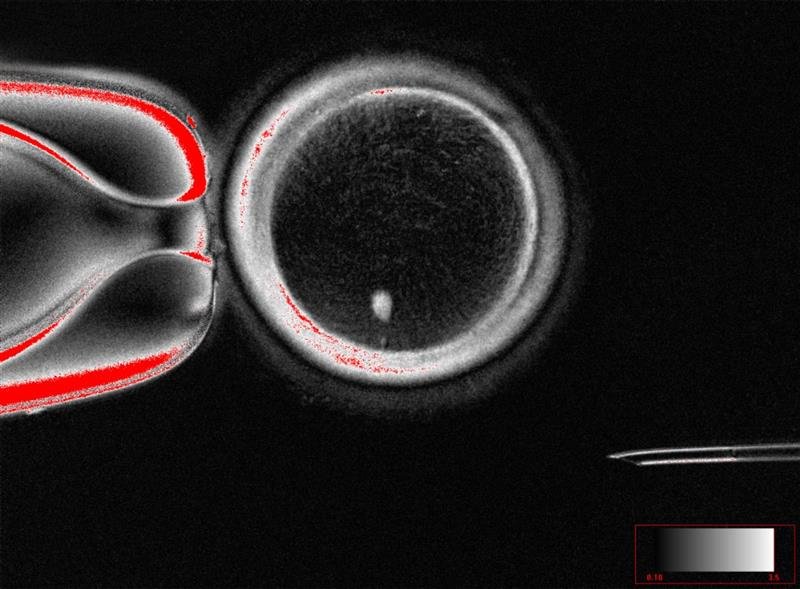
The process, which would carry significant safety concerns, involves removing the nucleus from a woman’s skin cell and inserting it into an egg, or oocyte, from which the nucleus has been removed, scientists detailed in Nature Communications.
Doctors are seeing increasing numbers of people who cannot use their own eggs, often because of age or medical conditions, reproductive medicine specialist Ying Cheong of the UK’s University of Southampton, who was not involved in the research, said in a statement.
“While this is still very early laboratory work, in the future it could transform how we understand infertility and miscarriage, and perhaps one day open the door to creating egg- or sperm-like cells for those who have no other options,” Cheong said.
The new method overcomes an obstacle that has stymied previous attempts at this process, the researchers said.
Eggs contain 23 chromosomes needed for human development, which is half the usual number, because the sperm that fertilizes the egg will contribute the other 23 chromosomes. But skin cells and other non-reproductive cells – and any cells generated from them – contain two sets of human chromosomes, for a total of 46.
SOMETHING ‘THOUGHT TO BE IMPOSSIBLE’
Researchers from Oregon Health & Science University say that they solved the problem of the extra set of chromosomes by inducing a process they call mitomeiosis, which mimics natural cell division and causes one set of chromosomes to be discarded, leaving a functional egg, according to the report.
“We achieved something that was thought to be impossible,” study leader Shoukhrat Mitalipov of the OHSU Center for Embryonic Cell and Gene Therapy said in a statement.
“Nature gave us two methods of cell division, and we just developed a third,” Mitalipov said.
In one experiment, the researchers fertilized 82 functional modified eggs in test tubes using sperm. Only about 9% of the fertilized eggs developed to the blastocyst stage of embryo development, the point at which embryos consisting of 70 to 200 cells are transferred to the uterus during in-vitro fertilization treatments. None of the blastocysts were cultured beyond this point.
Most of the eggs created via mitomeiosis did not progress beyond the 4- to 8-cell stage after fertilization and displayed chromosomal abnormalities, the researchers said.
Still, the study shows that chromosomes of non-reproductive cells “can be persuaded to undergo a specific kind of nuclear division that would normally be seen only in eggs or in sperm,” Roger Sturmey, a reproductive medicine specialist at the University of Hull in the UK who was not involved in the research, said in a statement.
Because success rates in the study were low, “the prospect of putting all this to clinical use remains distant,” Sturmey said.
The researchers agree, predicting that at least a decade of further research is needed “before the approach could be deemed safe or effective enough to advance to a clinical trial, even assuming such a trial would be permitted in the United States.”
(Reporting by Nancy Lapid; Editing by Bill Berkrot)
