


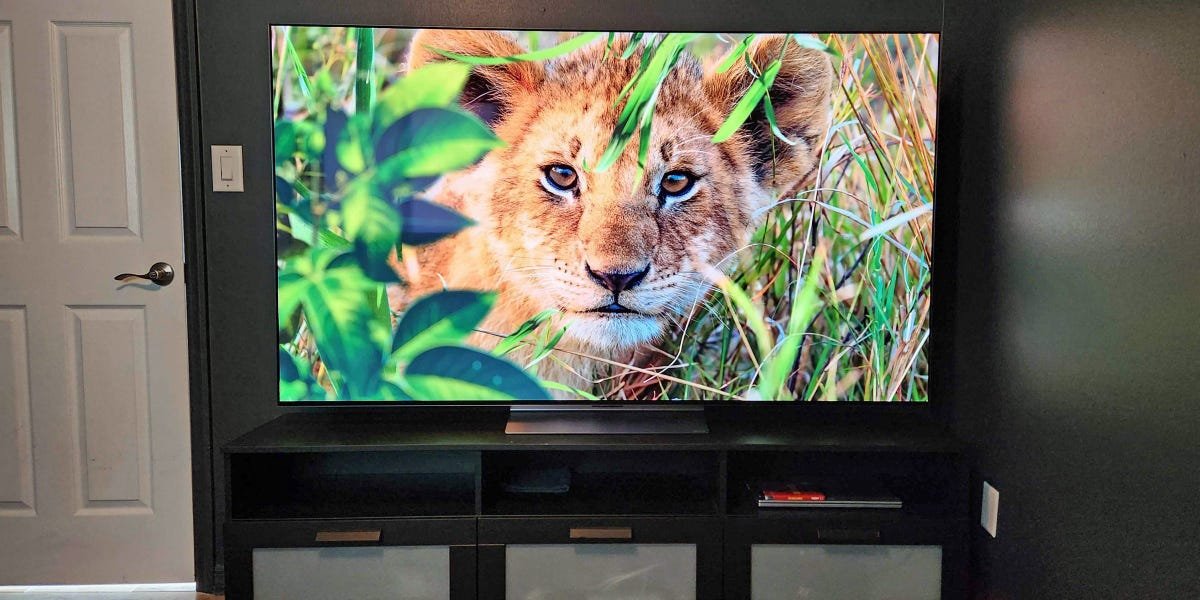
LG’s C Series OLEDs are among the most consistent performers in the TV industry. If someone asks me for a midrange OLED recommendation, the C Series is almost always in the conversation. But year-over-year improvements have been minimal. For 2026, however, LG is shaking things up. For the first time, the brand is offering a submodel in the C Series, called the C6H.
The C6H is available only in extra-large 77- and 83-inch sizes, while the standard C6 is available in 42-, 48-, 55-, and 65-inch sizes. The smaller C6 is a great TV in its own right, but its performance is very similar to last year’s C5. The C6H is a different story.
This larger model uses a more advanced four-stack OLED panel. Four-stack tech was first introduced in LG’s premium G5 OLED last year, and it’s exciting to see it trickle down to a more affordable series. This type of screen can get substantially brighter than a traditional OLED.
The C6H is one of the TVs I’ve been most excited to check out this year, and after weeks of testing, it doesn’t disappoint. Its launch price is a bit steep, but I’m confident it will get good discounts later in the year. In that context, this is poised to be the big-screen OLED to watch in 2026.
LG 77-inch C6H OLED 4K TV
The 77- and 83-inch sizes of LG’s C6 OLED use a brighter panel than smaller models, giving them performance closer to the brand’s high-end G Series.
The LG C6H is a souped-up version of the C6, only available in larger sizes
Steven Cohen/Business Insider
The LG C6H is available in 77- and 83-inch screen sizes. The 77-inch model retails for $3,699, while the 83-inch model retails for $5,299. Those prices are in line with what new midrange OLEDs this big typically launch for, and I expect them both to drop as the year goes on. For instance, you can now find last year’s 77- and 83-inch C5 for $2,200 and $3,300, respectively. I tested the 77-inch C6H for this review, but performance is the same across both sizes.
As a submodel of the C6, the C6H carries the same basic design as LG’s standard C Series, with a pedestal stand and a thin OLED screen. The panel itself is incredibly slim, which remains one of OLED technology’s coolest design perks. But the display has a thicker portion on the back that protrudes out to house its ports and processing components. At its thickest point, the TV measures around 1.9 inches.
The overall look is striking and premium. The back panel has a textured finish, and the display has a clean, modern aesthetic that should look great in any living room or home theater. It’s not quite as slick as LG’s step-up G Series, which is designed to mount flush against a wall, but the C6H still looks and feels high-end.
LG also gets points for including four HDMI 2.1 ports. All four inputs support up to 165Hz, which is great for gamers who want to connect multiple consoles and a high-end PC. Some rival TVs still only have two HDMI 2.1 ports, so it’s nice that LG continues to offer four.
Steven Cohen/Business Insider
The C6H also comes with the latest version of LG’s Magic Remote. This remote supports regular click-button navigation, but it also has motion controls that let you move a cursor around the screen by pointing the remote at the TV.
This is one of those love-it-or-hate-it features. Some people enjoy the pointer-style controls, but others find them imprecise and annoying. I fall somewhere in the middle. For the most part, I found the remote to be fine when using standard button presses, but there are still a few things I don’t like.
The biggest issue is the scroll wheel in the center of the remote. This doubles as the enter key when you click it, but it’s too easy to accidentally scroll when you’re trying to select something. And when that happens, the TV automatically switches to motion control. There really should be an option in the menu to fully deactivate motion control for those who don’t like it.
I’m also disappointed that LG no longer includes dedicated input and mute buttons. To access the input selection, you need to hold the Home Hub button down. To mute the TV, you need to hold the volume down button. There is a new favorite button that you can assign a function to, which helps a bit, but I’m not sure why we can’t just have dedicated mute and input buttons. The remote also isn’t backlit, which is a bummer. These are far from dealbreakers, but they are the kind of little quirks that stand out when the rest of the hardware feels so refined.
The LG C6H delivers stunning OLED picture quality with a major boost in brightness
Steven Cohen/Business Insider
The LG C6H is a stunning TV. Its OLED panel enables pixel-level contrast, with deep black levels that can completely disappear in a dark room without blooming or uneven patches. And since this submodel uses a four-stack tandem panel, its brightness can rival that of many top QLED and Mini LED TVs. It’s a genuinely impressive combination of strengths, with only a few small flaws.
First, let’s get the numbers out of the way for my fellow tech geeks. I measured the TV’s color and brightness using a colorimeter, pattern generator, and Portrait Displays Calman calibration software. I took my readings in the TV’s default Filmmaker Mode, since that preset typically offers the most accurate out-of-the-box image.
Peak brightness on a 10% HDR window reached around 2,011 nits before gradually dropping to around 1,880 nits. That’s a very impressive number for an OLED and a big upgrade from the 1,174 nits our reviewer measured on last year’s C5. It’s also not too far off from the 2,410 nits that the 2025 G5 offered in the same test. I haven’t measured the new G6 yet, but I expect its brightness to be similar to the G5’s.
Color measurements were similarly impressive. The TV achieved 99.5% of the P3 color gamut used in most modern Hollywood productions. You can’t really ask for more than that. Meanwhile, it measured around 78% of the wider BT.2020 color space, which is respectable for an OLED, but not on par with what new RGB LED TVs are capable of. However, it’s rare for content to actually use BT.2020 colors. Color accuracy was also exceptional, with an average DeltaE of 1.6. The lower the DeltaE, the more accurate a TV’s colors are, and anything below 2 is essentially imperceptible to the human eye.
Steven Cohen/Business Insider
Now, all that technical jargon might not mean much to many shoppers, but those numbers translate to absolutely gorgeous image quality. High scores with test patterns are one thing, but how a TV actually looks when watching content is what matters, and the C6H is a winner.
It’s my job to be nitpicky and look for flaws in a TV’s image. This can make it hard to ever sit back and just enjoy a movie or show, since I’m constantly looking for tiny issues. But when watching a TV as good as the C6H, I can actually get lost in how good everything looks. That’s not to say it’s perfect — more on that in a bit — but its shortcomings are minor compared to everything it gets right.
I watched a wide range of movies and shows, from HD YouTube clips to HDR 4K Blu-rays, and everything looked great. Of course, 4K HDR content looks best and fully takes advantage of the C6H’s capabilities. Colors dazzle in movies like “Aquaman,” while black levels are deep and inky in titles like “The Matrix.” The burning church scene in “1917” is a great showcase for OLED tech’s pixel-level contrast, and it demonstrates a level of precision and detail in shadows that no Mini LED TV can match.
The TV’s impressive brightness is on full display in “Mad Max: Fury Road,” with intense highlights that radiate off the screen. Some TVs struggle with highlights from the chrome car parts in this film, but the C6H handles them with the intensity they deserve. Lightning bolts and explosions in the movie’s memorable storm scene genuinely made me squint. This is stellar performance through and through, and a real home theater showcase.
Steven Cohen/Business Insider
Viewing angles are also excellent, much wider than you’ll get with any QLED or Mini LED TV. However, they’re not perfect. There is a slight green cast from off-angle, especially when watching neutral tones on the TV. But this is subtle and not a major issue.
Reflections, however, are a weak point. Like other TVs that use a glossy screen, direct reflections can take on a mirror-like quality. If you’re unable to control reflections in your room, you might be better off with a matte OLED TV, like the Samsung S95H, but that kind of screen hurts contrast in bright rooms. I ultimately prefer glossy panels, but buyers should keep this in mind.
When it comes to other flaws, I did see some slight vertical streaks in near-black backgrounds, and black levels that occasionally looked a step or two brighter than they should. That said, banding and false contouring — when gradations of color and shadows look blocky rather than smooth — are improved compared to last year’s LG OLEDs.
I didn’t see any issues in my test scene from “Ex Machina,” which exhibits blocky red shades on some TVs. However, particularly tricky test scenes in “The Green Knight” did still exhibit some issues, with unnatural transitions between shades of red in an underwater sequence. But few TVs can handle this scene correctly, and the C6H is pretty solid overall.
Gaming performance is also great. PS5 games in 120Hz mode with variable refresh rate, like “Marvel’s Spider-Man,” look smooth and vibrant. HDR gaming looks fantastic on the whole, and “Crimson Desert” is a standout on such a large, high-contrast screen.
LG’s webOS smart TV system continues to be a mixed bag
Steven Cohen/Business Insider
The C6H uses LG’s webOS smart TV system. It’s largely the same as last year’s version, with some small tweaks. Setup is straightforward, but you’ll need to create an LG account if you don’t already have one to access apps.
The platform includes all of the best streaming services, so most people should be covered. However, it’s still missing a few specialized apps available on other systems, such as the Criterion Channel.
I didn’t run into any major issues with general navigation through the home screen or streaming apps. But I do find moving through webOS’s settings menus to be a bit slow compared to rival platforms like Google TV.
The visual design of webOS is decent, but it’s not my favorite. By default, a large banner ad appears at the top of the homepage, followed by a row of your favorite apps. You also get various content recommendations and sponsored picks, along with a row of shopping recommendations, which I doubt anyone will find useful.
Of course, ads and sponsored picks are par for the course on any smart TV interface, and LG does deserve credit for allowing you to disable the banner ad and recommendations from appearing on the home screen. This option is a bit buried in the menu, but it’s there.
After deactivating them, you simply get a placeholder banner image on top of your main row of apps, and that’s it. I prefer this cleaner layout, but some people may find it a bit barebones. WebOS also supports multiple user profiles, so the home screen’s recommendations and app selection can be personalized for each user.
Steven Cohen/Business Insider
The webOS interface also includes a dedicated gaming section with access to several subscription-based cloud services. Most notably, you can use the Xbox or Nvidia GeForce Now apps to stream games to the TV without needing a console or PC. These apps are also available on TVs from some rivals, like Samsung, so it’s nice that LG offers them as well.
LG has carried over various AI features it’s introduced over the last few years, including AI picture and audio modes that automatically optimize settings. There’s also an AI Picture and Audio Wizard designed to personalize how these modes work by learning about your preferences.
If you’re unhappy with how any of the TV’s built-in video and audio presets perform, these AI functions may be of interest. But as always, I highly recommend just using the TV’s Filmmaker Mode and Standard audio mode to get the most accurate playback, and then tweaking things like brightness to your preference for your room.
Voice search can be conducted by pressing the AI button on the remote or by enabling the TV’s hands-free microphone and saying “Hi, LG.” There’s even a cool voice recognition feature that automatically switches the TV to different user profiles based on who’s speaking.
However, I continue to find LG’s voice assistant to be really inconsistent. In my experience, results for voice queries were often slow, and the TV sometimes struggled to understand what I was saying, returning results for queries that were incorrect. I haven’t had issues like this with other assistants, like Google’s Gemini.
None of this ruins the experience, but webOS remains one of the C6H’s weaker elements. It gets the job done, and I appreciate the customization options, but I’d still rather use a dedicated streaming device for day-to-day use.
Should you buy the LG C6H TV?
Steven Cohen/Business Insider
The LG C6H is a notable upgrade over last year’s C5. Though it’s only available in 77- and 83-inch sizes, those shopping for a high-performance big-screen OLED should definitely consider this model first. This isn’t just another year-over-year refresh. Thanks to its four-stack OLED panel, the C6H delivers a meaningful boost in brightness while preserving the core strengths that make LG’s C Series so reliable.
Right now, the C6H’s main competition in the big-screen OLED space is actually last year’s LG G5, which is sometimes on sale for less than the C6H currently goes for. The G5 can get a bit brighter and has a more premium design that can be mounted flush on a wall. However, it doesn’t come with a stand for those who don’t want to mount it.
If you can find the 77- or 83-inch G5 on sale for less than the C6H, I still give that model an edge in overall performance. But the C6H is likely to drop in price over the coming months, and I expect it to become the better value. I know I’ll be keeping a close eye on discounts as the year goes on.
For more recommendations, check out our guides to the best TVs and best LG TVs.
