


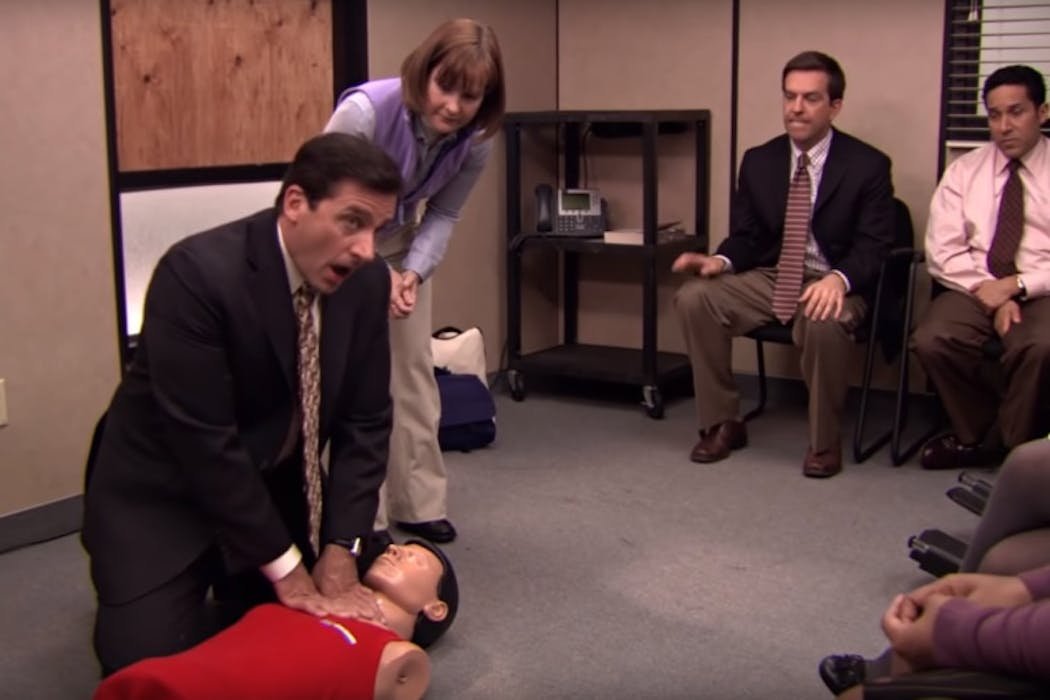
Television characters who experience cardiac arrest outside a hospital are more likely to receive CPR than people in real life. But the CPR on these shows often depicts outdated practices and inaccuracies about who is most likely to experience cardiac arrest and where, according to newly published research from my team at the University of Pittsburgh.
How CPR is portrayed in the media is important to understand because research has shown that health content on screen can influence viewers. When Buffalo Bills player Damar Hamlin suffered cardiac arrest during a game in January 2023, the world watched as medical professionals swiftly performed cardiopulmonary resuscitation. Hamlin went on to make a full recovery, and in the aftermath, a team of emergency medicine professionals and I at the University of Pittsburgh – where Hamlin is an alumnus – worked to teach all Division I athletes hands-only CPR.
During the CPR training we held at Pittsburgh area middle schools and college athletic programs, participants frequently asked whether they should check for a pulse or give rescue breaths. Many mentioned seeing CPR on television shows like “Grey’s Anatomy.” While these are steps that medical professionals do when giving traditional CPR, hands-only CPR is an effective version recommended for untrained bystanders. After determining the person needs help and the scene is safe, hands-only CPR has just two steps: Calling 911 and giving hard and fast chest compressions.
As someone who researches how medical topics on screen influence viewers, this piqued my curiosity. I wondered whether participants asked about checking a pulse or giving breaths in part because they saw these practices on screen.
The power of media
In 2022, my team and I analyzed 165 studies on the effects that health and medical content on scripted television has on viewers. We found that TV stories can influence viewers’ health-related attitudes, knowledge and behaviors. Sometimes this influence can be harmful, such as exposing viewers to inaccurate information about organ donation from television. But sometimes it can be positive – one study found that viewers of an “ER” storyline about breast cancer were more likely to recommend screening and a patient navigator who supports patients through treatment.
However, we hadn’t found any studies examining how seeing CPR on screen influences viewers. While previous studies on in-hospital cardiac arrest and CPR found inaccuracies with chest compression technique and survival rates in media, none had looked at portrayals of cardiac arrest that occur outside of hospitals and CPR conducted by a lay rescuer.
Performing CPR on TV
My team searched the Internet Movie Database to identify episodes in American TV shows that depict out-of-hospital cardiac arrest or hands-only CPR. We limited our results to episodes released after 2008 – the year the American Heart Association first endorsed hands-only CPR. Of the 169 episodes that fit our criteria, we documented the sociodemographic characteristics of the character experiencing cardiac arrest and the primary witnesses, as well as whether, how and where hands-only CPR was administered.
On a positive note, we found that over 58% of on-screen characters who experienced cardiac arrest outside a hospital had a layperson perform CPR. But in real life, less than 40% of people who suffer cardiac arrest outside a hospital receive CPR. Seeing such high rates of CPR being performed on screen could motivate viewers to act, as in the case of a 12-year-old boy who saved a life in 2023 using the CPR techniques he saw on “Stranger Things.”
However, less than 30% of episodes showed hands-only CPR being performed correctly. Almost 50% of episodes showed characters giving rescue breaths, and 43% of episodes had characters checking for a pulse. While we didn’t directly assess whether these episodes influence how viewers behave, based on our observations while conducting CPR training, it’s clear that these depictions may mislead viewers about how to administer hands-only CPR.
Who gets CPR and where on screen
Our findings also raise concern that how cardiac arrest is depicted on TV may mislead viewers about where cardiac emergencies happen and who may need CPR the most.
Of the on-screen cardiac arrests that didn’t occur at a hospital, we found that only 20% happened at home. In real life, over 80% of nonhospital-based cardiac arrests occur at home.
Additionally, those experiencing cardiac arrest on screen were younger than those in real life, with over 50% of characters under age 40. In real life, the average age is about 62.
Lastly, we found that almost 65% of the people receiving hands-only CPR and 73% of rescuers performing CPR were white and male. This is consistent with real-world statistics, where people of color and women who experience cardiac arrest outside the hospital are less likely to receive CPR from a layperson.
Accurate TV to save lives
The American Heart Association’s 2025 guidelines for CPR and emergency cardiovascular care emphasized the need to help the general public envision themselves performing hands-only CPR and improve CPR education to ensure all people who need CPR receive it.
Our team is working to understand what viewers take away from TV depictions of CPR, with the goal of collaborating with public health and medical professionals to improve how CPR is portrayed in Hollywood.
Previous research has shown that entertainment narratives have the power to inspire altruistic behavior, and news reports have documented instances of people who perform CPR after seeing it on screen. Similarly, I believe scripted, compelling television may be a powerful, cost-effective way to improve CPR education and ultimately save lives.
This article is republished from The Conversation, a nonprofit, independent news organization bringing you facts and trustworthy analysis to help you make sense of our complex world. It was written by: Beth Hoffman, University of Pittsburgh
Read more:
Beth Hoffman receives funding from the University of Pittsburgh and the National Institutes of Health. She also consults with Hollywood, Health & Society.
