


Companies have been offered what looks like a golden ticket: Pour money into AI, and your firm will bubble over with productivity. Costs will go down; workers will produce more. It sounds almost too good to be true.
Right now, it kind of is.
On the one hand, there are people like software engineer Iren Azra Zou. She says that Anthropic’s Claude Code has helped her complete software engineering tasks in a day that used to take as long as a week. “It saves an insane amount of time,” said Zou, who works at the trucking logistics startup Double Nickel.
Rachel Wisnewski for BI
The company and economy productivity boost is less clear-cut. More code doesn’t necessarily mean better products or features — though it can mean much more spending — and AI productivity gains haven’t transferred to areas beyond coding as neatly.
“The Great Coding Reset” is a multi-week series exploring how AI has sparked an existential transformation in software engineering. Last week, we looked at the months when new AI models changed what it means to be a coder. Next week, we’ll get into the debate over tokenmaxxing.
Follow here to receive an alert when the next piece in the series publishes.
For those like Amazon data scientist Sarthak Gupta, AI is actually creating more work, at least in the short-term. He’s working longer hours as part of what he calls an “automation phase.”
“That upfront investment is real,” said Gupta. He’s building out pipelines, integrating AI tools, and onboarding existing workflows into those new systems. “The bigger unlock isn’t the speed on any single task, it’s that the same pipeline keeps paying off every month, every quarter, every time the work repeats,” said Gupta.
Gupta and Zuo’s experiences point to a brewing AI productivity disconnect: Some workers are completing tasks more quickly, but researchers say AI gains have yet to consistently translate into greater company productivity, revenue, or profits. And, facing pressure to show that their massive AI spending is worthwhile, companies are racing to prove that individual efficiency can scale.
A productivity surge
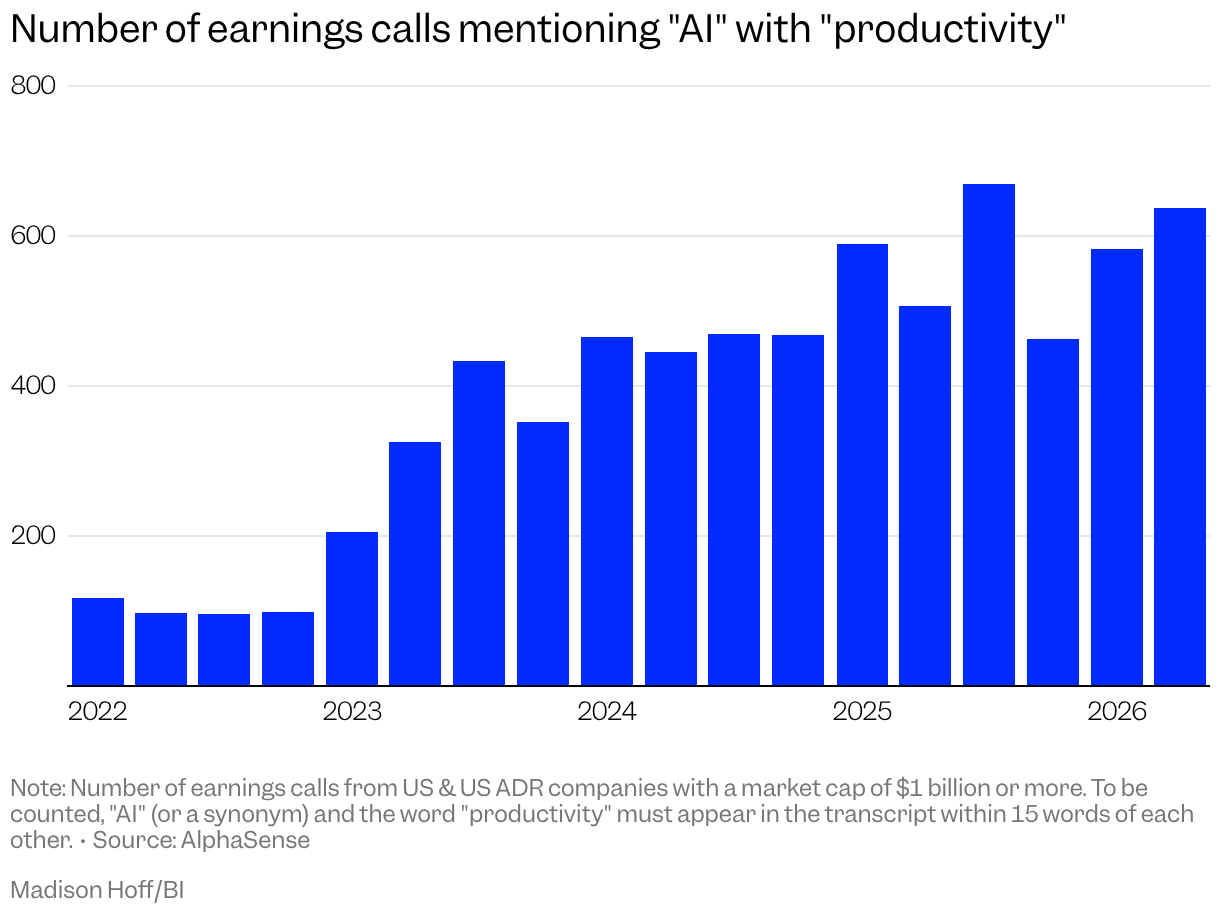
Leaders are eager to discuss AI and productivity. In an analysis for Business Insider, business intelligence platform AlphaSense compared how frequently the word “AI” (or a synonym) appeared in proximity to the word “productivity” in major companies’ earnings calls. It found these words appeared together in 637 earnings calls in the second quarter, up about 25% from the same period a year ago.
Labor productivity, which measures worker efficiency across the economy, has boomed in recent years. Productivity growth in the US has risen above its pre-pandemic trend since 2020, and strengthened further after late 2022 — around the time ChatGPT was released.
But those gains aren’t necessarily due to AI. Roughly 90% of firms actively using AI reported the technology had no impact on productivity over the prior three years, according to a February National Bureau of Economic Research working paper based on a survey of nearly 6,000 executives.
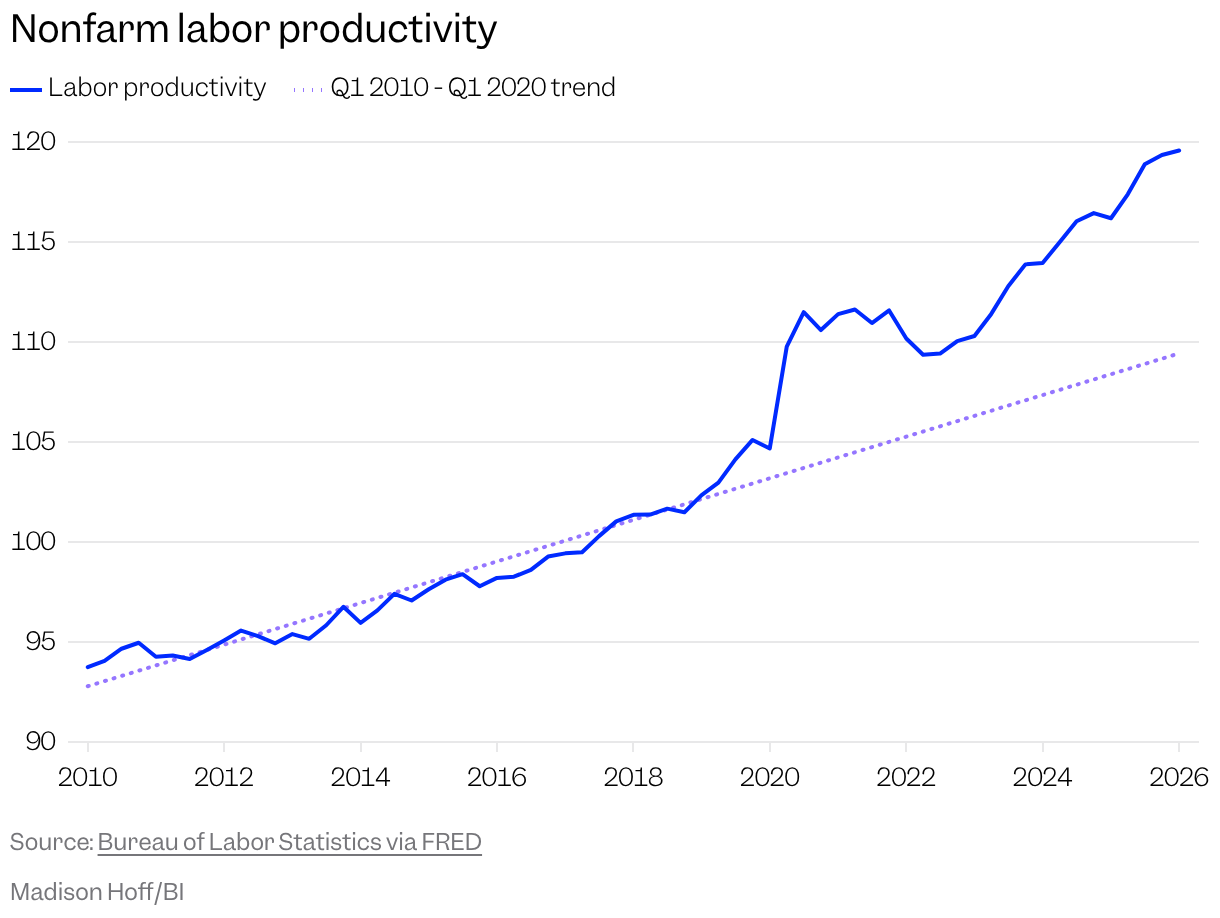
Researchers have pointed instead to other explanations for the recent productivity surge, such as remote work, elevated job switching in 2021 and 2022, and shifts in the workforce composition.
“So far the productivity impacts from AI appear to be small and haven’t really moved the dial on aggregate productivity growth,” Mark Zandi, the chief economist at Moody’s, told Business Insider.
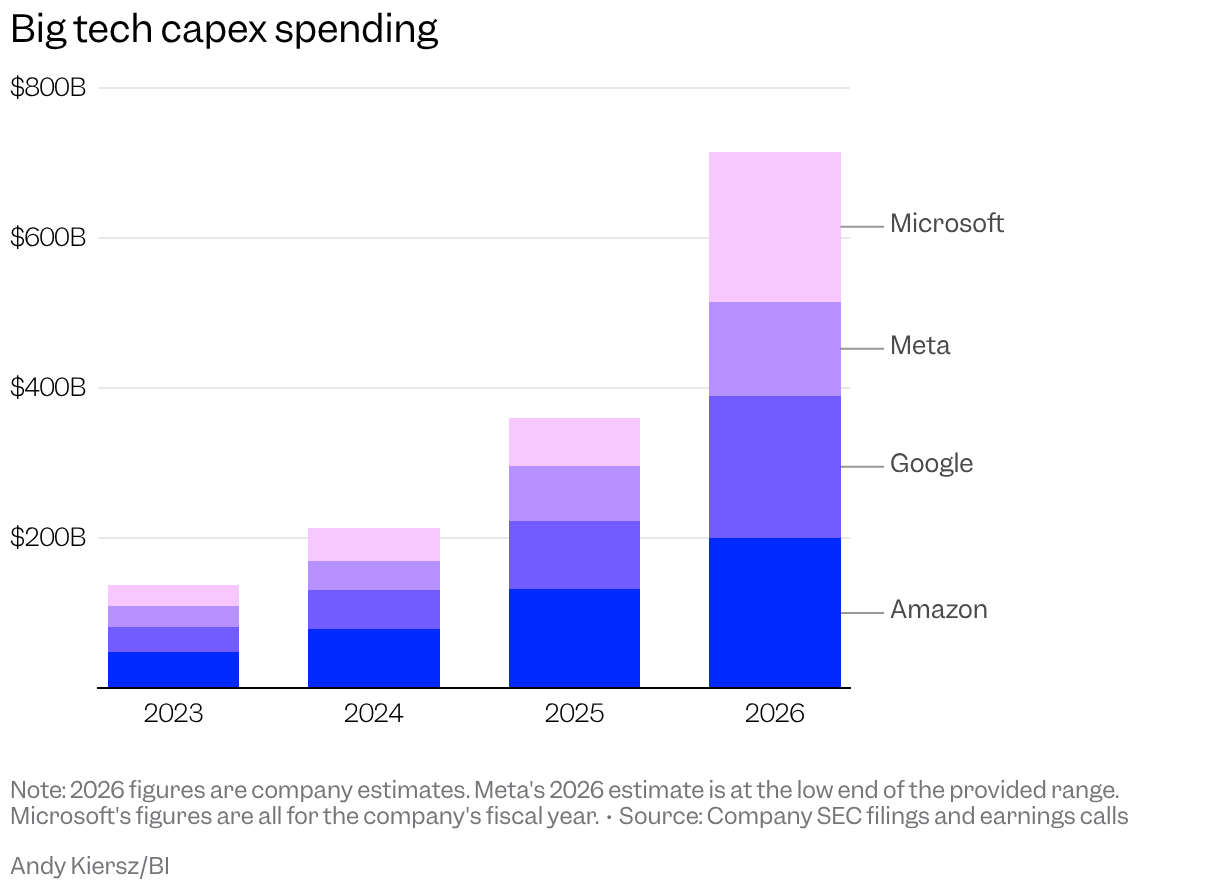
A new Wharton paper by Jessica and Jonathan Wachter finds that tech companies are spending as if they expect such a productivity boom to materialize, but that if it doesn’t, “the current buildout will be the largest misallocation of capital in history.” They warn that some major tech companies could risk bankruptcy if they don’t quickly increase productivity.
Alexander Sukharevsky, a senior partner at McKinsey, said a “gen AI paradox” persists at many companies because they haven’t figured out how to scale AI across their operations.
It’s common for workers to report individual productivity boosts — and for companies to see promising results in pilot projects — but much harder to turn those isolated gains into companywide improvements. Part of the challenge, Sukharevsky said, is getting employees to both adopt the technology and learn how to use it effectively.
Rachel Wisnewski for BI
At Uber, for instance, COO Andrew Macdonald said last month there wasn’t a direct correlation between increased AI use and “useful consumer features.”
His comments have kick-started a tokenmaxxing reckoning: Workers burning tokens, the units of text data processed by AI models and how they’re priced, aren’t necessarily bolstering company productivity, but are instead racking up sometimes massive bills. Enrique Dans, a professor of technology and innovation at the business-focused IE University in Spain, said that it’s a perfect example of metrics gone wrong.
“When a metric turns into a goal, it stops being a good metric,” Dans told Business Insider, adding: “It’s not about measuring people’s productivity according to how many tokens they burn; that’s absurd. The metric should be, ‘what have you achieved? What have you been able to accomplish?'”
While many workers are still figuring out how to use AI effectively, Michael Feroli, chief US economist at JPMorgan, said the skills needed to use large language models may require less training than previous technologies, raising the possibility that AI-driven productivity gains could materialize sooner than they have in past tech cycles.
“I think there’s a case that it could be quicker,” he said adding, “that we could be looking at years, not decades.”
The uncomfortable AI middle
AI’s biggest evangelists have predicted a utopia where productivity abounds, the GDP booms, Universal Basic Income keeps humans afloat, and — forget the four-day workweek — work as we know it will have slipped away.
“There will come a point when no job is needed — you can have a job if you want for personal satisfaction, but the AI will be able to do everything,” Elon Musk predicted in 2023.
We’re clearly not there yet, and perhaps never will be. Instead, we’re stuck in the uncomfortable AI middle. GDP is holding strong (but not going bonkers), labor force participation among prime-age workers is chugging along, and this article was written by human beings.
That’s not to say AI isn’t having an impact on the labor market. Companies have increasingly cited AI during layoffs or in hiring slowdowns. Some have said cuts are to fund their AI investments, or that they are in anticipation of productivity gains that haven’t fully materialized.
“The AI productivity lift is going to happen over time, and slowly,” said Zandi. He doesn’t think we’ll see a big boost from AI in economic data until at least the late 2020s, or early 2030s. “I don’t think we’re going to see mass layoffs or unemployment. We will see a lot of job loss in certain industries, but job gains in others. The net should be a labor market that hangs together reasonably well.”
Companies are also making headcount decisions for reasons that have little to do with AI, such as overhiring during the pandemic and economic uncertainty related to inflation, tariffs, and the war in Iran.
Software engineering roles could be an early signal of how those dynamics could play out in other white-collar roles, especially because so many coding tasks can be offloaded to AI tools. So why, despite tech companies laying off employees left and right, aren’t we seeing a massive decline lately in software engineer job postings?
One theory is that AI means companies are producing far more code than ever, and that this output still needs to be managed and fixed by software engineers.
“Someone has to understand what the thing is that got built, has to maintain it, has to fix security issues that come up, upgrade the systems beneath it, and so on,” said Aaron Levie, the CEO of cloud storage company Box, in a June X post. “That’s all jobs.”
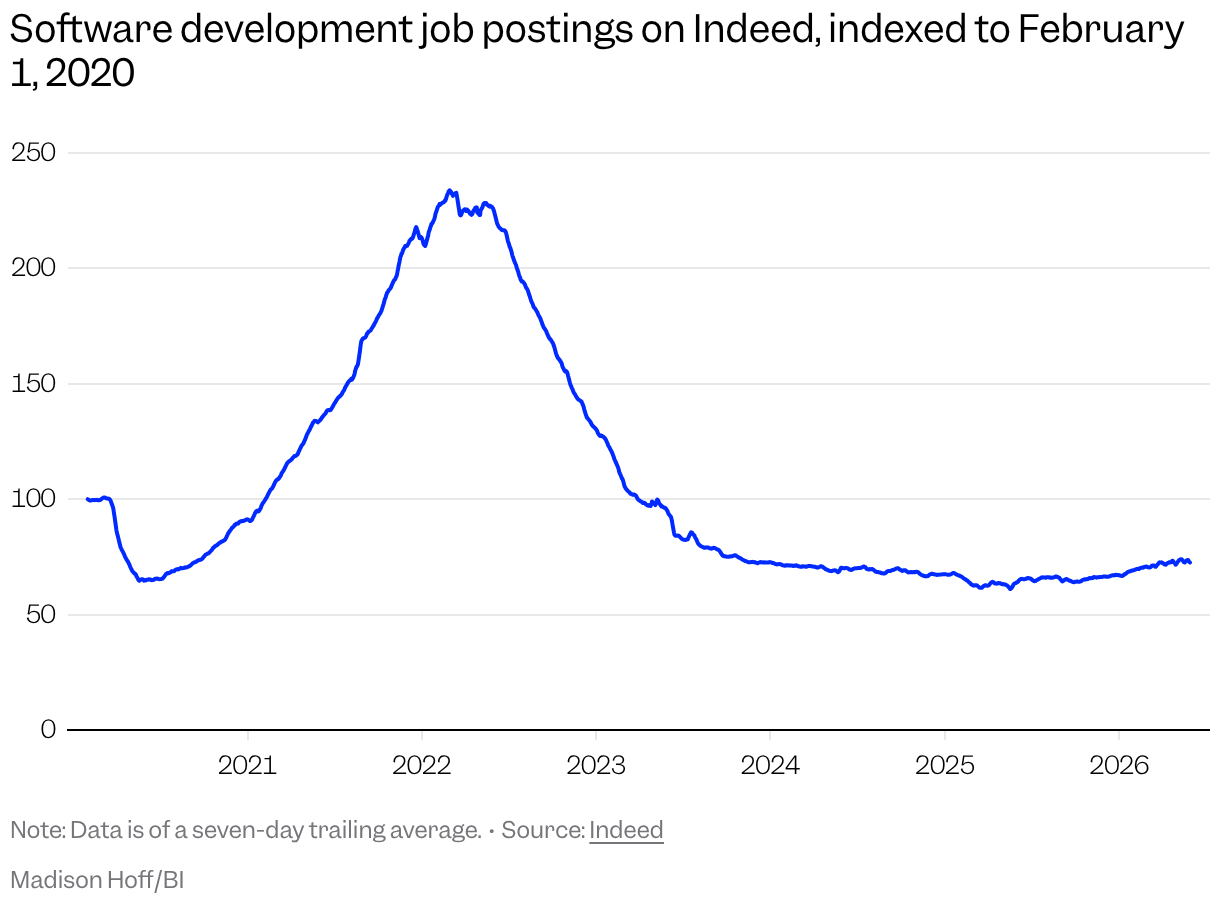
Similarly, David Sacks, the Silicon Valley investor, said that coding has been “AI’s breakout use case,” citing increased activity on the developer platform GitHub.
“The fact that it’s increased demand for software engineers — rather than decreased it — should call into question the entire ‘AI will cause mass job loss’ narrative,” he wrote on X.
AI’s spreadsheet moment
Companies want to show AI is worth the investment; workers want to prove their worth. The continued bottleneck is that organizations are building new infrastructure on the fly, and, so far, the rules of business haven’t been rewritten.
It’s a moment reminiscent of when spreadsheets were first introduced to the workplace. Lotus 1-2-3, the predecessor of Excel, suddenly and radically changed how quickly accountants and bookkeepers could work when it launched in 1983.
“AI isn’t yet the jobpocalypse some predicted. Like spreadsheets and email before it, the technology will ultimately make workers more productive,” the outplacement company Challenger said in a report published in June.
Rachel Wisnewski for BI
Spreadsheets didn’t become the backbone of the global financial system overnight, but it’s unthinkable now to imagine a workplace without Excel. AI has the potential to become another foundational workplace tool; it just hasn’t made the leap yet from novel software to procedural backbone.
“AI is not a mature tool that you can unpack, plug in, and start redefining your processes,” IE University’s Dans said. “This is something that is probably going to happen soon, but we are not there yet.”
