


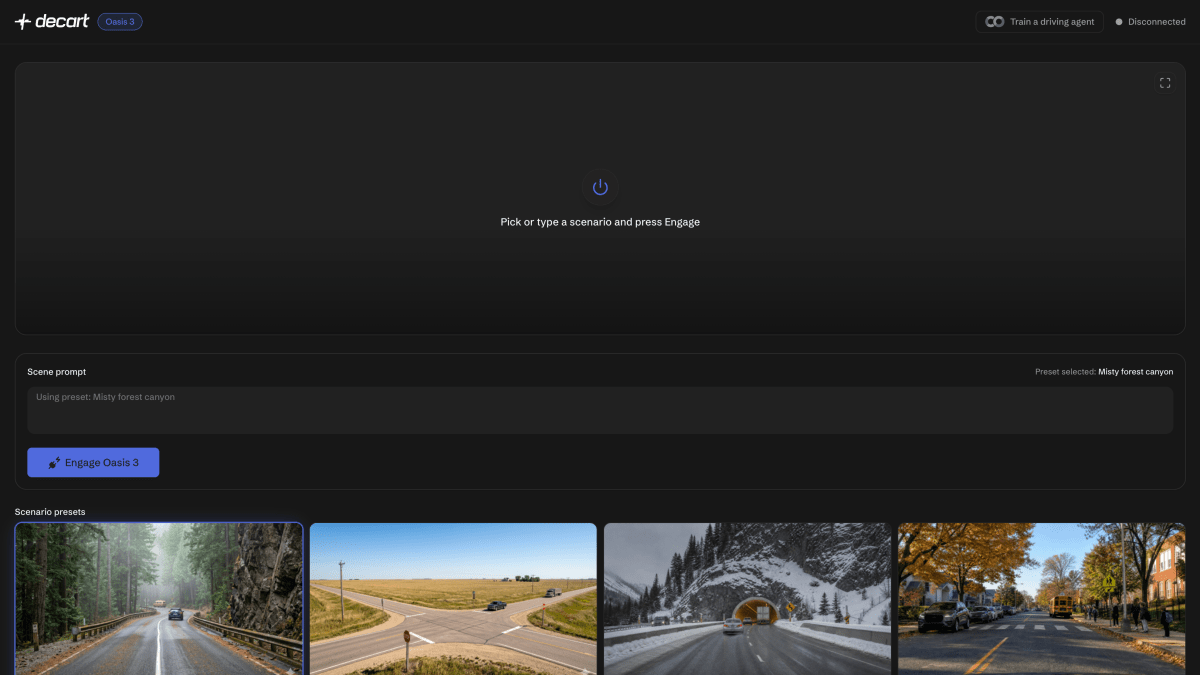
AI startup Decart on Wednesday unveiled Oasis 3, its latest interactive world model that can generate photorealistic driving environments in real time, TechCrunch has exclusively learned. The model is currently available via API.
The startup is initially targeting autonomous vehicle companies that need to simulate rare driving scenarios at scale, and plans to expand into robotics and other physical AI applications. But the bigger bet is on developers: By offering API access from day one, Decart is trying to build a developer ecosystem around world models much like how OpenAI did with language models.
“It’s going to be the first usable world model that people can actually program on top of,” Dean Leitersdorf, co-founder and CEO of Decart, told TechCrunch. “I think there’s going to be an entire developer community that emerges on top of this.”
The startup already has a community of more than 100,000 developers, many of whom are building products on top of its real-time video model Lucy, largely in e-commerce and live streaming. Oasis 3 is based on that foundation model, and it represents the company’s push into physical AI. Access is priced at $0.02 per second, and enterprise pricing depends on use cases, Decart said.
Decart is playing in an increasingly packed world model arena. Last year, Google released Genie 3 in research preview, Fei-Fei Li’s World Labs launched Marble for commercial use cases, and video generation startups like Luma and Runway are also translating their physics-aware video models into world models.
Oasis 3’s release comes a few weeks after two-year-old Decart raised $300 million, which Leitersdorf says followed “huge demand increases for the models we built” in e-commerce, live streaming and physical AI. The round boosted Decart’s valuation to nearly $4 billion, and brought a series of strategic investors such as Toyota, Adobe and eBay. All of these companies are potential customers, says Leitersdorf. Nvidia, an existing investor, also participated in the round.
Oasis 3’s edge lies in the photo-realism of its models and infinite generation capability. That’s due to some efficiency wizardry on Decart’s part, powered by the company’s other main product: the DOS (Decart Optimization Stack) software that allows models to run efficiently on Nvidia, Amazon and Google hardware, making its models far less expensive to run than competitors.
“This is built on top of our entire real-time stack, which we optimize all the way down to the hardware,” Leitersdorf said. “By being so vertically integrated, we’re able to be more than an order of magnitude cheaper than anyone else in the industry in order to run these models.”
The startup’s models are so efficient, per Leitersdorf, that it has burned through “drastically less” than $100 million in its lifetime.
Oasis 3 generates physically accurate, multi-camera environments — one front-facing and two-side facing — for training and testing systems. And instead of offering limited demos and research previews, Decart allows developers to generate scenarios infinitely.
Compared to other models I’ve tried, like Google’s Genie 3 or World Labs’s Marble, Oasis 3 delivers the most photorealistic environments from a single text prompt I’ve seen. And the fact that you can interact with them for hours suggests a level of efficiency that Decart’s rivals might lack.
But by letting you generate a world for so long, the model also degrades significantly.
In my testing, I found the system could consistently set up a strong initial scene that matches the prompt, but the thematic integrity degraded rapidly as I moved through the world. I prompted it to generate a New York City street in the morning, it did so, beautifully. But as I drove along, the environment looked less like New York and more like a standard version of any urban, Western city.
When I tried to turn around and make my way back to the initial intersection, it was gone, replaced by an entirely new environment. On top of that, the controls aren’t very responsive, and I often lost control over where the car was moving (again, a drawback shared by other world models I’ve tested). The experience felt less like a coherent simulation and more of a dream-like, disjointed stream of consciousness that quickly grows nonsensical.
Another issue, which I’ve also seen in other world models, is that the car will just drive through other cars, meaning the model doesn’t simulate physics properly in the environment. Leitersdorf calls this a “major research problem that we’re cracking now,” attributing it to the fact that “there’s drastically more data on good driving compared to accidents.”
Part of what makes this physics consistency difficult is fundamental to how this world model works. Oasis 3 is auto-regressive, meaning it generates one frame at a time, and looks back at what it previously generated to decide what comes next. This is a key architectural feature of many world models, and it is a compute-intensive one, too.
In order to maintain consistency, Leitersdorf says the Decart team is working to improve the length of the model’s memory.
“Every frame we generate is roughly 8,000 tokens,” he said. “Generating this at tens of frames per second — that’s hundreds of thousands of tokens per second. The context window fills up very quickly. We’re researching how to do longer context to store millions more tokens, and how to compress the memory into fewer tokens.”
Leitersdorf thinks the consistency issue might be partially solved in the model’s next version, which will allow users to start generating worlds based on a video of an environment rather than an image. He acknowledged that world models as a field are still early.
Still, the founder is less focused on the current limitations of his tech than what will happen when developers get their hands on it.
“It takes me back to the early days of LLMs, when OpenAI invented the API for models,” he said, pointing to the emergence of a developer community that advanced the field by finding and building new use cases.
“When we talk again in three months, we’ll be like, ‘Here’s 100 developers that all built 100 different applications with Oasis that surprised all of us,’” he said.
When you purchase through links in our articles, we may earn a small commission. This doesn’t affect our editorial independence.
