


Leonhard Soenke cofounded Throne, a creator economy startup, in 2021 to help influencers create wishlists where fans could buy and send them gifts.
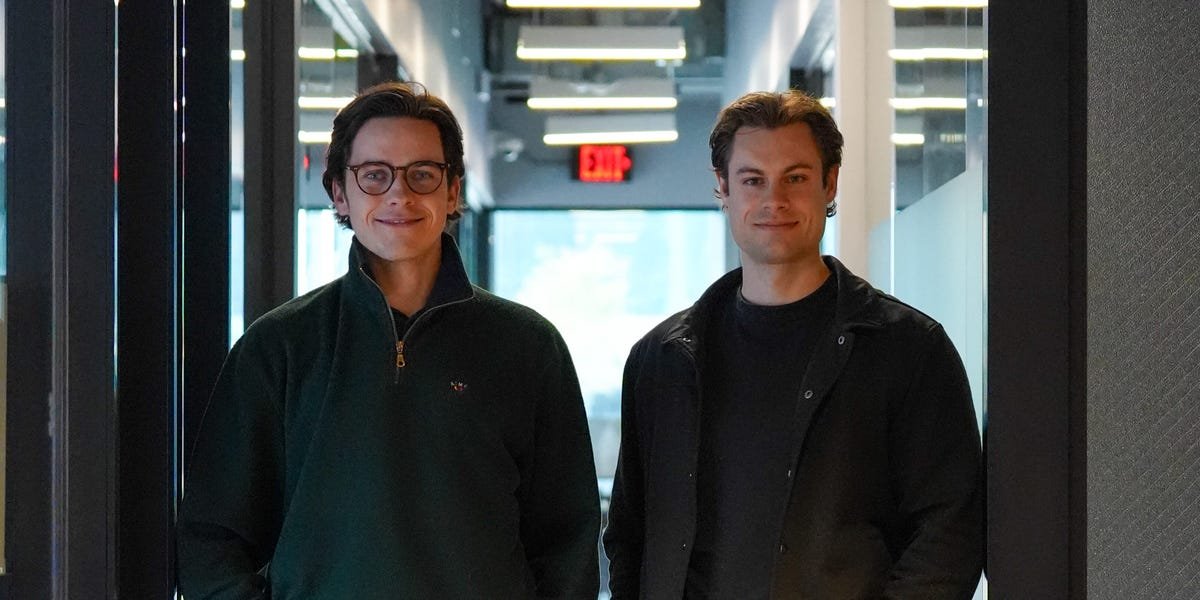
Five years later, Soenke and his cofounder Patrice Becker are setting out on a new venture. It’s not in the creator economy. Instead, it’s in the data center business.
TAR, which stands for Transformative American Resources, is a new energy startup aiming to make data center power more efficient. Soenke told Business Insider that TAR recently raised a $27 million seed round at a $500 million valuation from an undisclosed strategic investor.
From the outside, influencers and AI data centers seem like two different worlds. However, Soenke says there are transferable skills between the two. While I caught up with Soenke about his new endeavor, I noticed he was wearing a nearly identical gray Patagonia quarter-zip to the one he had while at Throne, now with the TAR logo embroidered on the chest.
“Our attitude is if ain’t broke, don’t fix it,” he told me.
This as-told-to essay is based on a conversation with Soenke. It’s been edited for length and clarity.
Patrice, my cofounder, and I met in university. We founded our first company, sold that, and then we founded Throne.
Sometime through the summer of last year, we were speaking about the need to get away from running something that’s very stable. We’re very, I would say, spiky personalities.
We spent a while in the creator economy. We got partnerships with major vendors, work closely with Amazon — it had really grown to a large org.
The creator economy has matured a lot. It’s a pretty crowded space.
Why leave and start something new in a different space? Two things.
One was the want to start something anew. Then you need to reevaluate, “Hey, are you going to stay in the creative economy? Are you going to go somewhere else?” The second question was, “Where is a space where we can really make a large impact?”
The movement we see in a lot of the [social] platforms is not as much as we’d see in something like the AI infrastructure stack.
We left New York, moved to San Francisco, and spent a lot of time with people at the labs, the major compute providers, discovering where problems lie.
That’s how we got to the whole idea of TAR: building the infrastructure to essentially power AI.
We still maintain a San Francisco office for a lot of the engineering stuff, and we recently moved to Austin. If you’re building energy for data centers, it’s good to be in Texas.
The hard decision to move on
It is giving away your baby a little bit.
The whole feeling of letting go, especially being a control freak myself, was the hardest part.
One thing that made it a lot easier is we handed Throne over to trusted team members who’ve been with the company for a really long time.
Patrice and I are happy to chime in on something. I’m still in Slack. When a bug comes up, I actually just hop in.
The process was actually a pretty long one of handing it over, probably six months. You ease into it.
Screenshot/Throne
Pivoting from the creator economy to data centers
In both cases, you solve very difficult problems. A lot of this is transferable.
Patrice and I love working on very hard problems. When we started Throne, I remember we were in an apartment together, basically doing all the customer support and stuff alone at the beginning. Throne took off really quickly because there was such a demand for it. We see very similar things for energy, where it’s such a strong pull from the market.
Chips and power will become more acute problems as models become more useful and permeate society.
We reduce time-to-token by building modular, scalable, behind-the-meter energy systems with a mix of generation sources. Most of the systems will consist of solar, batteries, wind energy, and natural gas. We’re not inventing a new way to produce energy. We are focused on innovating the way we deploy these existing technologies faster.
It’s a lot more capex-intensive compared to building a software platform — procuring heavy equipment, building a warehouse, and developing land. It’s a different beast.
Tom Fox/The Dallas Morning News via Getty Images
The biggest difference is working with more legacy players in the energy space.
Obviously, you come from a slightly different world if you’re in software and you’re just sitting in your New York or San Francisco office. We make an extra effort to get on-site, talking to contractors and blue-collar crews. That’s a big shift.
As a founder, you need to learn how to empathize with not just users, but customers and partners, and put yourself in their shoes.
