


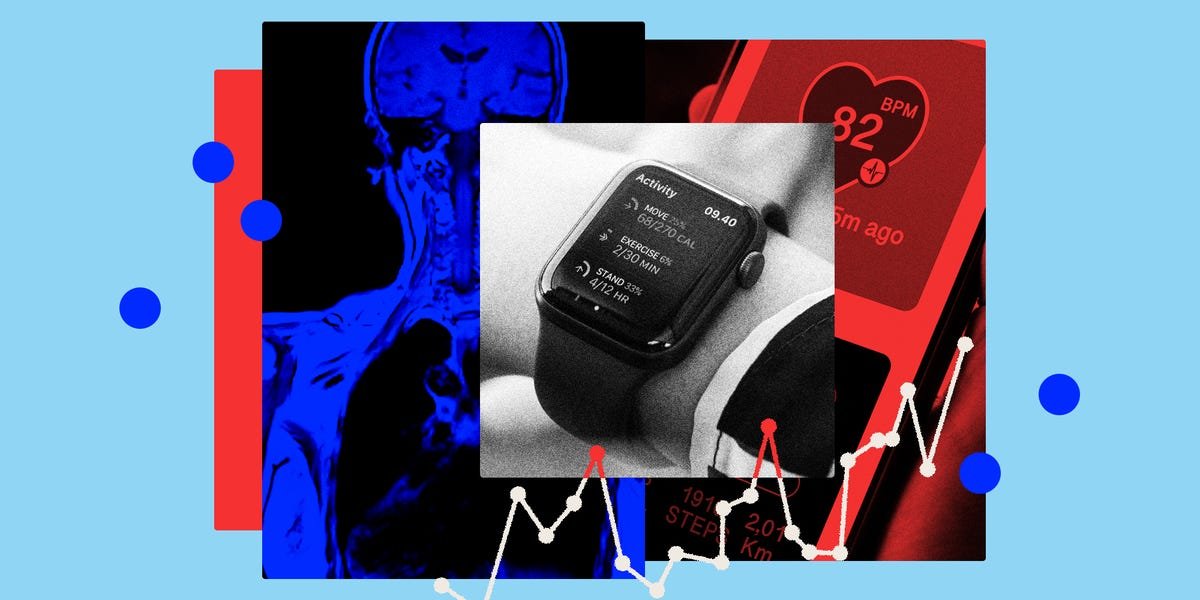
Katie Anne Hayes felt like her Garmin watch was giving her a lot of valuable information, at least at first. She took particular interest in the “Body Battery” feature, which purports to tell users how much energy they’ve got left in the tank. Hayes says she started checking it “pretty religiously” to gauge whether she could handle a workout or weekend concert. If her battery was low, “that was usually a good predictor of how I’d feel at the end of the day,” she says.
Hayes, 29, wasn’t doing all this for fun: Her doctor shrugged off long Covid symptoms she developed in 2023, and she got the Garmin to try to manage the condition herself. But what began as a simple way to track her daily stamina quickly turned into an unhelpful obsession. She’d get frustrated if her battery level was unexpectedly low ahead of an important work meeting and wake up anxious to see what happened while she slept. Eventually, her family members suggested she ax the watch.
“I got into this bad negative feedback loop with it,” Hayes says. “Taking off the watch, and having it be less of a mental reminder of the fatigue that I might experience, I think, was helpful.”
Thanks to technology, we can know more about our bodies than ever before. From wearables to full-body scans, deep-dive blood and DNA tests, and even at-home vaginal microbiome kits, we have a wealth of insights at our fingertips. In a matter of seconds, chatbots can turn heaps of data and metrics into personalized advice that sounds right. But at what point does so much data become too much? Where does the balance tip from self-knowledge into self-surveillance?
Doctors, researchers, patients, and consumers are trying to figure out where that line should be. People are increasingly outsourcing their relationships with their own bodies to the algorithm. Consumer wellness tech is generating mounds of quasi-medical data without the systems or expertise to interpret it.
“You stop asking, ‘How do I truly feel?’ and you may start asking, ‘What does my app say?'” says Dr. Sandeep Kishore, a physician-scientist and associate professor at the University of California, San Francisco. “This is subtle, but it is a significant shift.”
In the wellness space, “longevity” is the word of the day. People are increasingly focused on preventive medicine and optimizing their health. The “quantified self” phenomenon, first coined in 2007, has snowballed into a multi-billion-dollar web of gadgets, tests, and analyses that promise to help you live your most perfect life.
The flood of health metrics raises a hard-to-answer question: How much of this is actually useful?
The global wearables tech industry hit nearly $100 billion in revenue in 2025, according to Grand View Research, and is expected to reach $230 billion by 2033. About a third of Americans wear smart watches, rings, and bands to track their health and fitness. Tens of thousands have signed up for elective whole-body MRI scans that can cost $2,500 a pop. Function Health, a personalized health testing platform that lets patients get upward of 150 tests, is valued at $2.5 billion. Smart ring maker Oura, valued at $11 billion, is expected to go public later this year.
Few people have taken the pursuit of optimization as far as the “Don’t Die” entrepreneur Bryan Johnson, but less extreme versions of this impulse have gone mainstream. You’ve likely noticed friends, family, and coworkers chatting about their sleep scores, step counts, and stress levels — or maybe you’re fretting about it yourself. Yelp searches for “full body MRI scan” and “genetic testing” are up more than 200% during the first three months of this year compared to last, and searches for “VO2 max testing,” “body composition analysis,” and “metabolic testing” have increased, too.
The flood of health metrics raises a hard-to-answer question: How much of this is actually useful?
Self-tracking can be a positive experience if it sparks motivation to move more, eat better, or go to bed earlier. Ten thousand steps a day is an arbitrary number made up by marketers, but if your smartwatch goal inspires you to get off the couch, so be it. Deborah Lupton, a sociologist at the University of New South Wales, Sydney, says trackers may also give us a sense of control over our health, and they can help those with chronic or contested conditions gain better acknowledgment, “because they have ‘real data’ to show healthcare providers.”
But it can also be a slippery slope — much of the tech is designed to give people a lot of noise and not much signal. “The vast majority of metrics that we can measure are a complete waste of time. They don’t tell us anything meaningful about health,” says Nick Tiller, an exercise scientist and research associate at the Lundquist Institute for Biomedical Innovation at Harbor-UCLA Medical Center.
While wearable consumer technologies have improved in recent years, they still have limitations in terms of accuracy and usefulness. Take the example of sleep.
Kelly Baron, a clinical psychologist at the University of Utah who specializes in behavioral sleep medicine, tells me devices have come a “long way” in their ability to track sleep, though their estimates of sleep stages remain limited. And even so, she tries to encourage people not to fixate on their REM or how much rest they get in a single night. Certain medications can affect sleep stages, and people may not realize this unless they talk to a doctor. And as much as we all aim for that perfect eight hours every night, life often gets in the way. What matters are averages and patterns.
Just like anything, we can take sleep tracking too far. “Is it making you feel better or for worse? Do you get up in the morning and look at the number and decide that’s how your day’s going to go?” Baron says. She’s one of the researchers who coined the term “orthosomnia,” where people’s preoccupation with their sleep readings actually makes their sleep worse and leads to insomnia. It’s modeled after “orthorexia,” where people become fixated on healthy eating to an unhealthy degree.
Users may also misunderstand what their trackers do and do not tell them. Apple Watches have an FDA-approved feature that can look for breathing disturbances and alert wearers if they show signs of potential sleep apnea (which they should then take up with a doctor). What many of those wearers don’t realize is that if the watch doesn’t send an alert, that doesn’t mean they don’t have a problem, and most devices aren’t cleared to detect sleep apnea at all.
Dr. Jesse Greer, a former Special Forces physician and the founder of Preamble Health, a preventive healthcare clinic, tells me he’s had a number of patients who “if I had to bet five bucks, they’ve got some sleep apnea,” but they insist they don’t because of their device data. “I can’t tell you how many times we’ve actually tested, found pretty bad sleep apnea, and the Oura ring is sitting there telling them that they’ve got a 90 sleep score,” he says.
The Oura ring does not detect sleep apnea, nor is it FDA-approved to do so. A spokesperson told me that its sleep and breathing insights “are intended for general wellness purposes only.”
Catching a dangerous tumor or detecting heart abnormalities early can be critical. As Dr. Kishore puts it, imagine if the Titanic had shifted by a degree when it left port — it probably would have missed the iceberg. At the same time, many devices and tests are causing people to get worked up over ice cubes.
Full-body scans can detect cancers and other issues life-savingly early, but they can also lead to a lot of unnecessary spending, testing, and anxiety. If you look hard enough, you’ll almost always find something. It’s only after expensive, invasive follow-ups that you discover that little something was often nothing.
“I think we’re setting ourselves up for a lot of physical harm and a lot of financial harm,” says Dr. Adam Cifu, a general internist and professor of medicine at the University of Chicago and an editor at Sensible Medicine on Substack. He warns that this can put a financial strain on individuals and the broader health system, as going down the rabbit hole for a benign speck can cost thousands of dollars.
Indeed, major medical groups advise against full-body MRIs for the general public. Dr. Cifu discourages it among his patients because in many cases “they’ll just give you something else to worry about.”
Doubts from the medical community aren’t keeping patients away from all of this testing. Victoria Usher, who runs a communications firm in London, tells me she’s become “completely addicted to” the extensive checks she undergoes every year in Bangkok. She spends $1,000 for five hours of “every test known to mankind,” including MRIs, CTs, cancer markers, ultrasounds, chest x-rays, and more. “It’s health tourism at its best,” she says. A friend caught a cancerous growth on her leg this way a few years ago, but thus far, Usher’s endeavors have resulted in the detection of an unproblematic heart abnormality and the realization that, like a lot of women as they age, her bone density is low and she’s got some plaque in her arteries. She doesn’t tell her doctor back home about the tests in Thailand for insurance purposes, though, when the heart thing was detected, and a Bangkok clinician didn’t have time to talk it over, she got it double-checked while back in the UK.
“There’s a couple of weird birth defects that they found in me that wouldn’t ever become a problem, but at least you know they’re there,” Usher says. She’s addressing bone density and arterial issues through lifestyle changes.
As people are swimming in this sea of information, they’re turning to AI, not their doctors, to make sense of all of it.
Dr. Kishore tells me he regularly has patients show up in his clinic with scores and metrics from wearables that aren’t yet clinically validated. To complicate matters further, patients are tossing test results and readings into ChatGPT and then presenting to their doctors with AI-generated diagnoses or agenda items for discussion. He says the AI is about “fifty-fifty” in terms of accuracy right now. When it’s right, it’s quite good and directionally helpful, but it’s also led to instances where he’s ordered extra workups largely to assuage patient anxieties. “I was reassured the AI was perhaps wrong, but we spent some resources in doing that and some emotional energy,” he says.
Many people aren’t taking their AI-generated medical records to their doctors. Instead, they’re keeping it to themselves and self-directing care. According to a recent KFF survey, 29% of American adults say they’ve used AI tools for information or advice about their physical health, and of those, 42% did not follow up with a doctor.
AI will bullshit you until you’re convinced that it’s giving you the right answer.
The issue is that AI often gets it wrong. Tiller, from Harbor-UCLA Medical Center, recently published a study that found that half of responses to 250 health-related questions posed to five popular chatbots were “problematic,” including 20% that were so problematic as to be dangerous. In many instances, the bots were ingesting online misinformation online and spitting it back out.
“The research shows that actually a lot of the advice that AI is giving is not always based on rigorous science,” Tiller says.
Separate research from Mass General Brigham found that publicly available LLMs home in on single answers and diagnoses prematurely when prompted with basic, early-stage queries, getting it wrong most of the time. When the chatbots had all of the pertinent patient readings and insights, they generally got diagnoses right — but often, when someone is asking AI health questions, they’re not bringing a complete picture.
“That’s the problem, people just assume that it’s right,” Tiller says. Whereas a doctor or fitness coach would question a patient or be honest when they’re not sure about an answer, AI is sycophantic, and it won’t say when it doesn’t know.
“AI will bullshit you until you’re convinced that it’s giving you the right answer,” Tiller says.
It’s not that AI doesn’t have potential in this space. It’s that patients, doctors, and consumers need to be clear-eyed about where it is right now.
To be sure, people aren’t turning to all of these trackers and AI analyses in a vacuum. They’re emerging because preventive care feels inadequate and inaccessible, healthcare is fragmented, and patients feel unheard. Consumer tech is eagerly but haphazardly filling in the medical system’s many gaps.
It’s natural to want to be your best self, but some of us are optimizing ourselves so relentlessly it’s a little miserable. It’s fine to want to get enough sleep and eat well, but if that means you become so rigid in your schedule that you refuse every mid-week dinner with friends, is that trade-off really worth it? After all, social connections boost longevity, too. If missing your step goal sends you into a spiral, maybe it’s time to put down the fitness tracker. What’s important to pay attention to is the overall trend — there’s no upside in weighing yourself every day if it means panicking over an extra pound or two the morning after a salty meal. Many of the best runners in the world don’t do fancy analyses; they just … run. Even Bryan Johnson has admitted that most of the most effective life-elongating hacks are basic and free.
Dr. Cifu says it sounds like some of the health-tracking obsessives “need a better hobby, because in a way, that’s what it becomes.” If it nudges you toward better behavior, fine. But also, you don’t need an Oura ring to tell you heavy drinking isn’t good for you, and you can record your sleep with a notebook.
The direct-to-consumer health market is booming, meaning there’s no shortage of new gadgets and tests. If you want to treat your body like a dashboard, you can. But people will be wise to remember that these data points are just that — data points. And as hokey as it sounds, the best data point you have is how you feel.
Emily Stewart is a senior correspondent at Business Insider, writing about business and the economy.
Business Insider’s Discourse stories provide perspectives on the day’s most pressing issues, informed by analysis, reporting, and expertise.
