


SEATTLE (AP) — For decades, scientists believed Prochlorococcus, the smallest and most abundant phytoplankton on Earth, would thrive in a warmer world. But new research suggests the microscopic bacterium, which forms the foundation of the marine food web and helps regulate the planet’s climate, will decline sharply as seas heat up.
A study published Monday in the journal Nature Microbiology found Prochlorococcus populations could shrink by as much as half in tropical oceans over the next 75 years if surface waters exceed about 82 degrees Fahrenheit (27.8 Celsius). Many tropical and subtropical sea surface temperatures are already trending above average and are projected to regularly surpass 86 degrees Fahrenheit (30 Celsius) over that same period.
“These are keystone species — very important ones,” said François Ribalet, a research associate professor at the University of Washington’s School of Oceanography and the study’s lead author. “And when a keystone species decreases in abundance, it always has consequences on ecology and biodiversity. The food web is going to change.”
These tiny organisms hold a vital role in ocean life
Prochlorococcus inhabit up to 75% of Earth’s sunlit surface waters and produce about one-fifth of the planet’s oxygen through photosynthesis. More crucially, Ribalet said, they convert sunlight and carbon dioxide into food at the base of the marine ecosystem.
“In the tropical ocean, nearly half of the food is produced by Prochlorococcus,” he said. “Hundreds of species rely on these guys.”
Though other forms of phytoplankton may move in and help compensate for the loss of oxygen and food, Ribalet cautioned they are not perfect substitutes. “Evolution has made this very specific interaction,” he said. “Obviously, this is going to have an impact on this very unique system that has been established.”
The findings challenge decades of assumptions that Prochlorococcus would thrive as waters warmed. Those predictions, however, were based on limited data from lab cultures. For this study, Ribalet and his team tested water samples while traversing the Pacific over the course of a decade.
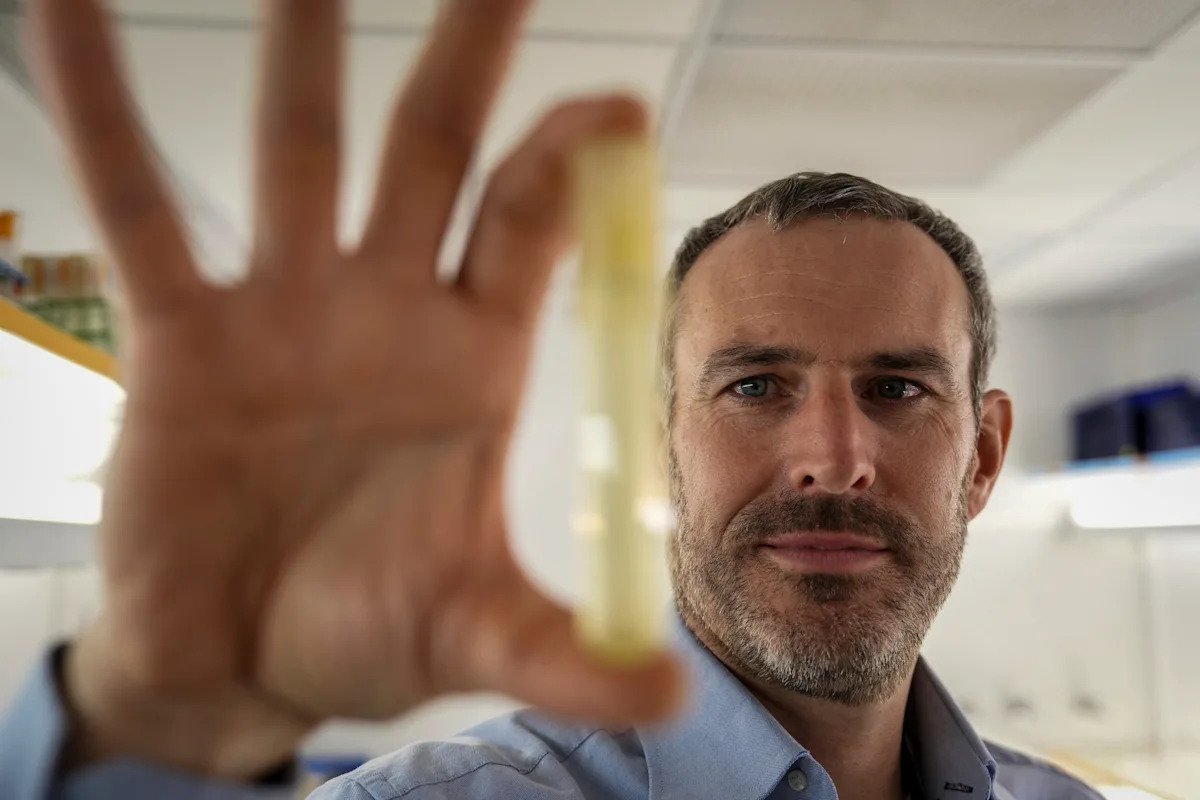
Over 100 research cruises — the equivalent of six trips around the globe — they counted some 800 billion individual cells taken from samples at every kilometer. In his lab at the University of Washington, Ribalet demonstrated the SeaFlow, a box filled with tubes, wires and a piercing blue laser. The custom-built device continuously pulls in seawater, which allowed the team to count the microbes in real time. “We have counted more Prochlorococcus than there are stars in the Milky Way,” Ribalet said.
Experts warn of ‘big consequences’
Paul Berube, a research scientist at Massachusetts Institute of Technology who studies Prochlorococcus but was not involved in the work, said the breadth of data is “groundbreaking.” And he said the results fit with what is known about the microbe’s streamlined genome, which makes it less adaptable to rapid environmental changes.
“They’re at the very base of the food web, and they feed everything else — the fish eat the things that eat the phytoplankton and we eat the fish,” he said. “When changes are being made to the planet that influence these particular organisms that are essentially feeding us, that’s going to have big consequences.”
To test whether Prochlorococcus might evolve to withstand hotter conditions, Ribalet’s team modeled a hypothetical heat-tolerant strain but found that even those would “not be enough to fully resist the warmest temperature if greenhouse emissions keep rising,” Ribalet said.
He stressed that the study’s projections are conservative and don’t account for the impacts of plastic pollution or other ecological stressors. “We actually tried to put forth the best-case scenario,” Ribalet said. “In reality, things may be worse.”
Steven Biller, an associate professor at Wellesley College, said the projected declines are “scary but plausible.” He noted Prochlorococcus form part of the “invisible forests” of the ocean — tiny organisms most people never think about, but are essential to human survival.
“Half of all photosynthesis is happening in the oceans and Prochlorococcus is a really important part of that,” Biller said. “The magnitude of the potential impact is kind of striking.”
Biller, Berube and Ribalet said that while other microbes may compensate somewhat, the broader risks to biodiversity and fisheries are real.
“We know what drives global warming. There is no debate among the scientific community,” Ribalet said. “We need to curb greenhouse gas emissions.”
He hopes the findings bring more attention to tropical oceans, which could serve as natural laboratories for warming adaptations and as early warning signals for ecological collapse.
“For the first time, I want to be wrong. I would love to be wrong,” he said. “But these are data-driven results.”
___
Follow Annika Hammerschlag on Instagram @ahammergram.
___
The Associated Press receives support from the Walton Family Foundation for coverage of water and environmental policy. The AP is solely responsible for all content. For all of AP’s environmental coverage, visit https://apnews.com/hub/climate-and-environment
