


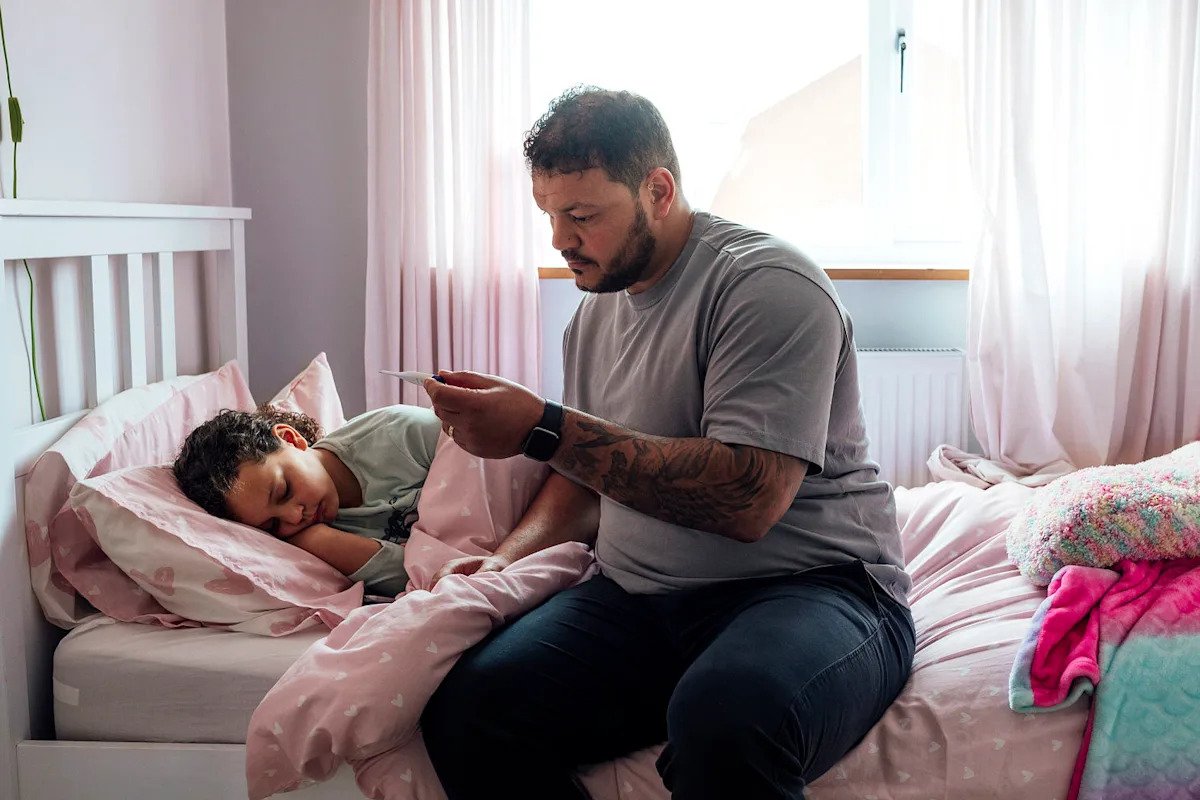
Treating childhood fevers has long been a source of parental angst. Do you feed a fever or starve it? (Spoiler: Kids who are sick need to eat and drink enough to keep their bodies hydrated and well-nourished, doctors say.)
But in September, when President Donald Trump told pregnant women to “fight like hell not to take” Tylenol over unfounded claims it was linked to autism, the ongoing debate over what’s long been considered a standard of care for kids’ fevers bubbled up again.
“A friend’s baby (7 months) was running a 101 fever on Friday night and she texted me, ‘of course now I’m scared to give him Tylenol,’” one Reddit user posted recently.
A person identifying as a health care worker posted in a different Reddit thread last month that a patient “brought their infant in with 103 fever and said they were too afraid to give acetaminophen.”
The president, who has no medical training, said multiple times that pregnant women and their children should “tough it out” instead of taking the pain reliever.
Acetaminophen is the generic name for Tylenol and is an ingredient in a variety of medications. There is no credible data, experts say, showing the fever-reducer isn’t safe when it’s used correctly. The American Academy of Pediatrics wrote last week that studies don’t find a “causal link” between acetaminophen and autism in children or during pregnancy. “Misleading claims that the medicine is not safe and is linked to increased rates of autism send a confusing, dangerous message to parents and expectant parents,” the group wrote.
What’s the point of a fever?
When a new and potentially harmful germ invades our immune system, the body reacts by raising its core temperature. Viruses and bacteria tend not to thrive in warm environments.
That’s not necessarily a bad thing — within reason, said Dr. Molly O’Shea, a pediatrician in Michigan and spokesperson for the American Academy of Pediatrics.
“Fever has value in fighting infection,” she said. “But there is a tipping point where that value is lost.”
That’s when the child is so uncomfortable that they don’t want to eat or drink.
“That’s when reducing the temperature makes sense,” she said. “More harm may come from dehydration.”
Is a high fever always dangerous?
When Seth Creech caught the flu during the 2009 H1N1 pandemic, age 6 at the time, his fever soared to 106 degrees Fahrenheit.

Seth Creech in 2009 at age 6. A bout with H1N1 sent his fever soaring to 106 degrees. (Courtesy of Buddy Creech)
It’s a frighteningly high temperature that would send most parents into a panic.
Seth’s father, Dr. Buddy Creech, a professor of pediatric diseases at Vanderbilt University Medical Center in Nashville, Tennessee, had a different view.
“As a pediatrician, I knew that 106 wasn’t going to hurt him,” he said. “In a normal, healthy child, the body is really well calibrated to keep that temperature in a range that’s not going to be harmful to the child. That’s important for parents to realize.”
What was concerning, Creech said, was how his son was acting while sick. “He looked terrible,” he said. “His eyes were glassy. He didn’t want to move.”
Fever-reducing medications like acetaminophen and ibuprofen brought Seth’s fever down to about 101 degrees. “He was totally fine at that point,” Creech said. “He was gold, playing Legos, video games.”
Seth Creech recovered and is now a 22-year-old college senior.
“If the child looks well and is feeling fine, is playful and is active, you really don’t have to do anything,” Buddy Creech said. “You can ride that out in part to see how they’re doing and to let the fever increase the pressure on the germ to die.”
O’Shea supported the stance that a child’s behavior is key in determining how to react to high temperatures. Signs to treat fevers include being unusually sleepy, cranky and refusing food and drinks.
Still, the AAP recommends calling the pediatrician for advice when a child’s fever reaches 104 degrees.
The threshold for babies younger than 3 months old is much lower, according to the group, at 100.4 degrees.
Creech said there’s no evidence that giving kids Tylenol or other medicines to ease their pain or fevers would prolong their illness.
“Parents should feel very safe giving their kids Tylenol when they need it,” he said.
This article was originally published on NBCNews.com
