


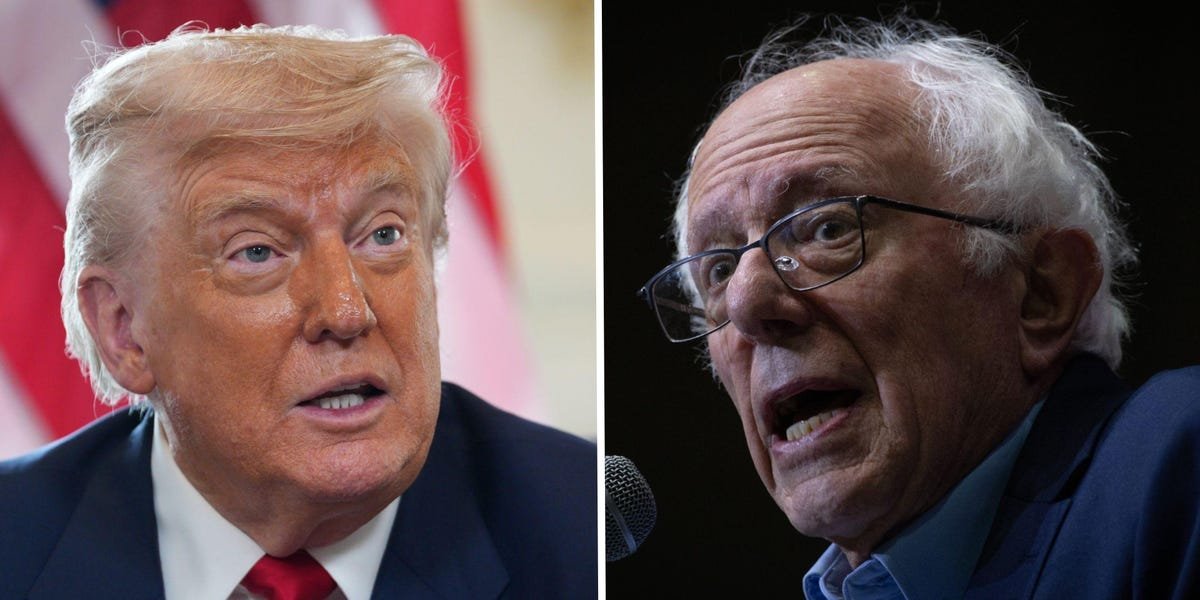
President Donald Trump’s Intel deal is earning him some measure of approval from an unexpected corner: progressives.
After Trump announced a plan for the US government to take a roughly 9.9% stake in the iconic US tech company, Sen. Bernie Sanders of Vermont offered cautious praise for the move. Other progressives say they have little problem with the investment itself, but would like to see other policies accompany it.
It’s the latest indication of how the deal, which marks a substantial break from longstanding GOP orthodoxy around free market capitalism, is cutting across political lines in strange ways.
While the president’s most loyal supporters have cheered the deal, many in the GOP have made their discomfort clear, arguing that it will distort markets and harm American capitalism in the long run.
“I think it’s a big mistake to have government ownership of things,” Republican Sen. Rand Paul of Kentucky said on CNBC this week. “And of course it’s a step toward socialism.”
In a statement for this story, White House spokesman Kush Desai said the administration was pursuing free-market policies and “rectifying the America Last policies that haven’t worked” simultaneously.
“Washington, DC’s blind commitment to consensus orthodoxy that ignored the realities of the world is exactly why Americans and America were left behind,” Desai said. “Look no further than lopsided ‘free’ trade arrangements that let foreign cheating decimate our industrial base.”
Related stories

Business Insider tells the innovative stories you want to know
Business Insider tells the innovative stories you want to know
‘That’s not the role for the United States government’
Under the deal, the US government is investing $8.9 billion in Intel stock, funded primarily by grants that the company would have received under the CHIPS and Science Act, a 2022 law signed by President Joe Biden aimed at spurring semiconductor manufacturing.
It will make the US government the largest single investor in the company.
The deal came seemingly out of nowhere. Days earlier, Trump said Intel CEO Lip-Bu Tan should resign, calling him “conflicted” over his connections to Chinese companies. Then led to a White House meeting between Tan and Trump, which resulted in the deal.
Trump and one of his top economic advisors have indicated that this could be the first of many such deals. “I’m sure that at some point there’ll be more transactions, if not in this industry then other industries,” Kevin Hassett, director of the National Economic Council, said in August.
The plan bears some resemblance to a years-old proposal from Sanders and Democratic Sen. Elizabeth Warren of Massachusetts.
The duo offered an amendment to the CHIPS Act that would have required companies receiving funding via the bill to issue warrants or equity stakes to the US government.
That amendment also had other conditions, including a ban on stock buybacks and required the company to remain neutral in union organizing efforts. It was ultimately not included in the final bill.
“I am glad the Trump administration is in agreement with the amendment I offered three years ago to the CHIPS Act,” Sanders said in a statement. “If microchip companies make a profit from the generous grants they receive from the federal government, the taxpayers of America have a right to a reasonable return on that investment.”
Sanders added that the Trump administration “should also make sure that these companies will not engage in illegal union busting, outsource American jobs overseas or buy back their own stock.”
Warren, on the other hand, has been less willing to praise Trump’s move. This week, she sent a letter to Commerce Secretary Howard Lutnick excoriating the administration for not attaching more conditions to the money — and for dropping conditions that initially came with the CHIPS Act funding.
“He waived all of the requirements that would make the taxpayer investment in that company work for the American people, and effectively just became one more profit-maximizing investor,” Warren told BI on Thursday, referring to Trump. “That’s not the role for the United States government.”
Other progressives have said they had little problem with the government taking a stake in a private company, but viewed Trump’s move as incomplete.
“I have no problem with the American taxpayers being reluctant shareholders in Intel,” Democratic Rep. Ro Khanna of California said on NBC’s “Meet the Press” on Sunday, though he said the company needed billions more in investment and that the government should use the agreement to push the company to sign a labor neutrality agreement.
Democratic Rep. Mark Pocan of Wisconsin said that Trump needed a broader industrial policy, versus ad-hoc agreements with individual companies.
“You can’t just do ideas here, and ideas there, and expect it to work,” Pocan told BI. “Even if there’s something good to an idea, without the other components, it doesn’t have the effectiveness.”
