


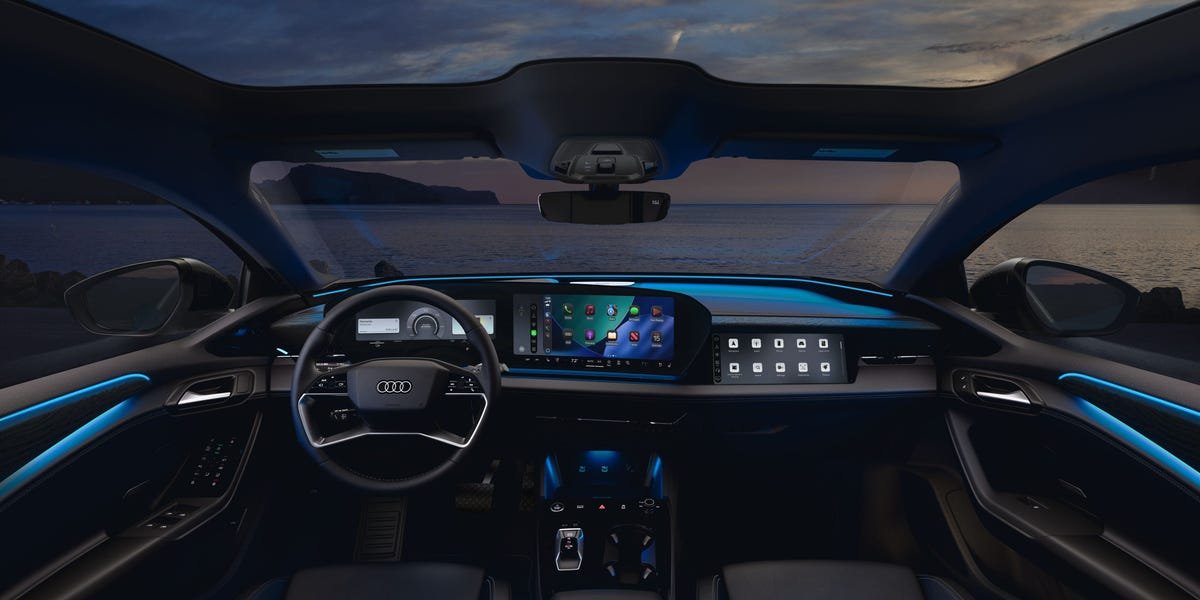
When automakers went electric, they also went sleek and digital.
Climate control knobs disappeared. Door handles tucked themselves into body panels. Audio volume dials became haptic sliders.
Now, as automakers face regulatory pressures and customer blowback, some of the industry’s biggest names are reversing course and reintroducing physical buttons.
Audi’s upcoming 2027 e-tron updates promise a more “tactile” interior experience. Ferrari’s first EV — designed in collaboration with former Apple design chief Jony Ive — is filled with physical controls. Even Tesla is redesigning its flush door handles.
“We will never, ever make this mistake anymore,” Andreas Mindt, the head of design at Volkswagen, told AutoCar last year when asked about filling cars with digital screens.
“Honestly, it’s a car. It’s not a phone: it’s a car.”
How the touchscreen took over
Ferrrari
The move to giant screens was about aesthetics, economics — and influence.
Sam Abuelsamid, co-host of the Wheel Bearings podcast, told Business Insider it all started with Tesla’s lead.
Tesla’s Model S, its first-ever ground-up design, centered much of its interface around a 17-inch touchscreen.
“It gives cars a more high-tech look and feel,” Abuelsamid said. “Also, it cut costs. It costs a lot of money to develop and validate physical controls.”
When Tesla’s sales started to take off, the industry tried to mimic the sleek styling. Throughout the industry, the influence of Tesla’s pared-down approach was evident.
Volkswagen’s ID.4 never had climate knobs. Rivian’s door handles electronically slid inside the door frame. Ford added huge tablets to the center of its Mustang Mach-E and F-150 Lightning.
Even Tesla took it a step further, removing the physical turn-signal stalks from the Model 3 — before bringing them back.
At first, the tech-forward approach worked for the target audience.
“It goes back to the types of consumers who adopt these technologies,” Eleftheria Kontou, an assistant professor in civil and environmental engineering at the University of Illinois, said to Business Insider.
“Environmentalists and technically-inclined shoppers are the most common EV buyers,” Kontou added. “They want a new tech gadget, so EVs are a very attractive option.”
But as EVs moved beyond tech enthusiasts and into the broader market, expectations shifted.
The usability problem
Sjoerd van der Wal/Getty Images
As EVs went mainstream, the downside of screen-heavy cabins became harder to ignore.
“The core safety concern isn’t mechanical reliability — it’s distraction,” Spencer Penn, a former Tesla Model 3 engineer and now CEO of sourcing platform LightSource, told Business Insider. “Touchscreens require visual attention and lack haptic feedback.”
The advantage of physical controls, he said, is ergonomic and psychological immediacy rather than mechanical redundancy.
That usability tension has begun drawing regulatory scrutiny.
China recently moved to ban certain flush and hidden door handle designs over safety concerns. In the US, the National Highway Traffic Safety Administration has investigated complaints involving electronic door mechanisms. And in 2024, the European Transport Safety Council said it would not afford five-star safety ratings to vehicles with too many screens.
A course correction
The EV revolution was built on the promise that cars could function more like smartphones — constantly updated, endlessly configurable, and increasingly software-driven.
That vision isn’t disappearing — and touchscreens aren’t going anywhere.
General Motors is building subscription revenue around digital features. Tesla continues to push new full self-driving updates. Ford’s next generation of EVs will rely heavily on cloud-connected systems.
Instead, they’re restoring some physical controls for high-frequency or safety-critical functions — volume, climate adjustments, hazard lights, windshield wipers — while leaving navigation, media, and ambient light settings to digital menus.
Audi
“Inspired by the functional aesthetic of the well-received Audi Concept C and the tactile experience of its physical controls reflecting mechanical quality, the familiar scroll wheel returns, permitting operation of various functions and replacing the previous touch-sensitive interface controlling volume and MMI menu selection,” Audi says about its 2027 e-tron.
But even in a software-defined future, drivers still expect something smartphones don’t require: the ability to drive down the road without looking at a screen.
“It is less expensive when you remove dozens of switches with a singular screen panel,” Penn said. “However, it’s more expensive if you misalign yourself with the voice of the customer.”
