


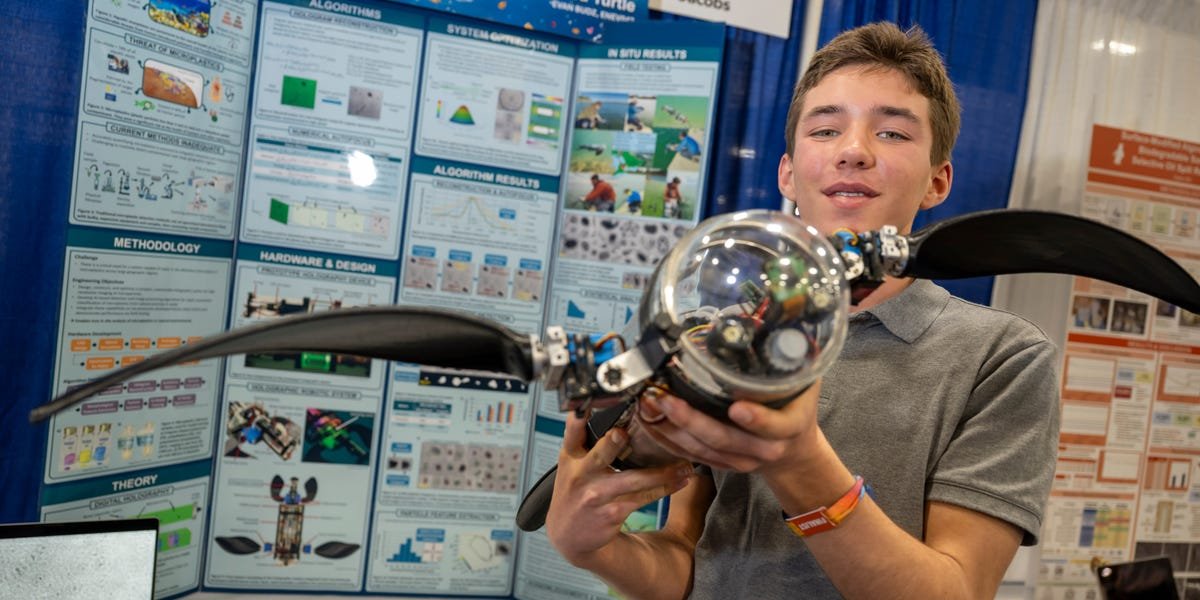
In the summer of 2024, Evan Budz stood at the edge of his grandparents’ pool in Canada, trying to solve a unique problem: How to make his autonomous sea turtle robot swim.
“I remember some of my first tests. I would put my robot in the water, and it would sink right to the bottom,” Budz, 16, told Business Insider. “It wouldn’t swim. It wouldn’t regulate its depth. It was like a brick.”
While most teenagers don’t face such a quandary, it became a major focal point for Budz, who became captivated by the aquatic creatures during a camping trip with his family in Ontario’s backcountry earlier that year.
“I saw a snapping turtle swimming in the water with fluidic movement and very natural motion. I was quite inspired to develop a robot that mimics it,” Budz said.
Evan Budz
The backyard pool trials, alongside months of additional tests, tinkering, and upgrades, paid off this May.
Budz won a $50,000 scholarship at the 2026 Regeneron International Science and Engineering Fair for building an underwater 3D holographic camera and combining it with AI models he trained to identify small pieces of plastic in bodies of water. He mounted that tech atop his autonomous turtle.
He said it took around 2,000 hours each to build the robot and holographic camera.
Trial and error
For Budz, basing his research project on the environment was a natural step.
“I’ve had a passion for the outdoors,” he said. “I have memories back when I was six years old, going backcountry camping with my parents. We would canoe out to these very beautiful and majestic lakes.”
He’s especially drawn to water, which he learned is swarming with microplastics after watching a documentary about oceans and marine ecosystems. The Ocean Conservancy estimates that 11 million metric tons of plastic waste enter the ocean annually, affecting over 1,300 species of marine life.
Business Insider’s Young Geniuses series spotlights the next generation of founders, innovators, and thinkers trying to reshape industries and solve global challenges. See more stories from the series here, or reach out to editor Peter Gelling to share your story.
In 2024, Budz spent about 5 months building the robot turtle, which he said is the perfect animal for this kind of work.
“They are very efficient swimmers, which is key when designing a bionic robot. I wanted to ensure my turtle could swim on long-range missions without the need for constant recharging or battery dying,” Budz said. “They’re also found across a variety of aquatic ecosystems, which means that they’ll be more or less well known to the other organisms that could be in the environment.”
Turtles can also reach large sizes, allowing Budz to comfortably house scientific payloads such as sensors and holographic imaging systems. To perfect the robot’s motion, Budz also consulted with experts at his local aquarium.
Society for Science
“From there, I developed a number of algorithms to allow the robot to swim autonomously following a predefined search pattern as well as regulate its depth,” Budz said. “It’s able to, essentially, follow where a user wishes it to go, completely without the need for manual navigation or human-based control.”
Budz began creating the holographic image system and training the AI models in the summer of 2025. He said the process required a lot of trial and error, especially fine-tuning the technology to accurately detect microplastics from other small water-bound organisms.
“That process included optimizing the physical hardware to achieve a high enough imaging resolution to identify microparticles and microplastics that might only be 10 microns in size,” Budz said.
The holographic image system must successfully capture 3D holograms before they’re run through AI models that identify microplastics.
More from the Young Geniuses series
Budz said creating the components took time, but the testing window was limited due to Canada’s harsh winters.
“Where I am up north in Canada, the winters are very cold and because of that, I had to test my final bionic robot at a number of the local lakes in my region before it became too cold,” he said.
By the time the Regeneron International Science and Engineering Fair took place, Budz said his project had an accuracy rate of 94% in distinguishing microparticles from microplastics.
Winning big
Budz said his research aims to make detecting microplastics faster and more accessible. He called the current test process, which is typically confirmed by laboratories, “convoluted.”
“Since it’s laboratory-based, it can take many days to complete analysis of even a small number of samples and it’s very expensive,” Budz said. “It’s not practical for remote areas where you might not have access to a laboratory or the highly trained personnel that’s required to complete that analysis.”
Budz’s research, however, can analyze microplastics directly in water. That kind of thinking is what led Budz to win the Gordon E. Moore Award for Positive Outcomes for Future Generations.
Society of Science
The Regeneron International Science and Engineering Fair, hosted by Regeneron Pharmaceuticals, Inc. and Society for Science, awarded more than $7 million to this year’s winners. The competition is open to high school students worldwide, and over 1,700 students participated this year.
“It was very surreal to have won this big award. I remember standing on the stage, and my name was called for the Gordon E. Moore Award,” Budz said. “I’m like, ‘Oh my gosh, is that actually me? Did I actually win that?’ So many thoughts racing through my head, a bit of disbelief hearing my name called for that, but it was a very awesome experience overall.”
Budz said he’s focused on high school these days, but he plans to use the $50,000 scholarship to attend university for either science or engineering. He’s also interested in sharing his research to further the field.
