


One year after it launched a universal school voucher program, Tennessee will nearly double the program with 15,000 additional vouchers, directing about $260 million in public funds to private schools.
The Tennessee Senate voted 18-14 on Thursday to fund 35,000 vouchers for the 2026-27 academic year. The Senate bill conformed to its companion in the House, adopted earlier this week, which included 5,000 fewer vouchers than Gov. Bill Lee’s ask of 40,000. The bill passed by a similarly slim margin of 52-43 in the House. The legislation now heads to the governor’s desk for his signature.
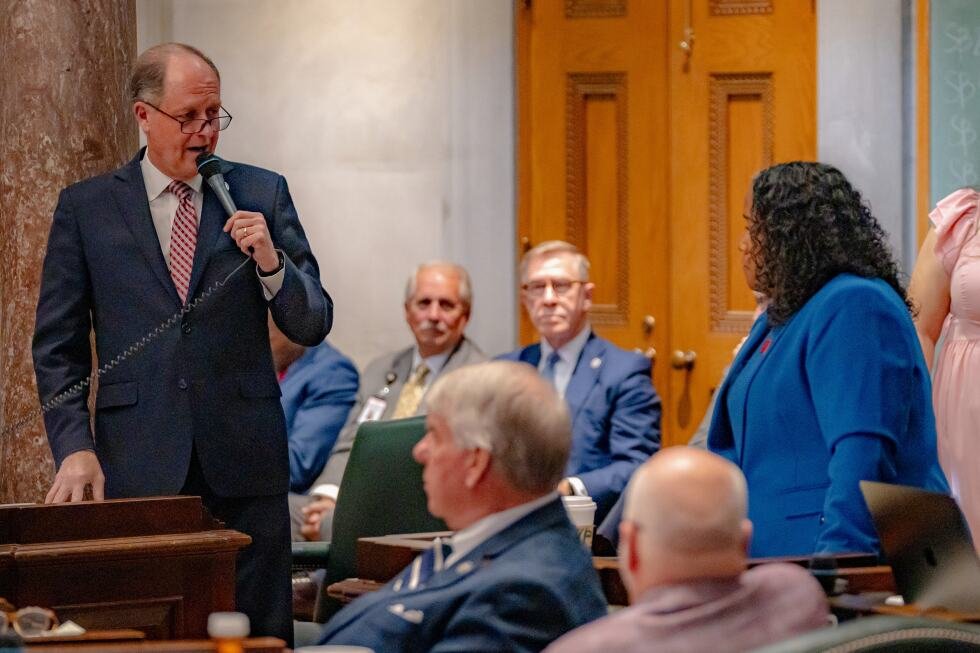
In an hour-long discussion on the Senate floor Thursday morning, legislators debated several last-minute changes to the program that could impact state funding for local public school districts, with criticisms raised by Democrats and some Republicans.
The bill includes an amendment that alters the hold-harmless provision of the voucher program. School districts that experience disenrollment will only be reimbursed for those students who leave public school to accept a voucher. That funding floor was put in place last year for all kinds of disenrollment, to assure public school districts that they would not lose state funding to vouchers.
Under the amendment, school districts will also only be compensated for public school students who provided their Social Security numbers at the time of their enrollment.
Sen. Joey Hensley (R-Hohenwald) said he’s “concerned about changing the funding floor, what that will do for our rural schools in the future.”
“The people should be able to depend on us doing what we say we’re going to do,” Hensley said.
Sen. Jeff Yarbro (D-Nashville) said this will ultimately phase out the hold-harmless provision altogether.
“Repeatedly this chamber has been asked to vote for something, and the year after it expands to something else,” Yarbro said.
Under federal law, schools cannot require students to share their Social Security numbers. When asked whether the amendment would require schools to collect this information, Senate Majority Leader Jack Johnson (R-Franklin) said it would not, since “schools can ask for the Social Security number, but parents do not have to provide them.”
Johnson added that voucher recipients are already required to provide their Social Security numbers. This amendment would use those numbers to follow students who move from public to private schools and document enrollment losses, he said.
Democrats argued that this raises privacy and safety concerns.
Sen. Charlane Oliver (D-Nashville) said that the amendment comes “after two unsuccessful efforts in this body to go after Plyler,” the Supreme Court precedent that held that all students have the right to attend a K-12 public school regardless of their immigration status.
She added that asking for students’ Social Security numbers would have a “chilling effect” on those who are undocumented.
“Parents will be afraid to enroll their children. We are also affecting enrollment numbers by children who will not be going to school. So the TISA funding will go down, further draining (districts),” she said, referring to the per-pupil funding formula.
Yarbro said that while this amendment doesn’t challenge Plyler, expecting schools to collect students’ Social Security numbers violates federal privacy laws.
“Some schools that used to collect this data stopped, because they had data breaches,” he said. “So we’re adding a privacy risk as well.”
Democrats and some Republicans also argued against growing the program without evidence that students accepting vouchers have performed better academically in private schools. Sen. Richard Briggs (R-Knoxville) cited a report from the comptroller’s office that found that students in the state’s former voucher program have underperformed their public school peers.
“There’s not been an examination yet when you have the same students taking the same test, that they even came close to performing at the level of the kids in the public schools,” Briggs said.
Republican leadership has repeatedly pointed to the number of applications to the voucher program as evidence of parent demand. This year, more than 56,000 families applied. Some legislators have argued that parent choice is a more important measure of success than other metrics used to evaluate schools, such as academic performance.
“We focus on test scores, we focus on TCAP, nationally normed assessment tests, and that’s fine,” Johnson said. “But if a parent who loves their child unconditionally does not believe that public school is meeting the needs of that child, we should satisfy our constitutional obligation and give them an option.”
___
This story was originally published by the Nashville Banner and distributed through a partnership with The Associated Press.
