


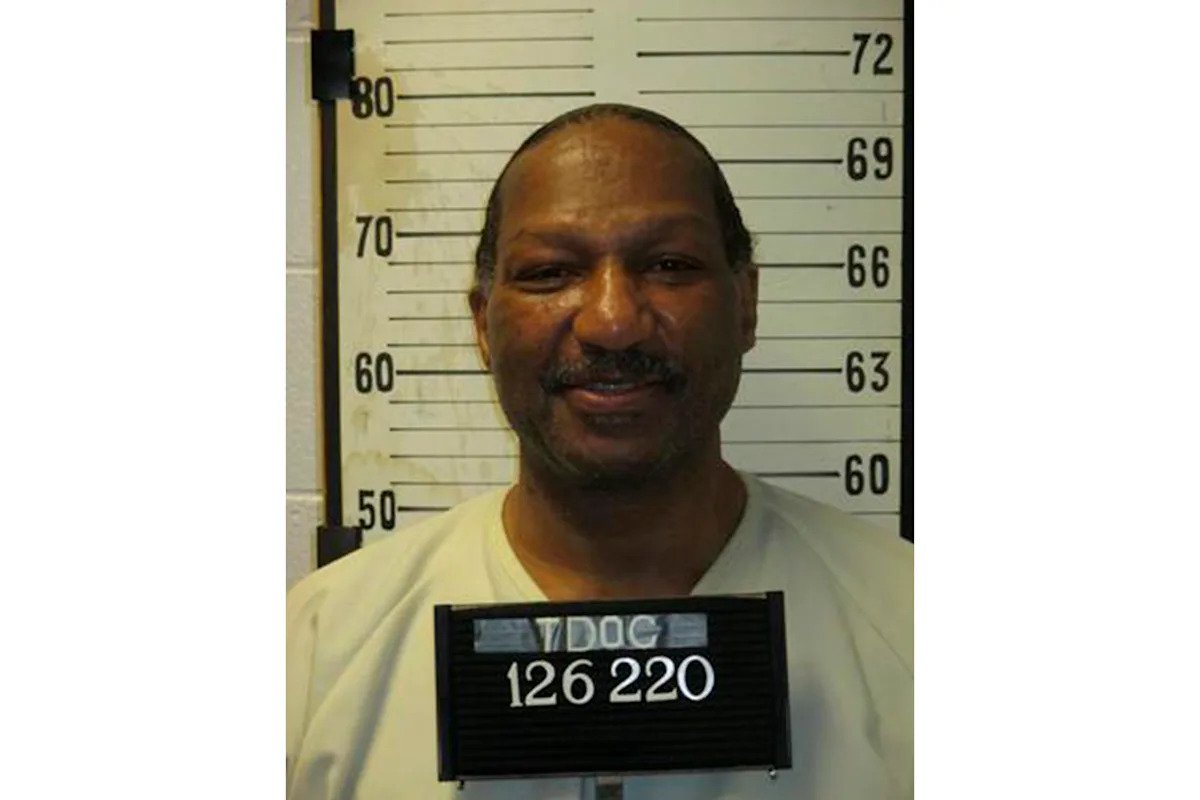
NASHVILLE, Tenn. (AP) — Tennessee is set to execute an inmate Tuesday without deactivating his implanted defibrillator, as uncertainty lingers about whether the device will shock his heart when a lethal drug takes effect.
Barring a late reprieve requested from the governor, Byron Black’s execution will go forward after a legal back-and-forth over whether the state would need to turn off his implantable cardioverter-defibrillator, or ICD. The nonprofit Death Penalty Information Center said it’s unaware of any other cases in which an inmate was making similar claims to Black’s about ICDs or pacemakers. Black’s attorneys said they haven’t found a comparable case, either.
The U.S. Supreme Court on Monday rejected several appeals by Black. The execution would be Tennessee’s second since May, after a pause for five years, first because of COVID-19 and then because of missteps by the Tennessee Department of Correction.
Twenty-seven men have died by court-ordered execution so far this year in the U.S., and nine other people are scheduled to be put to death in seven states during the remainder of 2025. The number of executions this year exceeds the 25 carried out last year and in 2018. It is the highest total since 2015, when 28 people were put to death.
Black’s condition
Black, 69, is in a wheelchair, suffering from dementia, brain damage, kidney failure, congestive heart failure and other conditions, his attorneys have said.
In mid-July, a trial court judge agreed with Black’s attorneys that officials must have the instrument deactivated to avert the risk that it could cause unnecessary pain and prolong the execution. But the state Supreme Court intervened July 31 to overturn that decision, saying the other judge lacked the authority to order the change.
The state has disputed that the lethal injection would cause Black’s defibrillator to shock him. Even if shocks were triggered, Black wouldn’t feel them, the state has added.
Black’s attorneys have countered that even if the lethal drug being used, pentobarbital, renders someone unresponsive, they aren’t necessarily unaware or unable to feel pain.
Black’s case
Black was convicted in the 1988 shooting deaths of his girlfriend Angela Clay, 29, and her two daughters, Latoya Clay, 9, and Lakeisha Clay, 6. Prosecutors said he was in a jealous rage when he shot the three at their home. At the time, Black was on work-release while serving time for shooting Clay’s estranged husband.
Linette Bell, whose sister and two nieces were killed, recently told WKRN-TV: “He didn’t have mercy on them, so why should we have mercy on him?”
“It feels like it is never-ending,” Bell told the news outlet. “They aren’t even resting in their own grave.”
Medical considerations
An implantable cardioverter-defibrillator is a small, battery-powered electronic device that is surgically implanted in the chest, typically near the left collarbone. It serves as a pacemaker and an emergency defibrillator. Black’s attorneys say the only way to be sure it’s off is for a doctor to place a programming device over the implant site, sending it a deactivation command, with no surgery required.
The legal case also spurred a reminder that most medical professionals consider participation in executions a violation of health care ethics.
While the judge’s order to deactivate the device was in place, state officials said Nashville General Hospital practitioners would do the procedure the day before at the hospital, but wouldn’t travel to the prison on execution day as the court required. The judge offered some leeway, allowing the procedure at the hospital on the morning of the execution.
But Nashville General then released a statement saying the state’s contractor didn’t reach out to proper hospital leadership and that there had been no agreement to do the work.
Intellectual disability claim
In recent years, Black’s legal team has also tried and failed to get a new hearing over whether he is intellectually disabled and ineligible for the death penalty under U.S. Supreme Court precedent.
His attorneys have said that if they had delayed a prior attempt to seek his intellectual disability claim, he would have been spared under a 2021 state law.
Nashville District Attorney Glenn Funk contended in 2022 that Black is intellectually disabled and deserves a hearing under that 2021 law, but the judge denied it. That is because an inmate can’t get an intellectual disability hearing under the 2021 law if they have already filed a similar request and a court has ruled on it “on the merits.”
In Funk’s attempt, he focused on input from an expert for the state in 2004 who determined back then that Black didn’t meet the criteria for what was then called “mental retardation.” But she concluded that Black met the new law’s criteria for a diagnosis of intellectual disability.
Black also sought a determination by the courts that he is incompetent to be executed.
