


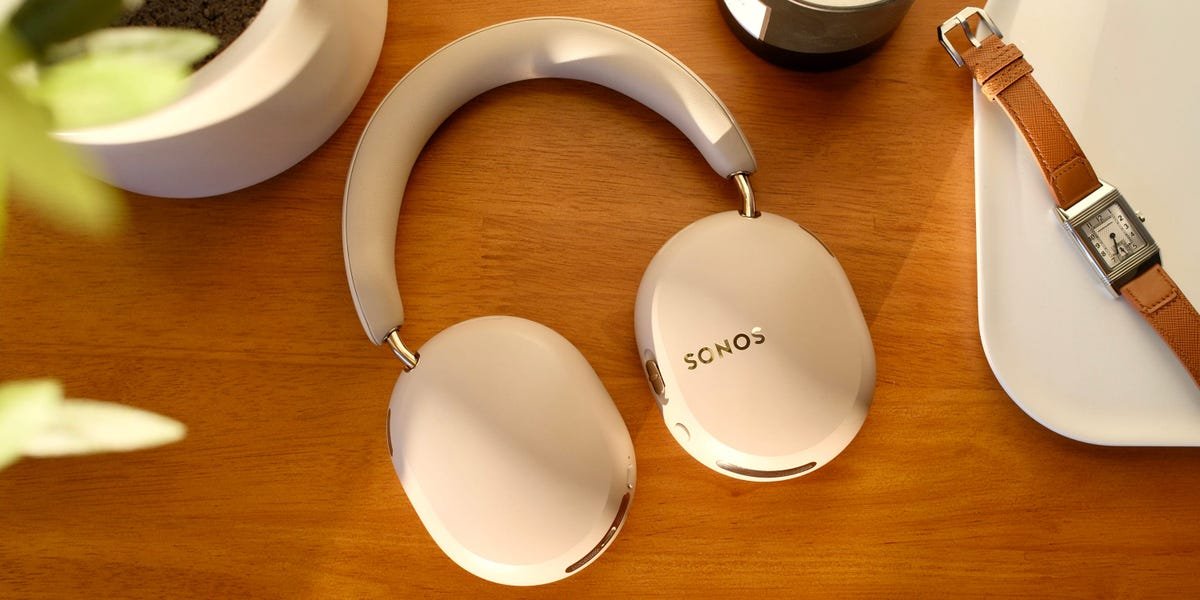
The new Sonos Ace Ultra are some of the most impressive headphones I’ve reviewed all year, mainly because of their top-notch active noise cancellation (ANC). And I don’t make that claim lightly. In addition to testing nearly every premium headphone model released over the last three years, I’ve already flown more than 11,000 miles with the Ace Ultra. I can assure you they’re built to travel the world as much as they’re suited for everyday listening at home.
The Sonos Ace Ultra headphones are an upgraded version of the original Sonos Ace headphones that launched in 2024. That standard model isn’t going anywhere, however, as it will remain available for a reduced MSRP of $349. Meanwhile, the new $449 Sonos Ace Ultra are meant to deliver a more premium experience, with improved performance across the board. Based on my experience, they deliver the goods.
They play the hits with dynamic audio and offer a comfortable fit thanks to plush ear cups. Key design elements carry over from the original Ace, but the Ace Ultra headphones really elevate their ANC game and support new features to more seamlessly integrate with other Sonos products. Though I have some minor quibbles, these are easily among the best headphones you can get for under $500.
Sonos Ace Ultra Headphones
The Sonos Ace Ultra are the brand’s new premium wireless headphones, offering improved noise cancellation over the standard Ace. They now also support better integration with other Sonos speakers, so you can press a button to switch audio between the headphones and your Sonos system.
The Ace Ultra are comfortable to wear for hours, whether you’re at home or on the go
Tyler Hayes/Business Insider
Sound quality and active noise cancellation are the meat of modern, premium headphones. But comfort and appearance shouldn’t be ignored.
Compared to the standard Sonos Ace, the most obvious visual change with this new step-up model is the expanded color choices. In addition to standard Black and White, Sonos now has Agave and Sand. Both offer an elegant look. In person, Sand is especially sophisticated without being gaudy. Both my wife and daughter instantly gravitated to my Sand-colored review unit, which drew their attention more than five rival headphones I had on hand from other brands.
Even though it’s hard to tell from looks alone, the headphones’ fit has also been revised, with deeper ear cups. This means they should be more comfortable for a wider range of people. But while the overall dimensions are technically larger than the standard Ace headphones, this is basically imperceptible in person.
The Ace Ultra headphones weigh 322 grams. On the one hand, that’s about 64 grams lighter than the AirPods Max 2, but on the other hand, it’s still a bit hefty compared to most competitors. But despite their weight, they don’t actually feel heavy. I wore them for hours (and hours) on a plane without any discomfort.
The Ace Ultra are rated for 35 hours of battery life with ANC on. Though that’s not quite industry-leading, it’s good for this space and five hours more than the standard Ace. In real-world use, they’ve lasted plenty of time while traveling, and it’s unlikely anyone would ever be frustrated by the playtime they deliver. The battery is even replaceable this time around, and I also like that the Sonos app estimates how much listening time you have left based on the percentage of battery used.
Tyler Hayes/Business Insider
When it comes to integrated media controls, the Ace Ultra headphones carry over the same basic design as the standard Ace. The Nothing Headphone (1) may still have my favorite buttons overall, but the Ace Ultra are up there, too. There’s a power button on the left ear cup, while the right ear cup has a Content Key switch and ANC button. The silver Content Key has been enlarged on the Ace Ultra, making it easier to find with your fingers. Moving it up and down toggles volume, while a tap pauses and plays music. Pressing and holding the Key can swap audio playback to/from the headphones and other Sonos speakers/soundbars if you have them. The buttons are delightfully simple all around.
ANC performance is neck-and-neck with top rivals
Tyler Hayes/Business Insider
The quieting power of the Ace Ultra’s ANC is tremendous. Not only did I test them against Sony’s popular WH-1000XM6 and Bose’s industry-leading QuietComfort Ultra 2nd Gen at home, but I also took the Ace Ultra on four flights to see how they hold up during noisy travel.
Using the Ace Ultra on real-world flights really cemented how well they perform. They made the plane’s engine noise and other disruptions as quiet as any other noise-canceling headphones I’ve tried. I went back and forth with two similar premium headphones on the plane. The competing models retail between $350 and $450, but neither could quiet the cabin as much as the Ace Ultra did.
Compared to the standard Ace model, Sonos claims the Ace Ultra has double the ANC performance. I believe it. While the previous model was competitive enough in 2024, the new Ultras are noticeably better. This enhanced performance is partly a result of more integrated microphones, up to 10 from eight, and the ability to adapt to different environments on the fly.
Tyler Hayes/Business Insider
In my at-home testing, the Ace Ultra were comparable to the Sony WH-1000XM6 and the Bose QC Ultra Headphones 2nd Gen in general ANC performance. All three premium models have excellent capabilities, with slight variances depending on the type of noise. So, in some instances, one may have a slight edge over the other, but generally speaking, they’re all incredibly close in overall ANC capabilities. So far in my time with the Ace Ultra, they are proving to be among the best at quieting noises like vacuums, café chatter, and fans.
The Ace Ultra’s Aware Mode (also called transparency), which lets in outside noise using the headphones’ mics, is also very capable. Enough that I’ve briefly forgotten I was wearing headphones at all. I also haven’t noticed any digital artifacts.
The Ace Ultra support a few new microphone-related features as well, including a Voice Boost function that homes in on other voices to help make speech clearer. But in the scenarios I’ve used it in so far, I can’t say I’ve really noticed it one way or the other. However, one feature I did appreciate was Sidetone. This funnels your own voice back into the headphones while using ANC and on a call. In my early use, it’s worked well, providing the best of both worlds — limiting outside noise without isolating my own voice.
The dynamic audio quality should appeal to most people
Tyler Hayes/Business Insider
The Sonos Ace Ultra headphones have a robust, dynamic sound. They can reproduce the kind of low, reverberating bass that you can start to sense, even before you can hear definition in the sound. But comparatively speaking, the Ace Ultra don’t have the same ultra-wide separation as some other popular headphones in this space.
In contrast, the Ultra’s sound is more blended and direct. Bose’s QC Ultra Headphones Gen 2 have the most comparable sound, but they’re a tad more bass-heavy by default. Sony’s WH-1000XM6 headphones, on the other hand, are more distinct throughout the midrange. In my listening, the Sonos Ace Ultra also sounded softer than the original Ace headphones. While the first-gen were a little bit harsher in their default setting, the Ultra are gentler in that regard.
If you’re focused on more critical listening all the time, then you might prefer other headphones to the Ace Ultra. In an audio-only blind test, I think the XM6 would win out. But the Ace Ultra (and most wireless models in this price range) aren’t trying to be reference headphones. I don’t think most people will have any complaints about their capable low bass or upper range. They also use adaptive EQ, so different listeners may hear something unique, depending on their environment. Of course, if you are particular about certain sound profiles, you can always use the Sonos app to adjust a 10-band EQ to your preferences.
Outside of music, the Ace Ultra also sound great with movies and TV shows. I used them while watching a variety of videos, from baseball games to films. Vocals were clear, the soundstage was wide, and they made for a good way to privately listen to TV content at home.
The new Sonos app enables the Ace Ultra to integrate with an existing Sonos system
Tyler Hayes/Business Insider
Sonos 27 is the company’s newly overhauled operating system, and it comes with a revised mobile app. The new software is already interesting, but I suspect it will be an even bigger deal as additional features roll out. It’s early, but there are already cool new functions, like a virtual volume knob that lets you adjust the volume from anywhere on the now-playing screen with a twist of your fingers.
The new mobile app has some design tweaks, such as clearer differentiation between the main home screen and your system speakers. However, there are no major visual changes to be worried about. The app remains on an upward trajectory from a previous low point in 2024, when a botched overhaul caused widespread glitches. Thankfully, those problems appear to be behind us. No one should skip these headphones over past Sonos software concerns.
There’s also new Headphone Linking functionality (available in early access) specifically for the Ace Ultra headphones. They can now instantly pull audio from a wide range of Sonos speakers. Previously, the standard Sonos Ace headphones could only swap audio with select Sonos soundbars. This makes them truly feel like an integrated part of a Sonos multi-room audio system.
Tyler Hayes/Business Insider
In practice, pulling audio from different speakers around my house to the headphones has been wild — it’s like catching and throwing sound around the room. Here’s one example of this capability in action. During testing, I had a Beam Ultra set up in my bedroom about 12 feet from where I was sitting on the bed. I also have an Era 100 SL off to the right that’s about 10 feet away. Pushing the Content Key button on the Ace Ultra headphones successfully routed the audio from the closer Era 100 SL to my headphones, rather than the audio from the Beam Ultra. The process took about 15 seconds, but it impressed me with its precision.
The headphones’ wireless linking is so precise thanks to Sonos’ Fabric technology. This tech uses high-frequency sounds to pinpoint the location of speakers and headphones in the home so that they can work together.
However, there are some limitations (detailed on the Sonos website) when sending playback to the headphones. For instance, wireless playback on the Ace Ultra does not currently support true lossless or spatial audio. Instead, the process uses high-quality but lossy stereo compression. But in practice, the streams shouldn’t sound all that different from what people typically hear on Spotify or Apple Music with default settings.
I still hate the carrying case
Tyler Hayes/Business Insider
When designing the Ace Ultra, Sonos took the opportunity to adjust and upgrade many aspects of the standard Ace headphones. But I also wish it had addressed the carrying case. Instead, we get a similar woolly fabric design. And I’m still not a fan.
The exterior of the slim case is scratchy and sends shivers up my spine every time I touch it. This is a matter of personal preference, but I hate the material. The zipper is hit-or-miss in terms of how smooth it is to use. Thankfully, the interior suede-like material is infinitely better.
My problem inside the case is the pill-shaped cable holder. It’s magnetic and a neat organizational trick, in theory. However, it looks paper-thin and feels cheap and disposable. For a premium product, the surrounding parts of it are disappointing. Those things aren’t dealbreakers or reasons not to buy the headphones, but if you travel with them often, you’ll be interacting with those parts a lot.
Should you buy the Sonos Ace Ultra headphones?
Tyler Hayes/Business Insider
Anyone shopping for headphones above $300 should absolutely consider the Sonos Ace Ultra. They rival top noise-canceling models from Sony and Bose, and deliver pleasing sound quality, responsive physical controls, and a great assortment of features.
However, their performance jump isn’t quite large enough to make them worthwhile for most people who already own the standard Sonos Ace, unless they can sell or trade in the older ones. That said, in many ways, the Ace Ultra headphones fulfill the promise that the standard Ace didn’t quite live up to when they hit stores in 2024. Thanks to their expanded headphone link feature, the Ace Ultra truly feel like a seamless addition to an existing wireless Sonos home audio system in ways that the standard Sonos Ace never could.
People with compatible Sonos speakers will get the most benefits, but I’d argue that having Sonos speakers at home isn’t a prerequisite. The fit, sound, and ANC performance of the Sonos Ace Ultra all make these some of the most impressive headphones I’ve tried in 2026.
