


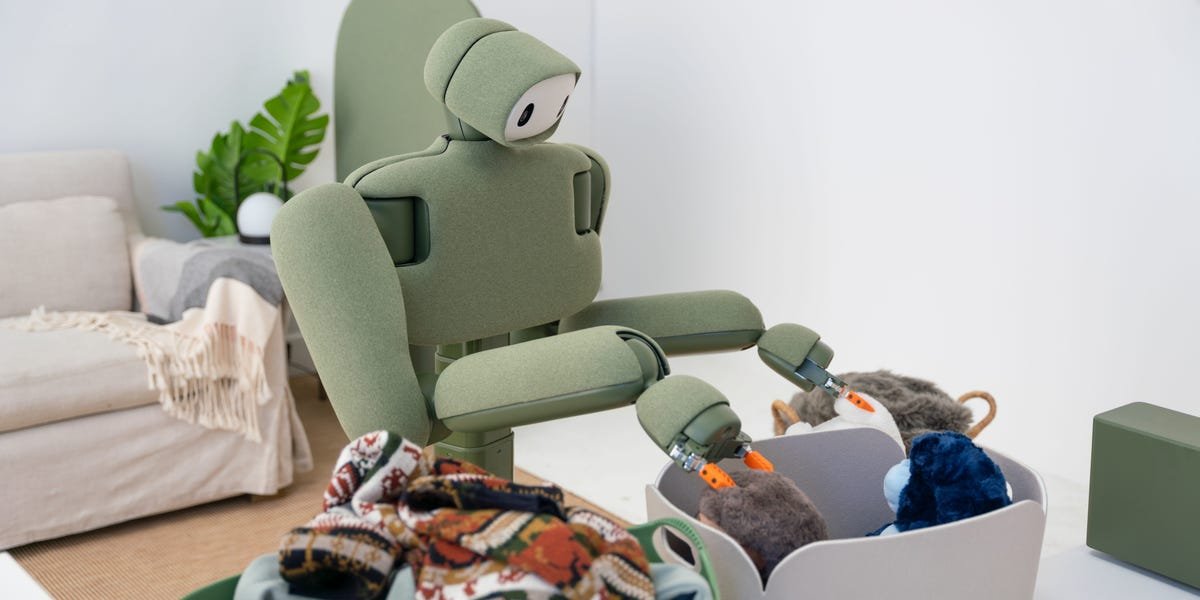
Before Silicon Valley’s robots take over, they have to learn to fold your underwear.
In recent months, some of the buzziest robotics startups — including Figure AI, Sunday Robotics, and Weave Robotics — have shown off robots that autonomously fold clothes. Together, the companies have raised billions of dollars at lofty valuations, as investors bet that home robots are finally nearing a commercial breakthrough.
We were promised robot butlers. For now, Silicon Valley would like to help you match your socks.
Home robotics companies are focusing on laundry because it’s an ideal first task. It is difficult enough to showcase a machine’s intelligence and physical control, and safe enough that failure carries few consequences, roboticists say. It is also a chore almost everyone does, and few enjoy. Consumers don’t need to know how AI works to appreciate a robot that turns a crumpled pile of clothes into a neat stack.
Teaching a robot to fold clothing has long been a “holy grail” of the field, said roboticist and Spelman College president Ayanna Howard. That’s because robots must learn to handle “deformable objects” — clothes that bunch, fold, and wrinkle — and manipulate them with enough precision to fold them well.
Weave Robotics
“This is one of the most challenging dexterous manipulation tasks for a humanoid robot,” Figure wrote in a blog post last year. Sunday CEO Tony Zhao told Business Insider that the company chose laundry partly because it “looks for hard things to do.”
Yet when a robot fails, the stakes are low.
“If you drop a piece of clothing, it’s not going to break,” Howard said.
The robotics industry has been through laundry hype cycles before. The Japanese company behind the $16,000 laundry-folding robot, Laundroid, filed for bankruptcy in 2019, and FoldiMate made repeated splashes at the Consumer Electronics Show in the late 2010s but never shipped a product.
High costs and poor reliability undid those earlier efforts. Today’s startups say that advances in AI, cheaper hardware, and a flood of talent and capital into physical AI will make this generation different — and capable of doing far more than laundry.
“For the longest time, the technology just wasn’t there,” Weave Robotics CEO Kaan Dogrusoz told Business Insider. “But then, everything changed.”
Whether that’s true is about to be tested outside the lab. The latest robots are expensive, and their reliability in real homes remains unknown because few have been deployed. While this generation can fold laundry much faster than its predecessors, a single item can still take minutes to fold, and unfamiliar clothing can leave the machines stumped.
Sunday plans to place its robot in homes through a beta program this fall. Weave and 1X expect to begin delivering robots to customers later this year.
Why laundry is a gateway into the home
Robotics companies are starting with laundry because it’s a bounded task inside the home, a tough environment for robots to navigate.
“The home is the ultimate unstructured environment,” said Matei Ciocarlie, a mechanical engineering professor at Columbia University who works on robotics.
Most robots operate in controlled environments such as factories and warehouses, where their surroundings and movements can be tightly defined. They are often separated from people for safety.
The home, by comparison, is a hellscape for robots. Every room is an obstacle course. Pets dart underfoot, and toddlers crawl across the floor, threatening to send machines into a faceplant.
Sunday Robotics
When folding laundry, a robot can stay in one corner while a hamper of clothes is brought to it, rather than having to navigate the entire house. Dogrusoz cited this as the reason Weave chose laundry as the first task.
“It’s an attempt to put bounds on the craziness,” Ciocarlie said.
What comes after laundry?
Teaching a robot to fold laundry is one thing. Convincing people to pay thousands of dollars for it is another.
Weave’s Isaac, for instance, costs $8,000 upfront, or $449 a month through a subscription. For most households, it would likely be cheaper to outsource the chore to a laundromat or a person. Or, as Howard put it: “That’s what kids are for.”
For these robots to make economic sense, they need to do far more than fold clothes.
Sunday’s AI system, for instance, is learning chores including vacuuming, organizing toys, fastening zippers, and making coffee. 1X is marketing its humanoid robot NEO as a personal housekeeper capable of folding laundry, organizing shelves, and tidying rooms. Weave declined to say which task it is tackling next.
Camille Cohen for The Washington Post via Getty Images
Howard said consumers are unlikely to seriously consider buying a home robot until it can perform enough useful tasks to justify its price, like heating dinner before its owner gets home, mowing the lawn, or cleaning the pool. The challenge will be building a single robot that can do all of these things.
Jason Corso, a robotics professor at the University of Michigan, said companies are “stuck in an appliance mindset,” building robots around individual chores rather than machines that can understand context and adapt to people’s needs.
For many of these companies, getting robots into homes to fold laundry is also the start of what they hope will become an expanding data flywheel. Robotics startups are scrambling for real-world data needed to train the “brains” of their machines. While large language models are trained on internet data, there is no comparable dataset for the physical world. Sunday, for example, trains its AI models on people doing everyday tasks in $200 sensor-equipped gloves that mirror its robots’ hands.
The most valuable data — the kind that could help companies truly master laundry and expand into other tasks — may come from the robots themselves as they encounter the countless edge cases of real homes.
A truly general-purpose home robot — the robot butler Silicon Valley has long promised — is still many years away, Corso said.
Have a tip? Contact Rya Jetha via email at rjetha@businessinsider.com or Signal at rjetha.07. Use a personal email address and a nonwork device; here’s our guide to sharing information securely.
