


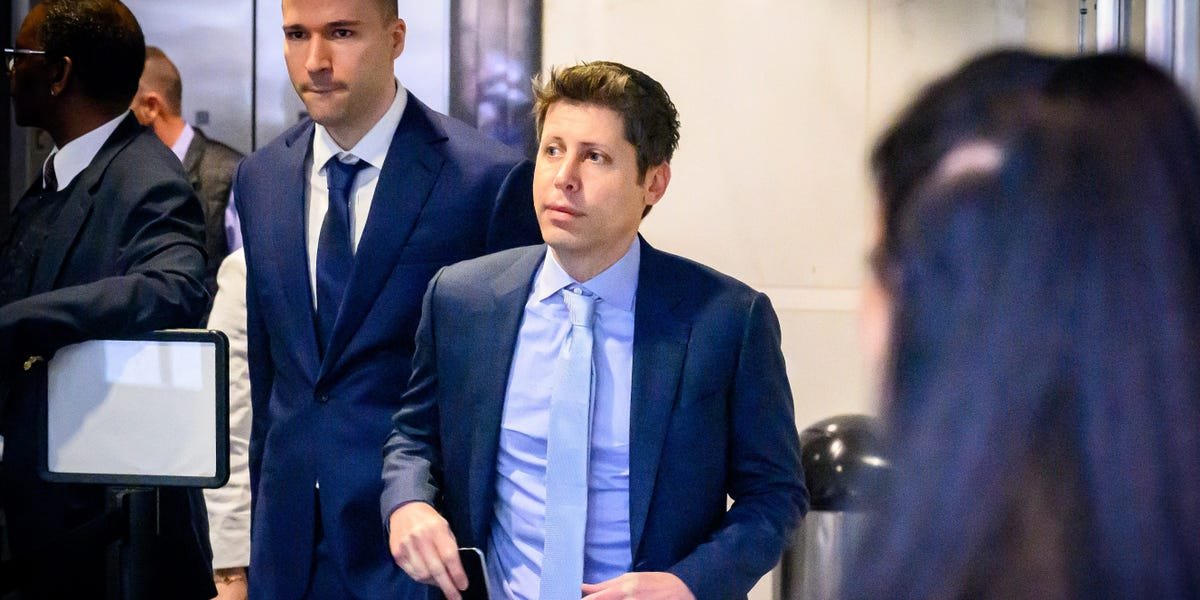
OpenAI CEO Sam Altman testified Tuesday that Elon Musk wanted “total control” of the ChatGPT maker — even suggesting that the AI startup be passed on to his children after he died.
Loading audio narration…
Addressing jurors in his high-stakes legal battle with Musk, Altman recalled a “particularly hair-raising moment” from nearly a decade ago, when Musk was still helping run OpenAI and was demanding “total control.”
Altman testified that as the AI company’s cofounders debated Musk’s demand for a controlling stake, someone asked Musk, “If you have control, what happens when you die?”
Musk responded, according to Altman, “I haven’t thought about it a ton, but, you know, maybe it should just, the control should pass to my children.”
Altman told the nine-person jury that he “didn’t feel comfortable” with that plan.
The CEO’s account of Musk’s hereditary musings came as Musk v Altman continued its third week in a federal courtroom in Oakland, California.
Musk has taken OpenAI and Microsoft to court in hopes of proving that their partnership is a betrayal of the AI company’s nonprofit origins. In Tuesday’s testimony, Altman, a named defendant in the case, attacked Musk as an eager pursuer of both profit and power.
Altman told the jury that Musk “felt very strongly that if we were going to form a for-profit, he needed to have total control over it initially.”
“This was because he thought he only trusted himself to make non-obvious decisions,” Altman said, adding that he heard from Musk or Musk’s former chief of staff that the Tesla CEO had decided that for the rest of his career, he was “only going to work on companies that he could control.”
Altman said he was against one person having control of OpenAI.
“Part of the reason that we started OpenAI was that we did not think AGI should be under the control of any one person, no matter how good their intentions are,” Altman said.
He told the jury that Musk said he would “give up control later,” but Altman was unconvinced.
“I had quite a lot of experience with startups, and I had seen a lot of control fights, and I had learned that, especially when a company was going well, the founders or people who had control did not usually give it up,” Altman testified, explaining, “they could have this control forever.”
SpaceX, Musk’s rocket company, is an example of one of these “founder-controlled tech companies,” Altman said.
When asked about Musk wanting to absorb OpenAI into Tesla, Altman was dismissive. “Tesla is a car company,” Altman said. “And it does not have the mission of OpenAI.”
Altman’s testimony marked a pivotal moment in the civil trial over the company the pair founded together in 2015.
Musk, who testified in the trial last month as the first witness, accused Altman and other OpenAI executives of stealing the “charity” they started.
“Essentially, they’re trying to steal a charity, and we’re trying to stop them,” Musk told the jury.
On Tuesday, when his lawyer directly asked “Did you steal a charity?” Altman clapped back. “It feels difficult to even wrap my head around that framing,” he responded.
Musk, who left the firm in 2018, has alleged that he poured tens of millions into OpenAI to support its founding mission as a nonprofit dedicated to developing AI for the public’s benefit, only for that mission to later be, in part, abandoned through the firm’s partnership with Microsoft, also named as a defendant in his lawsuit.
The outcome of the trial, now in its third week, could reshape the artificial intelligence landscape and cost OpenAI and its backer, Microsoft, billions in damages if Musk prevails.
Altman’s testimony follows a roster of other tech heavyweights — including OpenAI president and cofounder Greg Brockman and Microsoft CEO Satya Nadella — who have already testified before the Oakland jury.
In an X post ahead of jury selection in the case, OpenAI said Musk’s case “has always been a baseless and jealous bid to derail a competitor.”
