


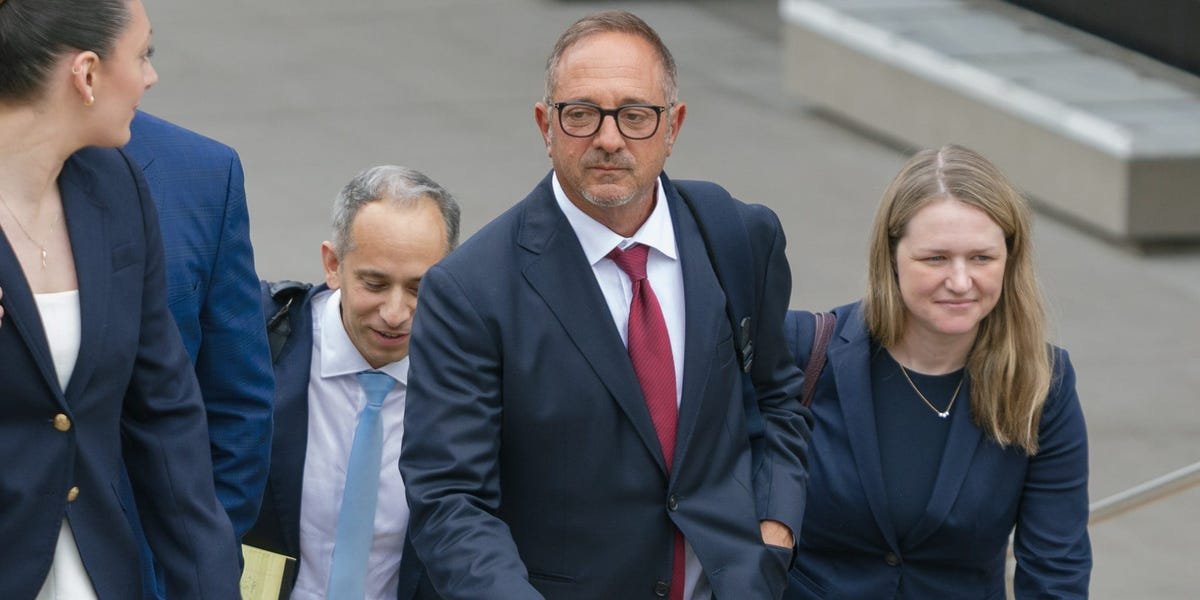
Short-seller Andrew Left defied conventional wisdom to take the stand and testify in his own defense at his securities fraud trial this week. On Wednesday, he faced hours of cross-examination by a prosecutor — and it turned testy at times.
A federal judge had to direct Left to answer questions at least a half-dozen times, and also scolded the government’s lawyer for editorializing as the closely watched case entered its final days.
Left, the founder of the influential Citron Research, is accused of manipulating the market by putting out reports on companies that moved the stock — and then making his own trades that did not align with his public posts.
Assistant US Attorney Ben Balding focused heavily on a Citron Research report titled “The Educational Enron” about Grand Canyon Education and repeatedly questioned Left on whether he ignored information contained in an 800+ page freedom of information document and financial disclosures.
REUTERS/Brendan McDermid
Balding also grilled Left at length about his relationship with researcher Adam Ramada, who helped prepare the report, and introduced a 2023 deposition in which he called Ramada “very volatile” and “not my type of researcher.”
Left made $2.5 million by selling the stock after the report. He told Ramada he was “going to make a lot of money” off the stock. But Ramada said in a message that he lost $2 million by holding it. “My fund got annihilated because of this move,” he wrote.
The prosecution questioned Left about his communications with Ramada about Harvey Pitt, the FEC chairman during the Enron scandal. Balding asked if Left was trying to get Pitt to sign off on the report to help tank the stock.
Left said he knew Pitt’s reputation and that it “would be quite foolish if I was committing a fraud to email or invite Harvey Pitt into my process.”
Citron’s juicy Tweets
Left is one of the best-known activist short-sellers in the country. A frequent guest on TV financial news shows, he has more than 300,000 followers on Citron Research’s X account. His trial has drawn extra attention because the outcome could affect what short-sellers can say about the companies they trade.
To drive home the point that Left is influential enough to move markets, prosecutors introduced messages and an investor report in which he touted himself as a man who could “send a stock tumbling” — a phrase taken from a Business Insider headline. Left responded, “the media has wonderful ways of getting clicks.”
Prosecutors argued that Left timed tweets and reports to deploy during market hours to provoke emotional reactions and drive rapid price swings, profiting before investors fully absorbed the reports. They said text messages from Left, like “What can I put in a tweet to juice it?” revealed intent to move stocks, insinuating that he changed his positions to capitalize on stocks like Tesla.
Noting that Left publicly turned bullish on Tesla after previously criticizing the company, Balding said Left gave “Mr. Musk a bro hug” with a tweet saying “Citron is LONG Tesla for this quarter.” He argued that Left knew a reversal would attract attention due to his reputation as a famous short-seller, and showed that Left closed his Tesla position within roughly an hour of the bullish tweet.
A government exhibit showed Left saying in a text, “The benefit of doing a victory lap is you can make a short-term trade the other way,” and Left testified that traders constantly reevaluate positions.
In his time on the stand, Left has maintained that he believed everything he put out publicly to be true at the time, did not try to mislead anyone, and timed his own trades to make money — as any short-seller would.
He said his reports and posts were intended to warn people about companies.
“As long as your information is right and you put out something intellectually honest,” he said on Wednesday. “I don’t target investors.”
The jury is expected to begin deliberations on Thursday. The top charge Left faces carries a maximum of 25 years in prison.
