


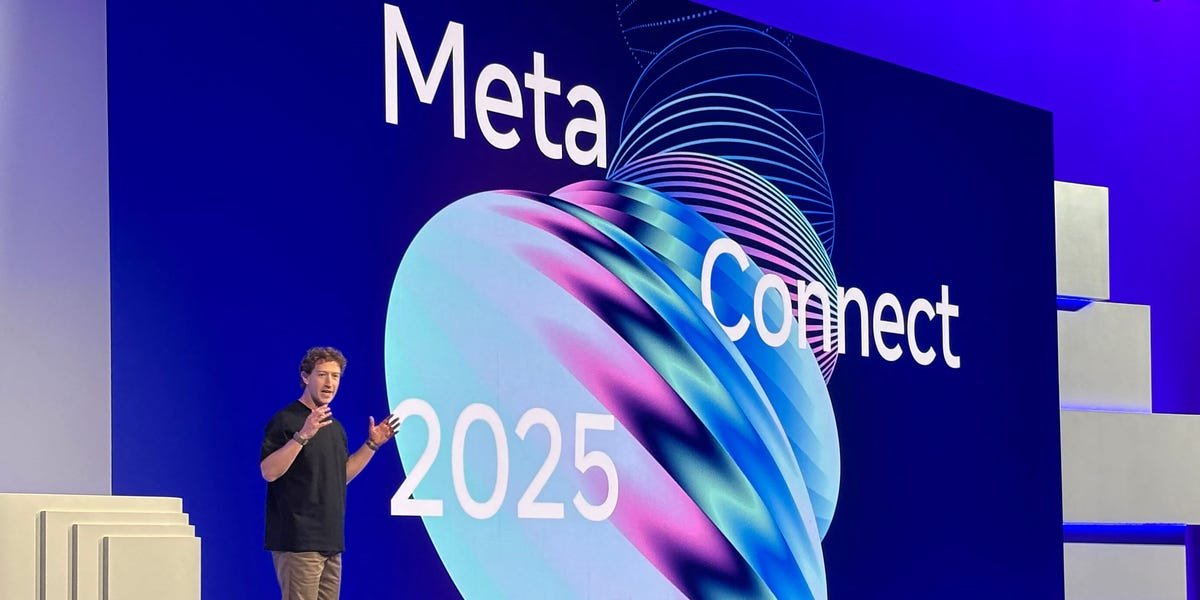
Mark Zuckerberg is spending billions on AI, but at Meta’s conference, Connect, the spotlight stayed on hardware. The social media company’s new $800 Ray-Ban smart glasses got a flashy debut, while its much-buzzed-about AI Superintelligence push was seemingly in the background.
Meta’s new glasses come with a built-in screen that can display text messages, maps, and captions over the real world. What was harder to spot were the big leaps in AI that are supposed to superpower these gadgets.
The only real nods to AI in the presentation at Connect were quick — and a little shaky. Zuckerberg attempted to demo LiveAI, a hands-free mode that turns the glasses into a real-time conversational assistant, using the camera and mic to see and hear your surroundings and offer instant advice.
The demo sputtered, with Zuckerberg blaming the venue’s WiFi. Later, he showed off a new metaverse feature that lets users type in simple text prompts to conjure up sprawling 3D worlds inside Meta’s Quest virtual reality headsets.
This year’s conference came just months after Meta slammed the reset button on its entire AI strategy. At the end of June, Zuckerberg announced a new “Superintelligence” division to build advanced systems that, in the company’s words, would let people spend “more time creating and connecting,” and has invested in nine-figure salary talent packages to power the group.
To run it, Meta tapped Scale AI’s Alexandr Wang, paying more than $14 billion for nearly half of his company, and spending millions of dollars to scoop up talent from rivals. The company said that it also expects to spend up to $72 billion on AI infrastructure this year alone. So it’s fair to ask: where’s the payoff?
Perhaps it’s just too soon to expect fireworks. Meta only stood up its Superintelligence unit this summer, and even its new boss admits that the pace has been breakneck.
Related stories

Business Insider tells the innovative stories you want to know
Business Insider tells the innovative stories you want to know
“Building an AI lab in 60 days flat is kind of incredible,” Wang said on the TBPN podcast on Wednesday, shortly after the conference ended. In other words, the money has been spent, the talent has been hired, but it may take time before Meta’s big bet turns into demos that work on stage.
Zuckerberg seems to have an idea of where this is going in the future. “Glasses are the ideal form factor for personal superintelligence,” he declared on stage.
“It’s the only device where you can basically let an AI see what you see, hear what you hear, talk to you throughout the day, and then once you get the display, it can just generate a UI in the display for you,” he told journalist Alex Heath in an interview.
All the action right now, however, is happening behind the scenes. In August, Wang sent a memo to employees announcing the biggest AI reorganization in Meta’s history, dissolving a major AI unit working on Artificial General Intelligence, and reshuffling staff into four new teams: research, products, training, and infrastructure.
Nearly every leader now reports directly to Wang, including former GitHub CEO Nat Friedman. Meanwhile, FAIR, Meta’s blue-chip research arm, has been pulled into MSL’s orbit. Even Yann LeCun, Meta’s chief AI scientist, now reports to Wang.
The new leader is also building an elite new lab called TBD, in charge of developing entirely new AI models. In a memo, Wang acknowledged the shake-up would be “disruptive,” but insisted it was necessary to move faster.
You can buy Meta’s new glasses in just a couple of weeks, but the company won’t have the field to itself for very long. Google is working on its own AI-powered glasses with a built-in display, although it’s not clear when they will be released.
OpenAI, meanwhile, is working with former Apple design chief Jony Ive on a pocket-sized AI “companion” device. Meta’s other social media rival, Snap, plans to roll out holographic AR glasses next year, and even Amazon is in the mix with eyewear that already handles calls and music.
A ton of money is on the line. The only question is: when will Meta show something worth the AI-powered hype?
Have a tip? Contact Pranav Dixit via email at pranavdixit@protonmail.com or Signal at 1-408-905-9124. Use a personal email address, a nonwork WiFi network, and a nonwork device; here’s our guide to sharing information securely.
