


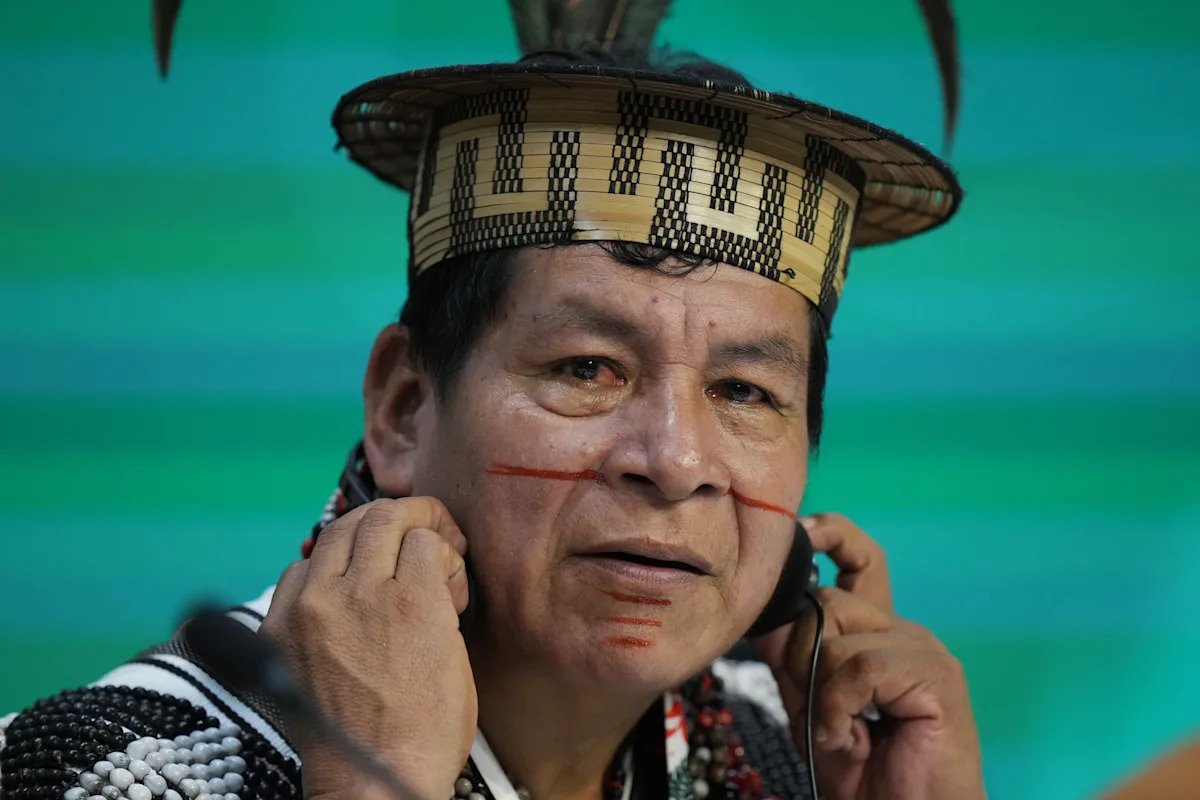
BELEM, Brazil (AP) — Indigenous people are used to adapting, so when the power failed at their kickoff event at this year’s United Nations climate talks, they rolled with it. Participants from around the world sweated through song, dance and prayers, improvising without microphones and cooling themselves with fans made of paper or leaves.
But the ill-timed blackout fed an undercurrent of skepticism that this year’s summit — dubbed “the Indigenous peoples COP” — will deliver on organizers’ promise to put them front and center at the event on the edge of the Amazon rainforest where many Indigenous groups live.
Indigenous peoples safeguard much of the world’s biodiversity and are among those who contribute the least to climate change, yet they’re disproportionately harmed by the devastation it causes.
“We’re working within a mechanism and we’re working within an institution that we know wasn’t built for us,” said Thalia Yarina Cachimuel, a Kichwa-Otavalo member of A Wisdom Keepers Delegation, a global group of Indigenous people from around the world. ”We have to work 10 times harder to ensure that our voices are a part of the space.”
This year’s climate talks, which run through Nov. 21, aren’t expected to produce an ambitious new deal. Instead, organizers and analysts frame this year’s conference as the “implementation COP,” aimed at executing on past promises.
A conference that’s not easy to attend
The climate talks — known as Conference of the Parties, or COP30 for this year’s edition — have long left Indigenous people out or relegated them to the sidelines.
Many aren’t represented robustly in the governments that often violently colonized their people. Others encounter language barriers or travel difficulties that keep them from reaching conferences like COP30.
The Brazilian government said hosting this year’s summit in Belem was partly an homage to the Indigenous groups skilled at living sustainably in the Earth’s wild spaces.
But Indigenous groups, as with other activists, aren’t traditionally included in climate negotiations unless individual members are part of a country’s delegation. Brazil has included them and urges other nations to do the same. It was not immediately clear how many have done so in Belem.
But there’s a big difference between visible and being included in the heart of negotiations, Cachimuel said.
“Sometimes that’s where the gap is, right? Like who gets to go to the high-level climate, who gets to go to the high-level dialogues, you know, who are the people that are meeting with states and governments,” she said.
She worried that the inclusion effort won’t continue at future COPs.
Edson Krenak, of the Krenak people and Brazil manager for Indigenous rights group Cultural Survival, said he has seen less participation from Indigenous people than he expected. He attributed that partly to the difficulty of finding space to stay in Belem, a small city that struggled to quickly expand lodging options for COP30.
He said it’s frustrating when Indigenous people aren’t involved from the beginning in developing policies but are expected to comply with them.
“We want to design these policies, we want to be involved in really dreaming solutions,” Krenak said.
Still, the fact that this COP is in the Amazon “makes Indigenous peoples the host,” said Alana Manchineri, who works with COIAB, an organization of Indigenous people of the Amazon basin like herself.
Fighting to make voices heard
At the opening of the Indigenous People’s Pavilion, the lack of power wasn’t the only issue. Presenters made do without an official translator.
One presenter, Wis-waa-cha, of Coast Salish and Nuu-Chah-Nulth lands, said lack of attention to such details can make people feel “continually dismissed through very passive ways.”
The office of Brazil’s presidency didn’t immediately respond to a question about why no translator was available for the event. It said they worked to fix the power outage as quickly as possible.
World leaders should focus on directly financing the communities that need support, said Lucas Che Ical, who was representing Ak’Tenamit, an organization that supports education, climate change and health initiatives in Indigenous and rural villages in Guatemala.
He knows that often at past COPs, the agreements reached don’t directly have a positive impact on the lives of Indigenous peoples. He hopes it’s different this year.
“I’m an optimistic person,” he said, speaking in Spanish. “There is a perspective that yes, it could give good results and that the governments that are deciding could make a favorable decision.”
Above all, he said he hopes that decision makers at this COP “can listen to the voices of Indigenous villages, local communities and all the villages of the world, where they live in poverty and who are part of the impacts of climate change.”
___
Follow Melina Walling on X @MelinaWalling and Bluesky @melinawalling.bsky.social.
___
The Associated Press’ climate and environmental coverage receives financial support from multiple private foundations. AP is solely responsible for all content. Find AP’s standards for working with philanthropies, a list of supporters and funded coverage areas at AP.org.
