


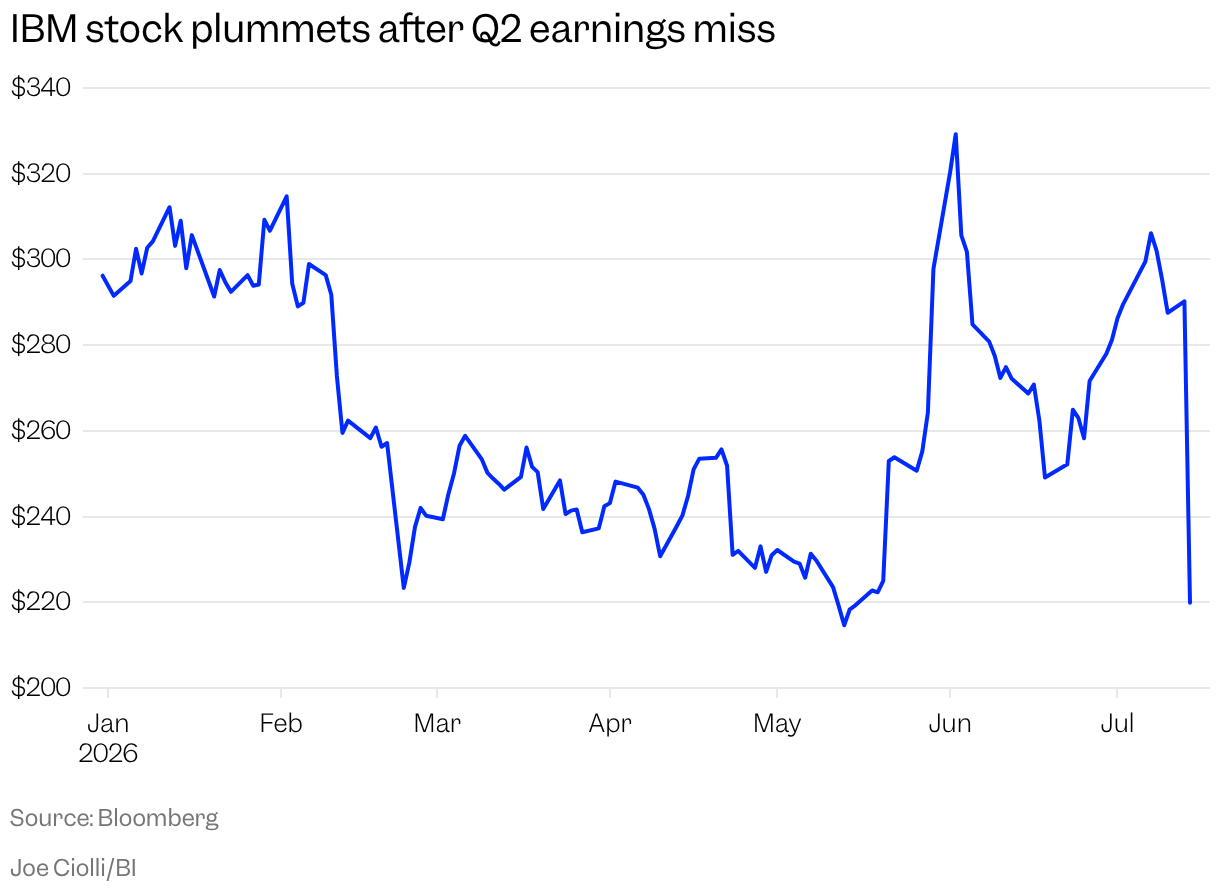
IBM shares tanked on Tuesday and were headed for their worst day ever after the tech giant reported preliminary second-quarter earnings that were much lower than expected.
The company’s stock fell 25%, hitting a low of $215.34 after closing Monday’s session at $290.23.
The company released its results showing the earnings miss ahead of schedule. The precipitous drop in IBM’s stock came after it warned of a second-quarter “shortfall” in the performance of its software and infrastructure division, linked to the rollout of its new z17 mainframes, which are designed to process AI workloads.
IBM CEO Arvind Krishna said that a major factor in the lower-than-expected performance was clients cutting spending on IBM products and reprioritizing their capex spend on “servers, storage, and memory purchases” ahead of “expected price increases.”
The prospect of further price rises appears to have prompted IBM’s clients to prioritize hardware procurement over the software and mainframe purchases the company had anticipated.
Krishna said in his letter to investors that while IBM had expected some changes in clients’ spending patterns, the company “did not anticipate the magnitude of the capex reprioritization.”
“This quarter we faltered,” Krishna said in a letter to investors released Tuesday. “We did not adapt and move quickly enough, and numerous large deals failed to close on the timelines we expected, driving the majority of our shortfall.”
Software stocks falter on spending fears
IBM’s warning and its sharp share price drop spread to other software providers, with Salesforce 4% and Microsoft dropping almost 3%. The IGV tech software ETF, which tracks a broad basket of software companies, was 2% lower.
What is driving software stocks lower is a change in spending patterns triggered by a global shortage of memory chips that has driven up hardware prices since late 2025.
Memory giants like Samsung, SK Hynix, and Micron have shifted production toward the specialized chips that power AI data centers, and that capacity is effectively sold out for 2026 under long-term contracts. The result is a squeeze on the everyday memory used by servers, PCs, and phones.
Micron’s CEO has said he expects “tight conditions to persist beyond calendar 2027 as a result of AI-driven demand across all segments coupled with structural supply constraints.”
IBM reported revenues of $17.2 billion across the company in the second quarter, up 1%, but behind analyst expectations. Revenues in the infrastructure division were down 7%.
