


A pizza box can feel like a recycling pop quiz. It’s cardboard, but there’s also the greasy bottom and cheese residue. Should the box go into the blue recycling bin or into the trash?
Loading audio narration…
The wrong decision may seem like a harmless toss, but it can have serious consequences — ones that technologists are hoping artificial intelligence can remedy.
Recycling facilities, or materials recovery facilities, sort and process recyclable materials such as plastic, glass, and paper, which are then sold to manufacturers to create new products.
However, if an unrecyclable item, like the grease-soaked pizza box, gets mixed in with the other valuable materials, the whole batch can be rejected and sent to a landfill. Large landfills threaten the environment and human health, and the US is among the world’s largest per-person generators of waste.
At Stony Brook University, researchers are exploring AI as part of the solution by developing an AI-assisted system to analyze and characterize municipal solid waste with far greater speed and scale than traditional methods.
Stony Brook’s project reflects a broader national trend, as scientists and engineers across the country increasingly place AI at the center of efforts to streamline recycling programs and build more efficient, effective waste management and sorting systems.
Training AI to sort trash smarter
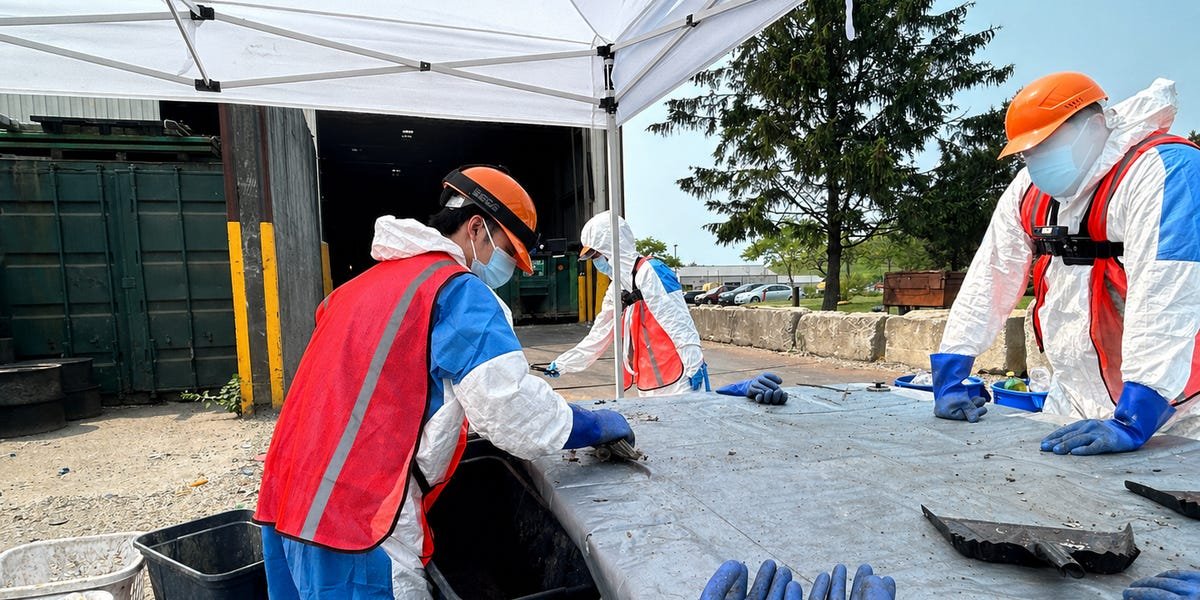
The Stony Brook project officially kicked off in January 2025. As part of her preliminary work, Ruwen Qin, an associate professor and the project’s principal investigator, visited material recovery facilities on Long Island and spoke with staff about the challenges they face and the solutions they are interested in. “Without the collaboration from local facilities, it is impossible to conduct this type of research, because that data is essential for developing artificial intelligence algorithms,” she said.
During these site visits, Qin and her team used low-cost cameras, such as GoPros, to capture video and audio. Qin said this data was used to guide the development of the AI model.
Subsequently, the Stony Brook AI model was trained to identify paper, plastics, food waste, and fabrics and automatically estimate their quantities. The work is supported by the Stony Brook University AI Innovation Seed Grant; after receiving the grant, Qin was able to involve graduate students in the research. Qin has also closely collaborated with the university’s Waste Data and Analysis Center throughout the initiative.
“A very important task is to sample and sort the waste and try to determine what materials are in the waste stream and what the quantity is,” Qin told Business Insider. “As we train the algorithm, we can analyze samples in large quantities more efficiently than a human being.”
This process of identifying, separating, and analyzing components of a waste stream is known as characterization. It’s time-consuming and detail-oriented work. But Qin said AI can ideally expedite the process. AI models, like the one she’s developing, can pinpoint whether something unrecyclable has been mistakenly mixed with other recyclable products and prevent it from being rejected and sent to landfills.
While the project is in its early stages, Qin said her short-term goal is to provide high-quality data to researchers, which she hopes will be used to develop more affordable and accessible open-source models.
Qin added that her team will continue training the model so that it can eventually “identify different waste materials under all conditions.” She also hopes to secure additional funding to transfer the technology into real-world applications, such as material recovery facilities.
In the future, Qin said that she’s interested in merging AI with robotics: the algorithm could instruct robots on what they can and can’t take from the waste stream.
Scaling the tech
AI’s recycling algorithms are starting to trickle into the waste management industry. For example, in Colorado, AMP Robotics has developed an AI-robotics system for the factory line. And Greyparrot, a London-based startup, has an AI sorting system used in more than 20 countries in North America, Europe, and Asia.
Aurora del Carmen Munguía-López, an assistant professor at the University of Buffalo who researches recycling solutions, said when it comes to developing AI-sorting systems, there’s still work to be done. As pilot projects move from different universities into plant facilities, Munguía-López told Business Insider that part of the challenge is determining whether these algorithms can work at the scale required in professional settings.
While AI’s energy-hungry data centers are creating environmental risks, Munguía-López said its overall impact could still be positive if the technology increases recycling rates, reduces reliance on fossil-fuel-based plastic production, and lowers greenhouse gas emissions.
Given the tech’s potential to improve recycling and reduce emissions, Qin wants to ensure that Stony Brook’s AI model is an intellectual product that anyone can use to their advantage. “We want to make the data, the model, and the technology publicly available to benefit society,” she said.
