


The biggest names in AI are expanding their search for workers abroad as the talent war gets tougher.
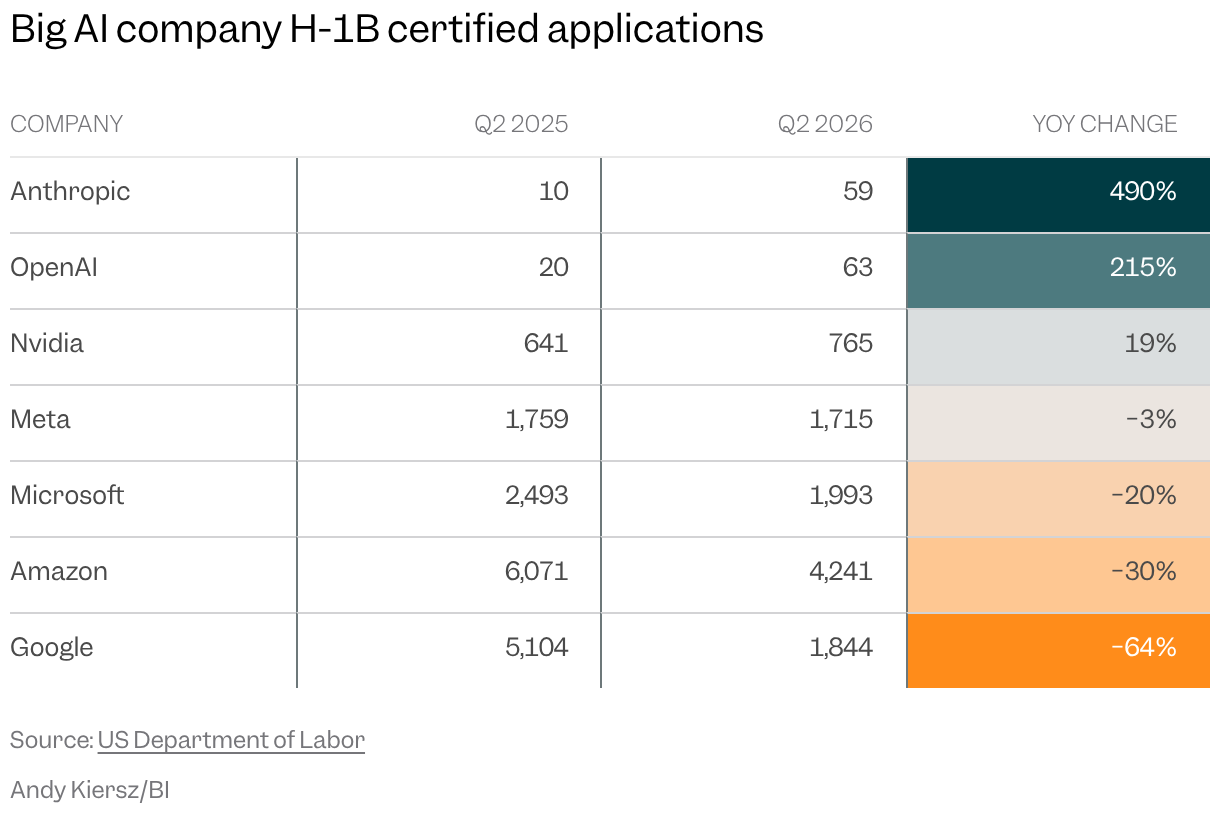
Federal data shows Anthropic, OpenAI, and Nvidia filed more H-1B visa applications for new hires and renewals in the second quarter of fiscal 2026 than they did a year earlier, as other tech giants pulled back from the program.
The split points to a new reality in tech hiring. Companies are cutting jobs while concentrating talent in smaller, more specialized teams — or “pods,” as Meta calls them. They depend on a small pool of highly trained researchers, engineers, and infrastructure talent.
That can make foreign-born workers with specialized skills central to companies’ talent strategies, even as the visa process becomes harder to navigate.
Changes to the work visa program have made the process more costly and uncertain. New rules give applicants a better chance in the visa lottery if their employers plan to pay them higher salaries. The government has also imposed a temporary $100,000 fee on applicants living overseas.
That adds another hurdle at a time when companies across the tech industry are slowing hiring and conducting layoffs, while trying to do more with AI. The biggest AI companies, though, appear to be moving in the other direction.
Department of Labor data shows Anthropic had the biggest year-over-year percentage increase in certified applications among the seven companies reviewed by Business Insider. Its count rose to 59 in Q2 2026, up from 10 in Q2 2025.
OpenAI filed more applications than Anthropic, with 63 in Q2 2026, up from 20 in Q2 2025.
Nvidia saw a smaller year-over-year increase. The number of its certified applications still dwarfs the two model makers. The chipmaker reported 765 in Q2 2026, up from 641 in Q2 2025.
Meanwhile, Business Insider found declines in certified applications at several other tech giants compared with the previous year, including Meta, Microsoft, and Amazon. Google saw a 64% decline, as the company also trims head count through smaller, rolling job cuts targeted at specific teams.
Raghu Shivakumar, a recruiter with Nexocean, said that Anthropic and OpenAI likely seek more foreign workers because they have a “mindset of ‘do whatever it takes'” for hiring.
The $100,000 H-1B visa fee represents “a rounding error against the cost of not landing the right researcher,” he said.
H-1B applications are falling
Overall, US Citizenship and Immigration Services said that it received 211,600 properly submitted applications for the 2027 H-1B allocation, down from 343,981 the year before.
The pressures from visa policy changes help explain why lottery submissions fell this year, said Justin Parsons, a partner at Berry Appleman & Leiden, an influential immigration law firm. Parsons said some employers sat out this year’s lottery while they waited to see how the new rules would play out.
Certified H-1B and similar visa applications are those that the Labor Department has reviewed to ensure that a prospective immigrant worker will be paid similarly to other workers in similar roles, and that the hiring will not negatively affect employment for those workers. The tallies also include extensions of status for existing employees.
The figures only reflect Labor Department certifications. They are not final visa approvals or lottery selections. Multiple filings can correspond to a single worker. And while quarterly numbers offer a snapshot, annual tallies can vary based on hiring cycles and other factors.
The cost of a great tech hire
The push for elite talent is happening as the H-1B lottery tilts toward more experienced workers. Because the new wage-tier system gives higher-paid applicants a better chance, younger workers are at a disadvantage, said Sneha Puri, an economist at the Indeed Hiring Lab.
Companies may be less willing to sponsor a new graduate if they think the chances of securing a winning lottery ticket are slim.
Shivakumar, the recruiter, says he has also seen tech giants grow more comfortable setting up entire teams overseas, especially after the rise of remote work, and he says companies may want to avoid racking up H-1B application costs.
Anthropic, OpenAI, Nvidia, Meta, and Amazon did not respond to email requests for comment. Microsoft and Google declined to comment.
