

Close Menu
  • Home
  • AI
  • Education
  • Entertainment
  • Food Health
  • Health
  • Sports
  • Tech
  • Well Being

Subscribe to Updates

Subscribe to our newsletter and never miss our latest news

Subscribe my Newsletter for New Posts & tips Let's stay updated!

What's Hot

Snap’s Specs Have Arrived With a $2,195 Price Tag

June 16, 2026

Anthropic’s latest feud with the Trump admin may actually help it, sales data suggests

June 16, 2026

Germany’s ZDF Removes Language Tying Elon Musk to Belfast Unrest

June 16, 2026
Facebook X (Twitter) Instagram
  • Home
  • About Us
  • Advertise With Us
  • Contact us
  • DMCA
  • Privacy Policy
  • Terms & Conditions
Facebook X (Twitter) Instagram
IQ Times Media – Smart News for a Smarter YouIQ Times Media – Smart News for a Smarter You
  • Home
  • AI
  • Education
  • Entertainment
  • Food Health
  • Health
  • Sports
  • Tech
  • Well Being
IQ Times Media – Smart News for a Smarter YouIQ Times Media – Smart News for a Smarter You
Home » Flying Taxis Are Racing to Carry Passengers: I’ve Seen All 3 Rivals.
Tech

Flying Taxis Are Racing to Carry Passengers: I’ve Seen All 3 Rivals.

IQ TIMES MEDIABy IQ TIMES MEDIAJune 13, 2026No Comments6 Mins Read
Facebook Twitter Pinterest LinkedIn Tumblr Email
Share
Facebook Twitter LinkedIn Pinterest Email


Three US aerospace startups are in a high-stakes race to bring the “Jetsons'” dream of flying cars to life — and each has a different vision of what that future looks like.

Aerospace companies Joby Aviation, Archer Aviation, and Beta Technologies have spent the past few years showcasing their flying taxi prototypes at industry events around the world. They’re pitching them as an environmentally cleaner, cheaper alternative to helicopters.

I’ve seen all three — either on static display or in flight. I’ve gotten a glimpse of how these vertical takeoff and landing aircraft, or eVTOLs, could be used on a regular commute or skip traffic to the airport.

The wide-winged, trunky aircraft are quieter than fuel-powered planes and helicopters, and they fly surprisingly smoothly. How would they work? Imagine a web of low-altitude air taxi corridors connecting airports, neighboring towns, conferences, and events like the Olympics.

Still, none have been certified by aviation authorities, so they’ll not be regularly carrying passengers just yet. Joby and Archer aim to launch commercial service as soon as this year; Beta’s timeline is several years out. They’re all actively participating in a US Department of Transportation program that would aim to integrate electric air taxis into the national airspace system as quickly as possible.

And each is demonstrating a markedly different approach, with distinct aircraft designs, certification strategies, and business models. Each is publicly traded in the US: Joby had a recent market capitalization of around $9 billion; Archer and Beta are each around $4 billion.

The companies are facing tough sledding so far this year: Their stocks are down between 30% and 40% since January. Wall Street analysts have said investors are shifting their focus away from technological milestones toward proof of certification and commercialization. In other words, they want these things to get off the ground.

Air taxis indeed still face myriad hurdles, including securing those regulatory approvals, raising capital, building out infrastructure, and convincing the public to embrace a new type of aircraft. Affordable fares and vast infrastructure changes are likely to be needed to achieve even a modest future of traveling around a city for errands or work.

Here’s a closer look at how Joby, Archer, and Beta’s futuristic flying taxis compare — and what potential commuters might expect if these aircraft reach commercial service.

Each eVTOL use its rotors differently.

Collage of Joby, Archer, and Beta aircraft.

Joby (top left) and Archer (bottom left) have tiltrotors. Beta’s eVTOL (top and bottom right) has fixed rotors.

Taylor Rains/Business Insider

Joby’s “S4” and Archer’s “Midnight” eVTOLs share a similar design approach, with six tilting rotors mounted above the aircraft that transition to support both vertical and forward flight. Midnight also has six additional fixed lift propellers used only during takeoff and landing.

Beta’s “Alia 250” uses four fixed vertical-lift propellers and a rear pusher propeller for forward flight. None tilt. Clark says the design is simpler with fewer moving parts.

All 3 are building custom engines. Beta’s has the most range.

The eVTOL engine at Beta's assembly plant.

All three companies use proprietary propulsion systems tailored to their aircraft designs.

Taylor Rains/Business Insider

In general, each eVTOL is powered by rechargeable batteries that supply energy to multiple electric motors, with redundancy built in so the aircraft can continue flying safely even if a component fails.

Beta’s Alia 250 has the longest range at about 250 miles per charge and can reach 176 mph. Joby’s aircraft can fly up to about 200 mph over roughly 150 miles, while Archer’s Midnight reaches speeds of around 150 mph with a range of about 100 miles.

The companies have completed public demos.

Joby's eVTOL during a flight demonstration over NYC.

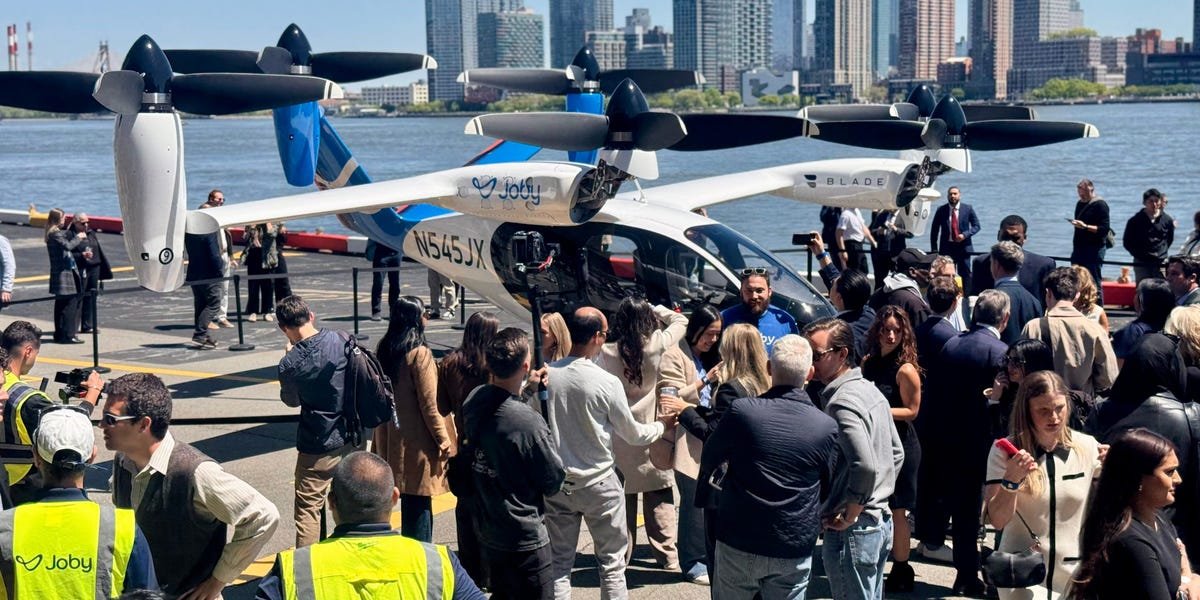
Media watched Joby take off and land its eVTOL at a heliport in Manhattan in April.

Taylor Rains/Business Insider

I recently saw Joby demonstrate a passenger shuttle flight from New York’s JFK to downtown Manhattan. The 10-minute trip was barely audible as it cruised up the Hudson River, only becoming louder on approach to the vertiport.

I also saw Beta’s eVTOL fly over Burlington, Vermont, during a media day in June, showcasing its quiet profile, stability, and vertical flight performance.

Separately, Business Insider’s Lloyd Lee observed Archer and Joby flights over California in October, describing both as little more than a faint hum overhead.

Joby and Archer have fewer passenger seats.

Black Midnight electric air taxi cabin with open doors and passenger seats displayed inside an exhibition hall.

Midnight (pictured) and Joby have two rows of passenger seats behind the pilot. Both air taxis are sleek with a lot of legroom, but they carry one fewer passenger than Beta’s.

Taylor Rains/Business Insider

In theory, more seats help spread operating costs and could translate into lower fares. The startups have said their eVTOLs cost just a few dollars per passenger mile, with Joby and Archer saying their fares would be roughly in line with Uber Black car service.

But the economics remain uncertain, with pilot costs, maintenance, and other operational expenses also factoring into future fares. Even if eVTOL fares are cheaper than helicopter fares, that doesn’t mean they’ll be affordable for the average traveler or convenient for their needs.

Beta has a longer certification timeline.

The cockpit flight display on the CX300.

My view outside Beta’s cTOL during a demo flight. The eVTOL will look basically the same, with its fifth passenger seat up front next to the pilot.

Taylor Rains/Business Insider

The startups aim to begin commercial air taxi flights by the end of the year, though any certification hiccups or delays could push that to 2027.

Beta president and CEO Kyle Clark said the Alia 250 is looking at a few more years. Its slower timeline reflects the company’s stepwise certification approach based on its cTOL, the Alia CX300.

All 3 have secured support from big-name airlines.

Archer route map shows Downtown Skyport connections to several New York area airports and aviation partners.

Archer Aviation’s planned New York air taxi network in partnership with United. This offers an idea of what eVTOL traffic could look like in other major cities, such as Los Angeles and Dubai.

Archer Aviation

In 2021, United Airlines placed a $1 billion order for up to 200 Midnight aircraft. Joby made a $60 million deal with Delta Air Lines in 2022 to operate codeshare airport transfers to the airline’s hubs.

UPS has placed an order for up to 150 of Beta’s eVTOLs. Beta also secured orders from Air New Zealand for its cTOL.

Beta and the airline already demonstrated the Alia CX300’s real-world application, with test pilots flying cargo to a dozen airports across the islands, covering about 7,000 miles.

The ultimate goal is autonomous air taxis.

EHang's eVTOL flying over a city with buildings in the distance.

EHang’s eVTOL is basically a people-sized drone.

Feature China/Future Publishing via Getty Images

Eventually, the US startups hope to create autonomous versions that can fly without a pilot — essentially the Waymo of the skies.

It’s an ambitious long-term goal that raises questions regulators would need to address before approval, including safety, certification, cybersecurity, and public perception. Labor unions are also likely to strongly oppose efforts to allow pilotless passenger aircraft into the national airspace.

Still, China proved it can be possible. In late 2023, the nation certified a fully autonomous two-seater eVTOL from the Guangzhou-based UAM company EHang, which is now being used for sightseeing tours.


Source link

Share. Facebook Twitter Pinterest LinkedIn Tumblr Email
IQ TIMES MEDIA
  • Website

Related Posts

Snap’s Specs Have Arrived With a $2,195 Price Tag

June 16, 2026

Germany’s ZDF Removes Language Tying Elon Musk to Belfast Unrest

June 16, 2026

Meta CTO Andrew Bosworth Addresses Morale After Layoffs, AI Shift

June 16, 2026
Add A Comment
Leave A Reply Cancel Reply

Editors Picks

Education Department loses special ed, civil rights: What we know

June 16, 2026

Trump moves special education out of Education Department

June 16, 2026

White House grants Indiana new flexibility on federal education spending

June 16, 2026

Britain’s Prince George elects to attend Eton, following in footsteps of Prince William

June 16, 2026
Education

Education Department loses special ed, civil rights: What we know

By IQ TIMES MEDIAJune 16, 20260

WASHINGTON (AP) — The Education Department is handing off two of its most important functions,…

Trump moves special education out of Education Department

June 16, 2026

White House grants Indiana new flexibility on federal education spending

June 16, 2026

Britain’s Prince George elects to attend Eton, following in footsteps of Prince William

June 16, 2026
IQ Times Media – Smart News for a Smarter You
Facebook X (Twitter) Instagram Pinterest Vimeo YouTube
  • Home
  • About Us
  • Advertise With Us
  • Contact us
  • DMCA
  • Privacy Policy
  • Terms & Conditions
© 2026 iqtimes. Designed by iqtimes.

Type above and press Enter to search. Press Esc to cancel.