


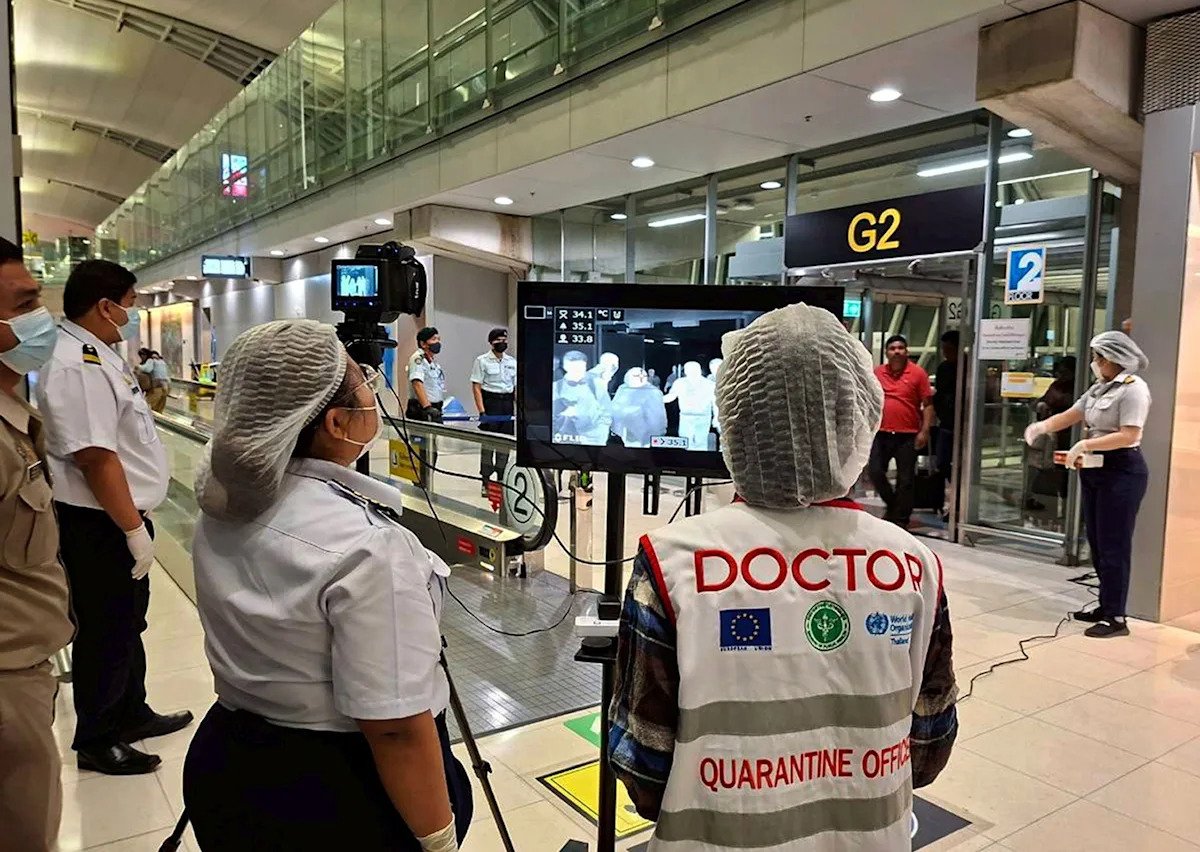
Several countries, including Thailand and Nepal, have increased their surveillance after cases of the deadly Nipah virus were detected in India.
So far, just two cases have been confirmed among 25-year-old nurses, a woman and a man, in West Bengal, according to the World Health Organization.
A spokesperson for the Department of Health and Human Services told ABC News earlier this week that Indian health authorities have deployed an outbreak response team and the Centers for Disease Control and Prevention is in contact with local officials. The CDC said it is “monitoring” the situation.
Despite the virus’s high fatality rate, experts have said it’s very unlikely it will lead to a global emergency.
Here’s what you need to know about the virus, including signs and symptoms, how the virus is transmitted and what treatments are available.

The Suvarnabhumi Airport Office via EPA via Shutterstock – PHOTO: A handout photo released by Suvarnabhumi Airport shows Thai health officials wearing protective masks monitoring passengers from international flights arriving at Suvarnabhumi Airport, Samut Prakan province, Thailand, Jan. 25, 2026.
What is Nipah virus?
Nipah virus is a type of zoonotic disease, meaning it’s primarily found in animals and can spread between animals and people.
It was first discovered in 1999 after a disease affected both pigs and people in Malaysia and Singapore, according to the CDC.
The virus is most often spread by fruit bats, and can spread through direct or indirect contact.
The virus can also spread from person to person by being in close contact or coming into contact with the bodily fluids of an infected person.
What are the symptoms?
Symptoms typically occur between four and 14 days after exposure. The most common symptom is fever followed by headache, cough, sore throat, difficulty breathing and vomiting.
Diagnosing the virus in the early stages is often difficult because the symptoms resemble many other illnesses, the CDC has said.
The virus can lead to severe symptoms, including disorientation, drowsiness, seizures or encephalitis, which is inflammation of the brain. These can progress to a coma within 24 to 48 hours, according to the CDC.
New York confirms 1st locally acquired case of chikungunya virus in 6 years in US
Deaths range anywhere between 40% and 75% among all cases, the federal health agency said. Some permanent changes among survivors have been noted, including persistent convulsions.
What are the treatments available?
Currently there are no specific treatments available for Nipah virus other than managing symptoms with supportive care, including rest and fluids.
Experts said there are treatments currently under development. One is a monoclonal antibody, a treatment that uses immune system proteins manufactured in a lab. They mimic the antibodies the body naturally creates when fighting the virus.
Dr. Diana Finkel, an associate professor of medicine in the division of infectious disease at Rutgers New Jersey Medical School, previously told ABC News that the drug has already completed phase I clinical trials and is currently being used on a compassionate basis.
Researchers are also studying the potential benefit of remdesivir — the intravenous medication used to treat COVID-19 — which has been shown to work well in nonhuman primates with Nipah virus.

Kateryna Kon/Science Photo Library/Getty Images – PHOTO: Nipah virus particles, illustration
What is the likelihood of Nipah virus spreading?
Experts said that while anything is possible, it’s very unlikely that cases in India will lead to global spread.
“The world is small, but the likelihood that somebody’s infected, or an infected fruit bat with Nipah virus would be here, right now, is very unlikely,” Finkel previously told ABC News.
She said when people are exposed in health care settings, it’s often because proper standard precautions were not followed, such as not wearing gloves or masks.
CDC says it is monitoring mysterious deadly disease in Congo
Experts have said Nipah virus cases are also a reminder of the potentially devastating effects of habitat destruction and climate change, possibly leading to more interaction between infected animals and humans.
“You have to think about why are fruit bats that harbor this Nipah virus, why are they coming into contact with people?” Dr. Peter Rabinowitz, director of the University of Washington Center for One Health Research, previously told ABC News. “What is changing in terms of the movement of the bat populations? Are they leaving [a] habitat where there were not very many people? Are they now spending more time close to people?”
ABC News’ Youri Benadjaoud contributed to this report.
