

Close Menu
  • Home
  • AI
  • Education
  • Entertainment
  • Food Health
  • Health
  • Sports
  • Tech
  • Well Being

Subscribe to Updates

Subscribe to our newsletter and never miss our latest news

Subscribe my Newsletter for New Posts & tips Let's stay updated!

What's Hot

Google Employees Call on CEO to Block Classified Military AI Projects

April 27, 2026

OpenAI ends Microsoft legal peril over its $50B Amazon deal

April 27, 2026

DeepMind’s David Silver just raised $1.1B to build an AI that learns without human data

April 27, 2026
Facebook X (Twitter) Instagram
  • Home
  • About Us
  • Advertise With Us
  • Contact us
  • DMCA
  • Privacy Policy
  • Terms & Conditions
Facebook X (Twitter) Instagram
IQ Times Media – Smart News for a Smarter YouIQ Times Media – Smart News for a Smarter You
  • Home
  • AI
  • Education
  • Entertainment
  • Food Health
  • Health
  • Sports
  • Tech
  • Well Being
IQ Times Media – Smart News for a Smarter YouIQ Times Media – Smart News for a Smarter You
Home » Digital reconstruction unveils face of ancient Pompeii victim using AI
Education

Digital reconstruction unveils face of ancient Pompeii victim using AI

IQ TIMES MEDIABy IQ TIMES MEDIAApril 27, 2026No Comments3 Mins Read
Facebook Twitter Pinterest LinkedIn Tumblr Email
Share
Facebook Twitter LinkedIn Pinterest Email


ROME (AP) — Archaeologists and researchers at the ancient Roman site of Pompeii have used artificial intelligence for the first time to digitally reconstruct the face of one of the victims of the AD 79 eruption of Mount Vesuvius that smothered the city, offering a new way to understand one of history’s most famous natural disasters.

The digital portrait represents a man who was among two victims discovered as they attempted to flee the city toward the coast of what is now Italy during the volcanic eruption. Researchers believe the man died early in the disaster, during a heavy fall of volcanic debris.

The reconstruction was developed by the Pompeii Archaeological Park, which announced on its website that it was done in collaboration with the University of Padua and based on archaeological survey data from excavations near the Porta Stabia necropolis, just outside the walls of the ancient city.

The announcement shows the AI-generated illustration of what the man could have looked like. He is shown running along a rough, debris-covered road, holding a large, shallow bowl over his head and using it as a shield while Mount Vesuvius is seen erupting in the background.

FILE -People visit the archaeological site of Pompeii, near Naples, southern Italy,Tuesday, May 26, 2020. (AP Photo/Alessandra Tarantino, File)

This image from video by the United States Geological Survey shows lava erupting from Kilauea volcano on Tuesday, March 10, 2026, in Hawaii Volcanoes National Park, Hawaii. (USGS via AP)

Pompeii, a UNESCO World Heritage site near Naples, was buried under ash and pumice when the Vesuvius erupted nearly 2,000 years ago, preserving the city and the remains of thousands of its inhabitants in remarkable detail.

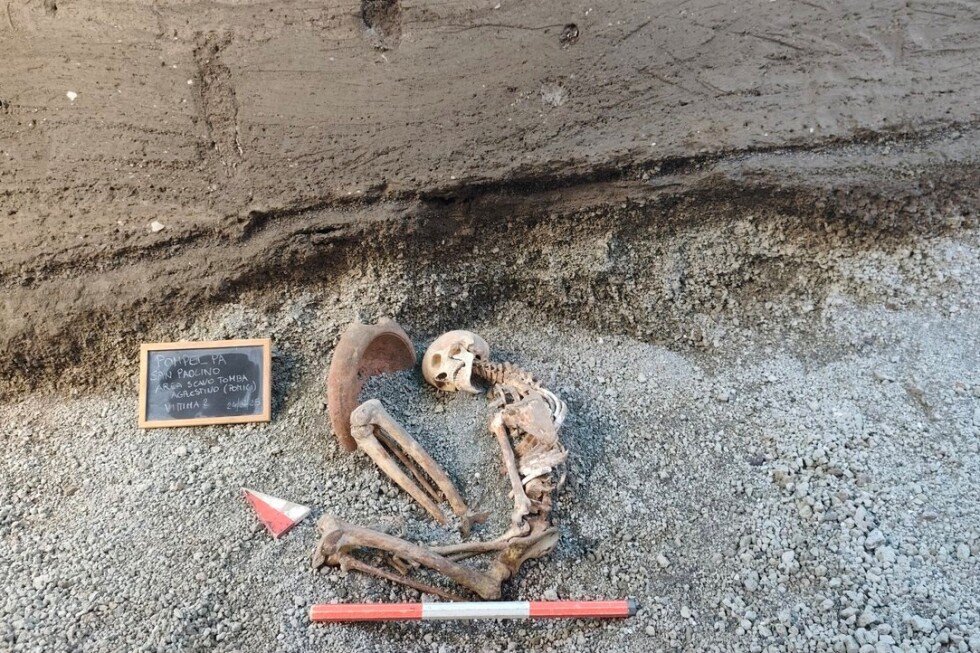
Archaeologists found the man holding a terracotta mortar, which they interpreted as an improvised attempt to shield his head from falling small volcanic stones that rained down during the eruption.

Ancient accounts — including those of Roman writer Pliny the Younger — describe Pompeii’s residents using objects to protect themselves as ash and debris blanketed the city.

The man was also carrying an oil lamp, a small iron ring and 10 bronze coins, personal objects that offer insight into his final moments as well as into daily life in Pompeii before the catastrophe.

The digital portrait was created using AI and photo-editing techniques designed to translate skeletal and archaeological data into a realistic human likeness.

“The vastness of archaeological data is now such that only with the help of artificial intelligence will we be able to adequately protect and enhance them. If used well, AI can contribute to a renewal of classical studies,” Pompeii park director Gabriel Zuchtriegel said in a statement.

The project aims to make archaeological research more accessible and emotionally engaging for the public while maintaining a scientific foundation, researchers said.


Source link

Share. Facebook Twitter Pinterest LinkedIn Tumblr Email
IQ TIMES MEDIA
  • Website

Related Posts

Michigan tests expanding free ‘pre-K for all’ to home child-care providers

April 27, 2026

AI anxiety upends college plans as students scramble for ‘AI-proof’ majors

April 27, 2026

Mississippi middle school students save school bus from crashing

April 24, 2026
Add A Comment
Leave A Reply Cancel Reply

Editors Picks

Michigan tests expanding free ‘pre-K for all’ to home child-care providers

April 27, 2026

Digital reconstruction unveils face of ancient Pompeii victim using AI

April 27, 2026

AI anxiety upends college plans as students scramble for ‘AI-proof’ majors

April 27, 2026

Mississippi middle school students save school bus from crashing

April 24, 2026
Education

Michigan tests expanding free ‘pre-K for all’ to home child-care providers

By IQ TIMES MEDIAApril 27, 20260

Around small tables and colorful magnifying glasses, Lori Legger six teaches young children about living…

Digital reconstruction unveils face of ancient Pompeii victim using AI

April 27, 2026

AI anxiety upends college plans as students scramble for ‘AI-proof’ majors

April 27, 2026

Mississippi middle school students save school bus from crashing

April 24, 2026
IQ Times Media – Smart News for a Smarter You
Facebook X (Twitter) Instagram Pinterest Vimeo YouTube
  • Home
  • About Us
  • Advertise With Us
  • Contact us
  • DMCA
  • Privacy Policy
  • Terms & Conditions
© 2026 iqtimes. Designed by iqtimes.

Type above and press Enter to search. Press Esc to cancel.