


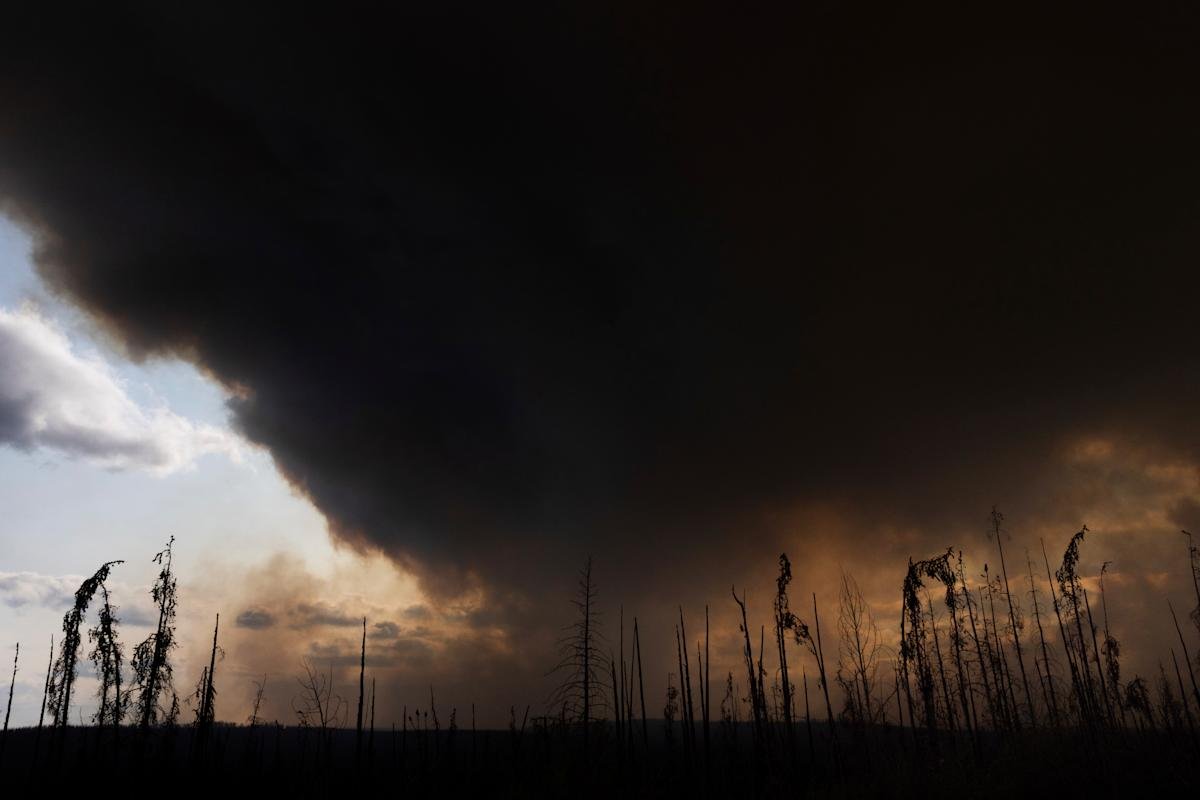
While images of wildfires capture their ferocity, data can provide insight into how bad a fire season is.
Such is the case with two graphics, powered by satellite data, that showcase a Canadian wildfire season off to a wild — and scary — start.
Twice a day a NASA satellite sends images to the ground, giving a real-time view of where fires are burning. This is especially useful for remote areas where no sensors are stationed.
As of Tuesday that satellite had picked up four times as many fire hot spots across Canada than is typical for early June. That’s more than any year since the satellite began transmitting in 2012, except 2023, according to data from Global Forest Watch.
Though the satellite has recorded thousands of hot spots so far this year, that does not mean there are actually that many active fires. Each hot spot could be detected repeatedly over the course of days. And because each detection is about the size of 26 football fields, it can represent part of a much larger blaze, said James MacCarthy, wildfire research manager at Global Forest Watch.
Based on data from the Canadian Interagency Forest Fire Centre, about 200 fires are actively burning in Canada and have consumed about 7,700 square miles (19,900 square kilometers) of terrain, most of it in the last week.
Only 2023 saw such high numbers so early in Canada’s fire season, which runs from April through October. That year wildfires burned a record 67,000 square miles — more than twice the surface area of Lake Superior, the largest of the Great Lakes.
Taken together, the hot spots and acres burned mean 2025 is the second-worst start to the season in years.
“A warm and dry finish to May and early June has created a significant fire season,” said Liam Buchart, a fire weather specialist with the Canadian Forest Service.
The weather conditions are made more likely by climate change and encourage wildfires to start. That means even though 90% of wildfires in Manitoba this year have been human-caused, according to the provincial government, climate change helps enable their spread.
“Climate change is creating the conditions that make it more likely that human-caused fires are going to spread, or even start,” MacCarthy said. “It might be a human starting it, but it’s going to spread quickly because now there’s hot and dry conditions that are occurring more frequently and more intensely than they have in the past.”
The hot and dry weather is likely to to continue for at least the next week across Manitoba, Saskatchewan and Alberta, according to Natural Resources Canada. The agency’s forecasts also call for “a warmer and drier than normal July and August for large portions of Canada,” Buchart said.
“The remainder of the fire season looks to remain above normal, especially over the northern prairie provinces and southern British Columbia,” he said.
___
The Associated Press’ climate and environmental coverage receives financial support from multiple private foundations. AP is solely responsible for all content. Find AP’s standards for working with philanthropies, a list of supporters and funded coverage areas at AP.org.
