


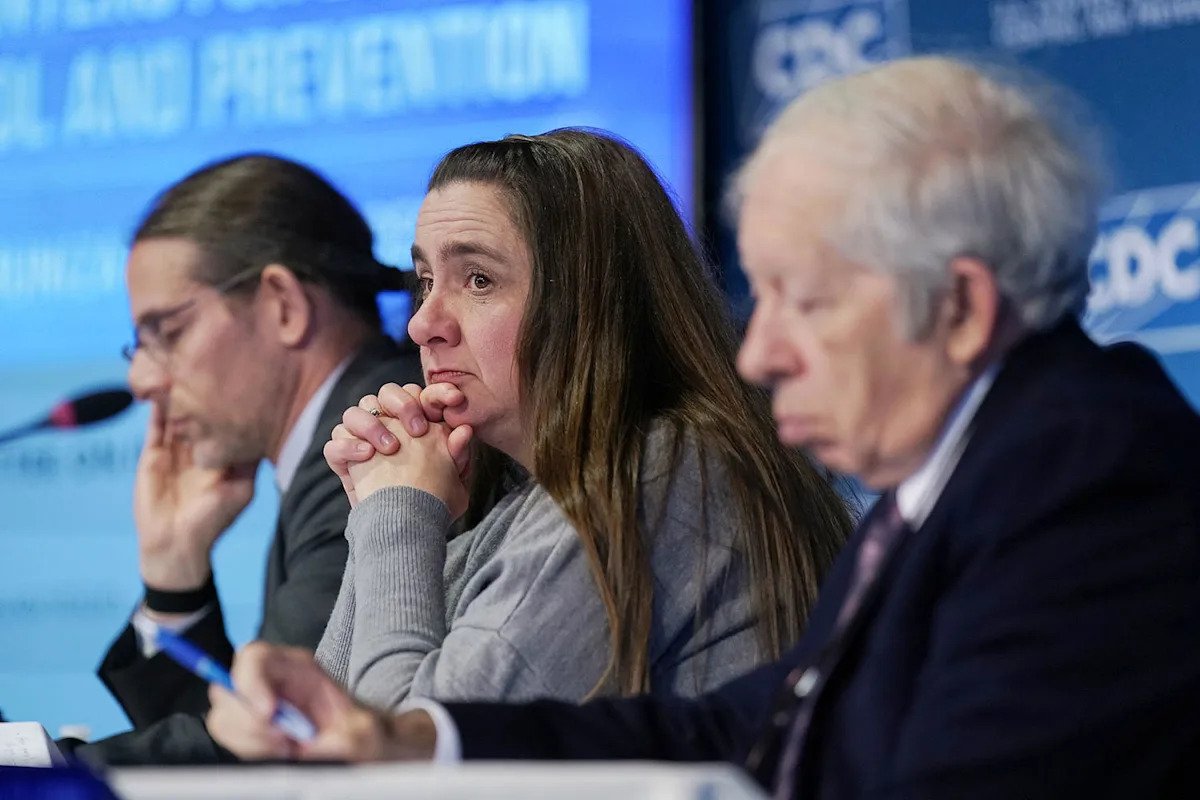
The Centers for Disease Control and Prevention’s vaccine advisory panel on Friday rolled back a decadeslong recommendation that all newborns get a first dose of the hepatitis B vaccine within 24 hours of birth.
The vote came after a day and a half of heated debate and confusion that included misinterpreted data and pleas from public health experts to uphold recommendations for the vaccine that protects against an incurable infection.
The panel, formally known as the Advisory Committee on Immunization Practices — whose members Health Secretary Robert F. Kennedy Jr. fired in June and replaced with a group that has largely expressed skepticism of vaccines — recommended that women who test negative for hepatitis B can decide in consultation with a health care provider whether their baby should get the birth dose. The group suggested waiting until at least 2 months of age for the first dose if the vaccine is not given at birth.
Three of the eight members voted against the change.
“We are doing harm by changing this wording and I vote ‘no,’” said Dr. Cody Meissner, the only ACIP member who has previously served on the committee.
Acting CDC Director Jim O’Neill — a former investment executive who does not have a medical background, but previously served at the Health and Human Services Department under President George W. Bush — will now choose whether to adopt the panel’s recommendations.
Sen. Bill Cassidy, R-La., a liver doctor who chairs the Senate’s health committee and cast a key vote in favor of confirming Kennedy as health secretary, said the panel’s new recommendation is “a mistake.”
“Ending the recommendation for newborns makes it more likely the number of cases will begin to increase again. This makes America sicker. Acting CDC Director O’Neill should not sign these new recommendations and instead retain the current, evidence-based approach,” Cassidy said in a statement.
Dr. Susan Kressly, president of the American Academy of Pediatrics, said the change makes children in America less safe.
“They are vulnerable when we have a duty to most protect them,” Kressly said. “I urge parents to talk to their pediatrician and get the hepatitis B vaccine at birth, regardless of the mother’s status.”
The committee “presented no information and no data that said this new approach is safer and will be safer for children. In fact, we know as clinicians who care for children, this will make them more vulnerable,” she said, adding that there is no evidence whatsoever that the vaccine poses a danger to newborns.
The panel also voted in favor of parents consulting with health care providers about testing their children for antibodies to hepatitis B before deciding whether their child needs another dose of the vaccine after the first one.
The hepatitis B shot is usually given to infants as a three-dose series. Typically, after the first dose is given within 24 hours of birth, children get the second dose at 1 to 2 months, and the third between 6 to 18 months of age.
Some panel members expressed concern about vaccinating during the neonatal period, a critical window of development for the brain and immune system — despite the fact that the hepatitis B vaccine has been safely given to newborns for decades. Others said they had not seen data to support delaying the dose until two months or older.
“We have to make decisions with the data that we have, and we must use only the credible data to make the decisions, and not speculations and not hypotheses,” said ACIP member Dr. Joseph Hibbeln, a psychiatrist and neuroscientist.
Ahead of the vote, representatives from liaison groups urged the panel to reconsider changing the current recommendation.
“This vote is an unnecessary solution looking to find a problem to solve,” said Dr. Jason Goldman, president of the American College of Physicians, addressing the panel members directly. “It will not fix your concerns of informed consent, but only endanger children.”
Dr. Amy Middleman, a representative for the Society for Adolescent Health and Medicine, noted that the CDC’s infectious disease experts could not vet misinformation before it was presented to the public.
“As a hep B researcher, I can confirm there has been a lot of misinformation presented in the last couple of days,” Middleman said.
The panel did not change the current recommendation to vaccinate newborns whose mothers test positive for hepatitis B or whose infection status is unknown. Hepatitis B can be transmitted from mother to child during delivery, and can lead to liver disease, cancer and death.
Kennedy, an anti-vaccine activist, has often cited the debunked theory that vaccines may be linked to autism. Earlier this year, he told conservative commentator Tucker Carlson that the CDC concealed data showing an elevated risk of autism among newborns who had received the hepatitis B vaccine.
After Kennedy’s shakeup of the vaccine advisory panel in June, many states have started to ignore the panel’s guidance and defer instead to recommendations from professional societies or newly formed public health alliances.
Public health experts worry the new recommendations will make guidance around hepatitis B vaccines less clear to providers and patients, since it does not strongly advocate for vaccinating newborns.
“The more confusing we make these recommendations, the harder this is going to be for clinicians to implement,” said Chari Cohen, president of the nonprofit Hepatitis B Foundation.
Cohen also questioned how feasible it would be to test babies for hepatitis B antibodies, which requires a blood draw.
“If we’re talking about doing less things that might traumatize our babies, why would we be giving them blood draws? And who’s going to agree to that?” Cohen said.
Food and Drug Administration Commissioner Marty Makary told NBC News in a sit-down interview Thursday that the evidence does not support a universal birth dose for hepatitis B.
“When a parent wants to wait until the child is 8, 10 or 12 years of age, we have to listen to those parents and be honest with them that there is no scientific evidence that there’s a benefit of doing it on the first day of life versus at age 10 or 12,” he said.
Many doctors and public health experts strongly disagree. Not all pregnant women get tested for hepatitis B, so public health experts say that delaying the shots could lead to more infections.
Cases of acute hepatitis B plummeted among children after the CDC began recommending a universal birth dose in 1991, falling 99% from 1990 to 2019. A CDC analysis of children born from 1994 to 2023 estimated that hepatitis B vaccination prevented more than 6 million infections and nearly 1 million hospitalizations.
On Tuesday, the Vaccine Integrity Project — a University of Minnesota initiative dedicated to safeguarding vaccine use in the United States — published a review of more than 400 studies that found no evidence of short- or long-term health problems from the hepatitis B shot after birth. Though not published in a peer-reviewed journal, the paper was reviewed by major medical societies including the American Academy of Pediatrics, the American College of Obstetricians and Gynecologists and the Infectious Disease Society of America.
This article was originally published on NBCNews.com
