


The rising popularity of Bausch + Lomb’s daily single-use contact lenses led to a massive manufacturing challenge. To keep up with demand, the company had to quickly expand capacity at two production facilities, in Ireland and New York.
The higher volume also drove Bausch + Lomb’s CEO, Brent Saunders, to embrace new AI software, which helps manufacturing workers monitor, test, and fix mechanical issues.
The technology, called Atlas and produced by Arena AI, is designed to predict machinery issues before they arise and send alerts to maintenance workers so they can diagnose errors and fix them.
Saunders said that Atlas was tested in Rochester in 2023 and, by last year, had been added to three new contact-lens production lines. “We’re seeing millions of lenses being produced that we wouldn’t have otherwise been able to produce without the Atlas AI,” Saunders told Business Insider.
Some 77% of the manufacturers plan to increase their AI investments over the next year, according to a July survey by KPMG of 183 AI manufacturing leaders across eight countries. Startups like beauty brand Prose, pet food maker Spot & Tango, and home battery producer FranklinWH are among the companies embracing AI in new manufacturing facilities that they’ve recently opened.
AI is helping startups manufacture more pet food and batteries
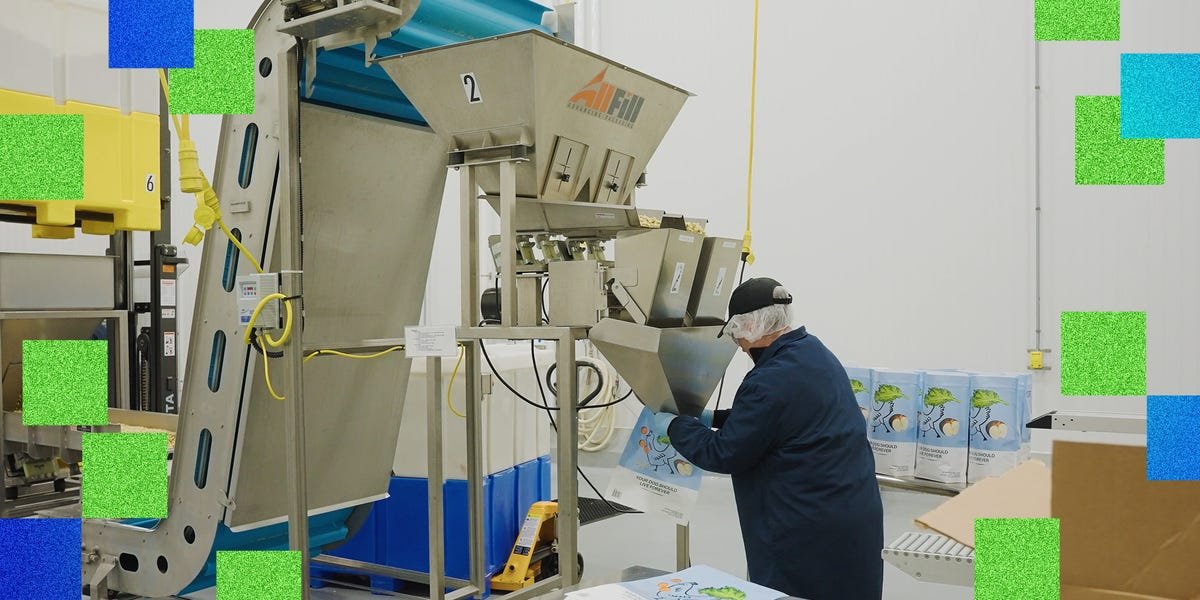
Dylan Munro, the chief operating officer and cofounder of Spot & Tango, said the company opened its first-ever manufacturing facility near Allentown, Pennsylvania, because the company wanted to better control the quality of the dog food it sells.
When the facility opened in late 2022, employees were responsible for manually coordinating raw materials from suppliers, scheduling production based on the availability of those ingredients, and booking trucks to coordinate the pickup and delivery of goods.
Since then, AI adoption has allowed Spot & Tango to scale its production without the need to hire more employees, according to Munro.
He told Business Insider that his company began to pilot an agentic AI tool sold by Didero, an AI supply chain management startup. The tool can log purchase orders, confirm them, and build appropriate production schedules based on ingredient availability. Meanwhile, Spot & Tango’s logistics team oversees these AI-enabled decisions.
A small group of Spot & Tango workers tested Didero’s AI tool with real-life procurement scenarios for three months before the company made it widely available to employees, said Munro. The company said this system now fully automates around 60% of purchase orders.
FranklinWH Energy Storage, which sells home batteries intended for power backup during outages, is using AI to help address customer service requests and within production, said Vincent Ambrose, the COO at FranklinWH. It added AI for the first time at a California production facility that opened earlier this year.
The facility features AI-enabled visual inspection, which uses cameras to closely monitor the production of lithium iron phosphate home batteries and flag quality issues, a procedure that workers used to do. The AI model continuously learns from production data to predict problems before they occur.
FranklinWH also produces in Asia, where AI isn’t utilized, but could be added later. “If we upgrade those facilities, I’m sure we’ll take what we’ve learned from our US manufacturing,” said Ambrose.
Automation helped Prose lower its shampoo-making costs
Arnaud Plas, the CEO and cofounder of Prose, said the company’s adoption of AI and automation has lowered the cost of manufacturing. When the company initially launched in 2017, factory-line workers assembled bottles manually, which contributed to a $5 production markup for Prose’s made-to-order, custom shampoos and moisturizers, which are developed based on customers’ hair surveys. Now, autonomous robotics is responsible for mixing Prose’s formulas.
“We wanted that incremental cost to be under $1,” said Plas.
The company achieved this goal in 2024, partly by automating formula mixing and bottle filling, but also due to the application of 200 algorithms that Prose’s machine learning and data scientists developed. These algorithms assist with the company’s demand planning, product formulations, predictive maintenance for machines, and more efficiently scheduling production, so there is less downtime needed to clean the machinery.
The company added AI and automation capabilities to a second manufacturing facility in California, which Prose opened in June. Plas said that 90% of Prose’s production now features automation and the influence of AI algorithms.
Munro, the Spot & Tango COO, said that he continues to field a lot of pitches from AI vendors promising big supply chain optimization, but approaches them with skepticism.
Munro said that some AI solutions pitched by vendors can encounter unforeseen technical challenges or slower-than-expected adoption from workers.
“We don’t want to rush to implement,” he said.
