


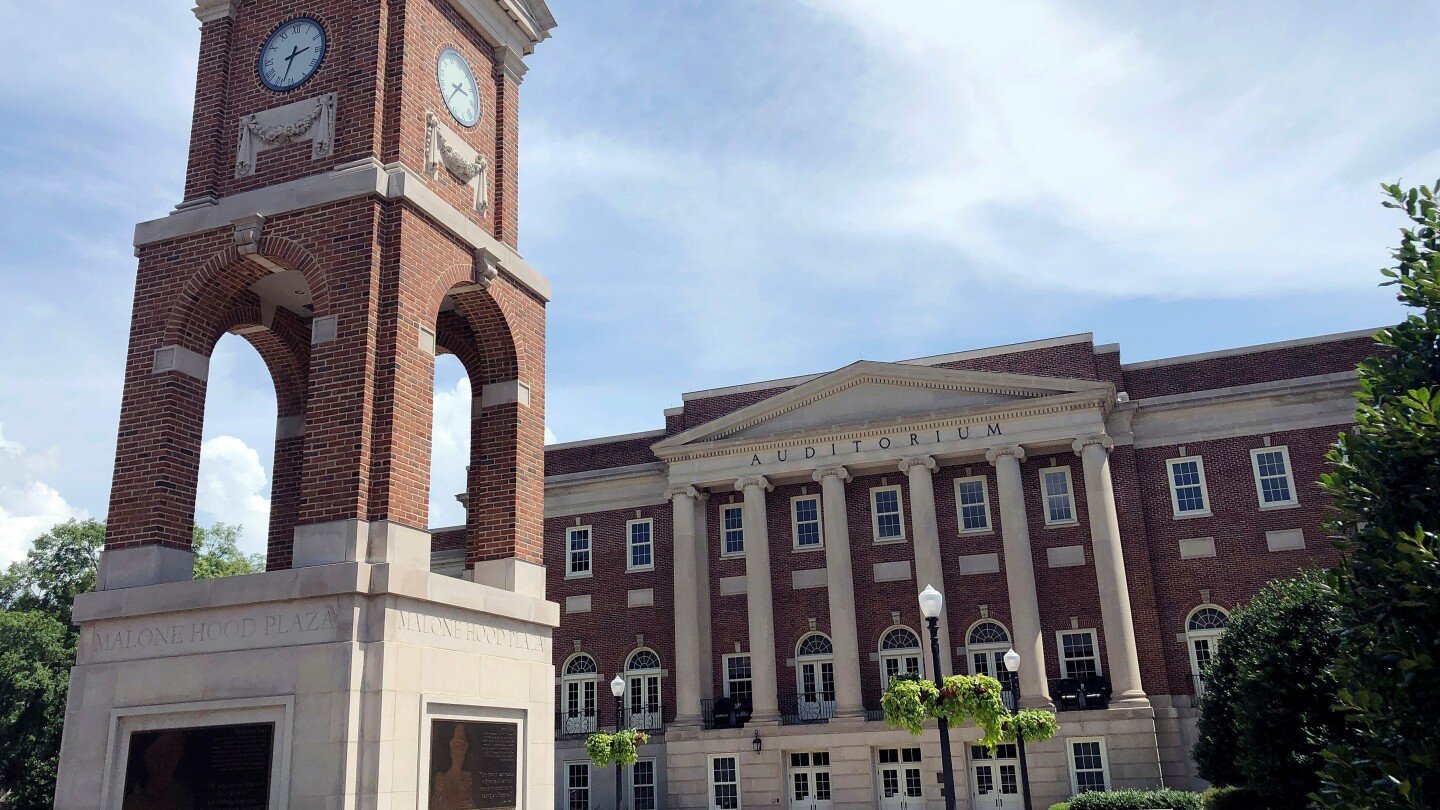
MONTGOMERY, Ala. (AP) — A group of students and professors at public universities across Alabama are asking an appeals court to halt a state law that bans diversity, equity and inclusion initiatives in public schools and prohibits the endorsement of what Republican lawmakers dubbed “divisive concepts” related to race and gender.
The Alabama measure, which took effect in October 2024, is part of a wave of proposals from Republican lawmakers across the country taking aim at DEI programs on college campuses.
The state law prohibits public schools and universities from using state funds for any programs or curriculum that endorse “divisive concepts” related to race, religion, gender identity and religion. Instructors are also prohibited from “encouraging” a person feel guilt because of those identities.
U.S. District Judge David Proctor allowed the law to remain in place, writing that a professor’s academic freedom does not override a public university’s decisions about the content of classroom instruction.
He wrote that the law “does not banish all teaching or discussion of these concepts from campus or, for that matter, even from the classroom,” Proctor wrote. “To the contrary, it expressly permits classroom instruction that includes ‘discussion’ of the listed concepts so long as the ‘instruction is given in an objective manner without endorsement’ of the concepts.”
The appeal comes on the heels of a July mandate from the Department of Justice that outlines similar required changes on public school campuses across the country. In 2025, student affinity groups have shuttered their doors, professors have been put on leave, Black student publications have closed and curriculums have changed.
Stay up to date with the news and the best of AP by following our WhatsApp channel.
Follow on

Antonio Ingram, a Legal Defense Fund lawyer for the plaintiffs, said in an interview that the law doesn’t clearly outline what endorsement entails, making professors vulnerable to frivolous investigations and limiting their ability to present vetted research.
“Truth becomes what the state says versus what independent researchers and theorists and academics have spent decades crafting,” Ingram said.
If allowed to stand, Ingram said, the law makes “universities mouthpieces of the state that could be used for propaganda, that could be used for things that are not accurate and empirically based.”
Dana Patton, a plaintiff who teaches political science at the University of Alabama in Tuscaloosa, said in an interview that the state law led her to change curriculum that she has taught for decades.
“We feel very constrained by the vagueness of the law,” Patton said, since some students might misinterpret a lesson for endorsement of a certain viewpoint.
Last year, five students complained that Patton’s curriculum for the interdisciplinary honors program she administers is in conflict with the law. Patton insists that she has always taken measures to ensure a wide array of view points are represented — but that hasn’t assuaged her fears. She has since taken some material off of her syllabus.
“It’s just safer to not teach certain things and and to avoid potential repercussions or complaints being filed,” Patton said.
