


A former Formula One engineer left the world’s fastest race cars to tackle a much bigger engineering challenge: teaching robots to work in factories.
Now, his Munich-based startup, microagi, has raised $55 million in the largest seed round secured by a German startup. Hummingbird led the round, with participation from Northzone, LocalGlobe, Village Global, and redalpine. microagi declined to disclose its valuation.
Bercan Kilic landed his dream job as an aerodynamics engineer for Red Bull Racing in 2023, joining the Formula One team at the height of its dominance. But the thrill quickly wore off.
The engineering was magnificent, he said, but he wanted to put his skills toward something bigger. He set his sights on deploying robots in factories to bring about a world of abundant, low-cost goods and services.
microagi helps manufacturers train robots for specific jobs. Rather than building its own robots or AI models, the company records workers using cameras and sensor-equipped gloves. It uses that footage to teach existing robotics models how to perform specific tasks inside a customer’s factory.
Kilic told Business Insider that five companies are collecting data through its platform, with one preparing to deploy robots in a factory.
You may not have heard of microagi, but its consumer-facing arm, shift, went viral this year for offering free apartment cleanings in New York in exchange for recording first-person footage of cleaners doing dishes, mopping floors, and folding laundry. This week, shift began offering free private chefs in San Francisco.
The round comes as investors pile into robotics and physical AI, driven by AI’s move from chatbots into machines, falling hardware costs, labor shortages, and pressure to reshore supply chains.
microagi
Kilic said he isn’t worried about microagi taking jobs from the people helping to train robots. Instead, he sees factory robots as necessary to address labor shortages in Europe and the US and keep pace with automation in China.
China installed 295,000 factory robots in 2024, accounting for 54% of the global total, compared with 34,200 in the US, according to a report from the International Federation of Robotics.
“If you run factories, the math is already on your desk,” Kilic said. “Your most experienced people retire this decade, and their replacements were never born. Reshoring only works if the robots do.”
Why microagi needs shift
microagi was founded in a Munich hacker house last year with the goal of moving robots out of research labs and into workplaces. The name reflects Kilic’s belief that AI models must become smaller before billions of robots can be deployed. Running enormous models on that many machines would require too much computing power, he said.
At first, microagi planned to focus solely on deployment. It would take existing robots and AI models, train them on a customer’s data, and put them to work. But the team soon found that many robotics models were not capable enough to serve as a useful starting point.
Kilic likened the problem to training a new worker. An adult might learn a factory job in a week, while a child might never master it, no matter how good the instruction. Existing robotics models, he said, are still closer to children.
That realization led microagi to build shift, its data-collection business. shift operates in 15 countries and pays more than 20,000 people to record themselves performing physical tasks, Kilic said. It sells the footage to AI labs and robotics companies developing robot “brains.”
shift
Kilic declined to name microagi’s model partners, though companies building this type of technology include Physical Intelligence, Skild AI, and Generalist AI. microagi adapts its partners’ models using each customer’s factory data, then helps deploy them on robots. Its customers span the automotive, logistics, and food industries.
“We provide the labs with data, they provide us with models, and then we layer on proprietary data to make our customers happy,” Kilic said.
shift is microagi’s answer to one of robotics’ biggest bottlenecks. Large language models were trained on vast amounts of text and images from the internet, but no comparable trove exists for robots. UC Berkeley roboticist Ken Goldberg has called this the “100,000-year data gap,” referring to the disparity between the training data available to robots and chatbots.
shift competes with companies including Scale AI, Turing, and micro1, which also pay people to record themselves performing tasks that robots may eventually do.
Chasing a ChatGPT moment
Kilic said microagi will use the new funding to pay for the computing power needed to train robotics models, expand shift’s data collection network, and grow its US presence from New York.
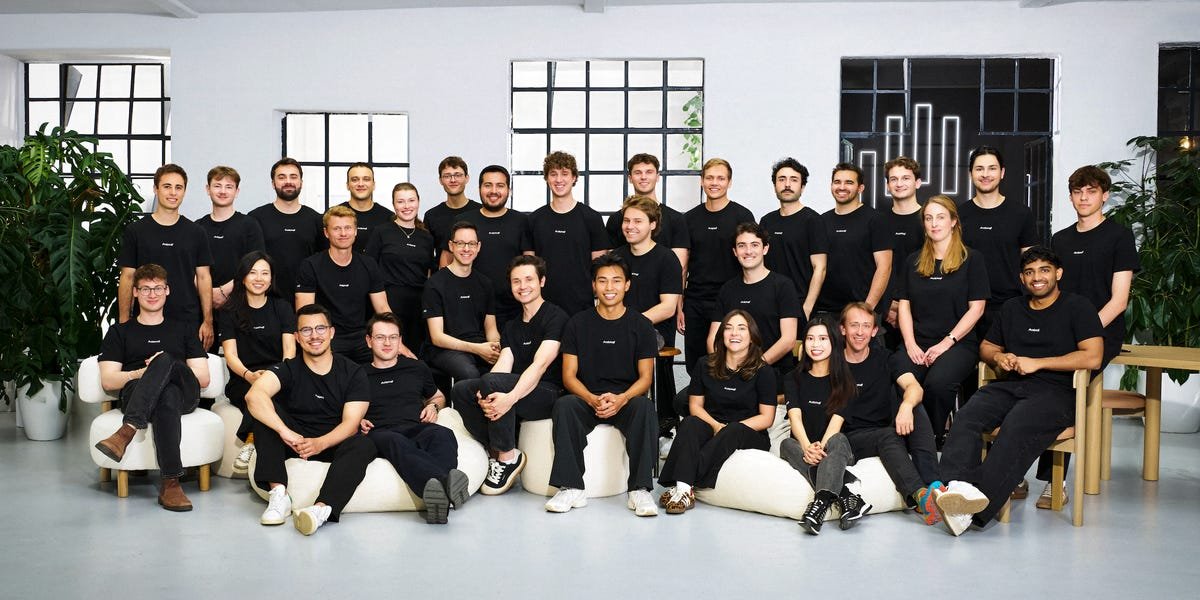
microagi employs 37 people globally, while shift has about 75, Kilic said.
He believes robotics is approaching its “GPT-2 moment.” For language models, that was the point when researchers found that adding more data and computing power could produce predictable improvements. Robotics companies are still working out that recipe, Kilic said, but he believes the industry is not far from its “GPT-3.5 moment,” when the technology becomes useful enough for broad deployment.
Hummingbird managing partner Firat Ileri, who led the investment, said he was struck by microagi’s intensity during a visit to its Munich headquarters, where employees rarely seemed to leave the office. Hummingbird was an early investor in AI coding startup Lovable, crypto exchange Kraken, and AI-chip startup Etched.
shift
Ileri said microagi stood out because of Kilic and his cofounders’ ambition and the startup’s focus on automating European factories as the continent’s workforce ages and shrinks. The EU’s median age reached 44.9 in 2025, up from 39.6 two decades earlier, according to Eurostat. The European Commission estimates that the bloc’s workforce could shrink by as many as 18.8 million people by 2050.
Kilic’s four cofounders are former Mercedes F1 engineer Yoan Iliev, former Alan Turing Institute researcher Anton Poletaev, RWTH Aachen engineer Nico Nussbaum, and serial entrepreneur Artjem Weissbeck.
The five cofounders have set an audacious target. Kilic said they want microagi to become the world’s largest company within five years, with its technology running on tens of millions of robots.
“In five years, if we haven’t deployed more than 20 million or 30 million robots, it’s a big failure,” he said.
Have a tip? Contact Rya Jetha via email at rjetha@insider.com or Signal at rjetha.07. Use a personal email address and a nonwork device; here’s our guide to sharing information securely.
