


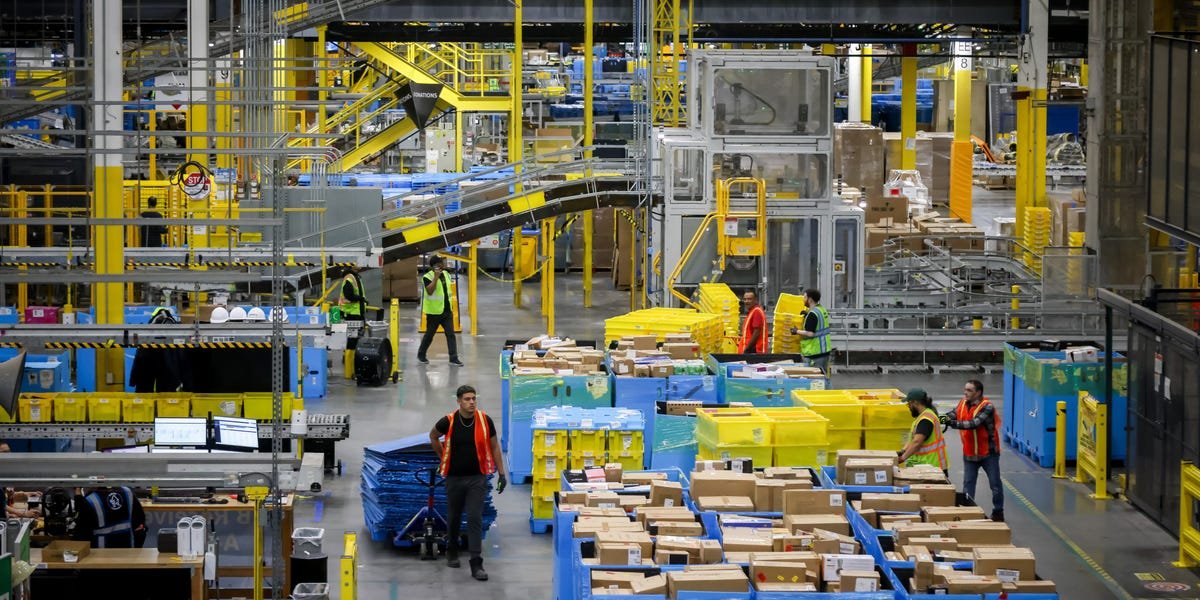
Amazon is testing software to decide where warehouse workers should go. Some managers keep ignoring it.
Internal planning documents show the tech giant intends to expand these labor-management systems across dozens of its North American fulfillment centers and sort centers, where they could save hundreds of millions of dollars a year.
However, some warehouse managers have been overriding the software recommendations, asking engineers to disable automated features, and finding other ways around the systems, according to internal Slack conversations and the documents from earlier this year.
The pushback has been enough for Amazon to conclude that software recommendations alone aren’t enough to get the new technology working as designed.
“Providing managers with optimized recommendations is necessary but insufficient,” Amazon said in one of the documents. “Without system-enforced guardrails, manual overrides and habits erode even the best science.”
The conflict highlights a broader challenge in automating warehouse management: software can make decisions, but people still have to follow the guidance. The documents and internal communications reviewed by Business Insider suggest getting managers to trust the software, and ultimately defer to its decisions, is proving more difficult than Amazon expected.
Competing philosophies
Amazon uses a growing mix of machine learning, computer vision, and other AI tools that increasingly guide staffing decisions traditionally made by managers.
Initially, those systems functioned as advisory tools. A program called DOPLERS calculates staffing plans, Full Facility Load Balancing recommends labor moves, and Right Link Station automatically tracks and captures check-in data for support staff.
But the internal documents reviewed by Business Insider show Amazon came to see manager discretion as an obstacle.
“Algorithm accuracy cannot be meaningfully measured without enforcement,” one of the documents stated.
The documents reveal two competing philosophies of warehouse management. Some managers believe warehouses are still too dynamic for algorithms to understand every situation. Amazon, however, saw that too much human judgment prevented those algorithms from working as intended.
As a result, Amazon’s strategy evolved to broader tracking of overrides and stricter enforcement planned over time.
“Hard enforcement is the end goal for 2026,” one planning document stated.
“Iterate on the logic”
Bloomberg/Getty Images
In an email ahead of publication, an Amazon spokesperson called this story’s premise “wrong,” saying the company is only piloting the technology at a small number of US facilities to help managers adjust staffing as package volumes change.
Managers still make staffing decisions, the spokesperson added, while the software system provides “better information” and is being refined based on testing and employee feedback before any broader rollout.
“As with all new systems, we continuously iterate on the logic — it takes time, testing, and iteration to get there — which is why it’s inappropriate to draw broad conclusions during initial testing phases,” the spokesperson said. “We always want to learn what’s working for our employees, and what isn’t, so we can make adjustments to get things right. That’s what pilots are all about.”
The spokesperson said the quotes and sentiments cited in the story came from an “early-stage planning document” that captured anecdotal observations during a pilot and “don’t reflect how the system operates today.” The issues were “not a widespread or ongoing concern,” the spokesperson said, adding that the tools are intended to help managers make more consistent staffing decisions, not replace their judgment.
An Amazon spokesperson previously told Business Insider that broader expansion plans remain subject to change and that projected savings estimates are hypothetical because the systems are still being tested.
“Please turn if off”
Still, the documents and internal communications reviewed by Business Insider suggest a deeper disagreement over who should make staffing decisions inside Amazon’s warehouses.
Some managers often wanted to keep more workers assigned to their areas to maintain productivity or because they believed operations required more staffing than the software recommended, according to Slack messages from inside Amazon that were obtained by Business Insider.
Several managers overstaffed warehouse support roles and “hid hours through manual time edits,” as some sites found “loopholes,” Amazon said in the official internal documents.
The Amazon spokesperson told Business Insider that managers make staffing decisions based on what the company has learned about shopping patterns over the years, but “there will always be variations.”
Internal Amazon Slack conversations from earlier this year show some managers at the company repeatedly asking to disable some of the automated staffing controls, or give warehouse leaders authority to do it themselves.
“Please turn it off now and I will explain,” one warehouse manager wrote shortly after Amazon’s enforcement effort launched at an early test site.
Minutes later, an Amazon product manager replied, “We will disable enforcement for now.”
Some managers argued the software often lacked the context they had on the warehouse floor, noting that the system overreacted to a brief slowdown in package volume, recommending staffing cuts that didn’t reflect real-time conditions.
Other managers complained the system pulled workers away from urgent areas, prevented them from reassigning idle employees, or left workers temporarily locked out of new assignments while different systems synchronized.
One manager said automated staffing changes caused packages to repeatedly circulate through the warehouse instead of being processed the first time, prompting a request to “disable the system until it gets fixed.”
Another manager questioned whether the software could account for differences between workers. “Does it understand 6 foot three Henry that weighs 250 pounds is way better at chasing than 67-year old Henrietta that weighs under 100 pounds and doesn’t reach 5 foot?” this person wrote in Amazon’s internal Slack.
The Amazon spokesperson told Business Insider that the Slack channel included a “small handful of managers” and the comments “don’t reflect the current state of the technology, since they’re from a channel that was intended to provide constructive feedback on this initial pilot.”
Amazon wants to double down
The conflict reveals something larger than a disagreement over warehouse software.
Historically, supervisors balanced labor using experience and local knowledge. Amazon wants software to make more of these decisions.
The official internal documents show Amazon interpreted manager workarounds less as evidence that automation had limits than as proof that recommendations alone wouldn’t change behavior.
Internal Amazon roadmaps call for progressively tighter controls, including limits on how far managers can deviate from the algorithm. Amazon’s own “Success Metrics” for 2026 mention a “reduction in manual staffing interventions by managers.”
“Enforcement is our highest-leverage mechanism and we’re doubling down,” Amazon stated in one of the documents.
Have a tip? Contact this reporter via email at ekim@businessinsider.com or Signal, Telegram, or WhatsApp at 650-942-3061. Use a personal email address, a nonwork WiFi network, and a nonwork device; here’s our guide to sharing information securely.
