


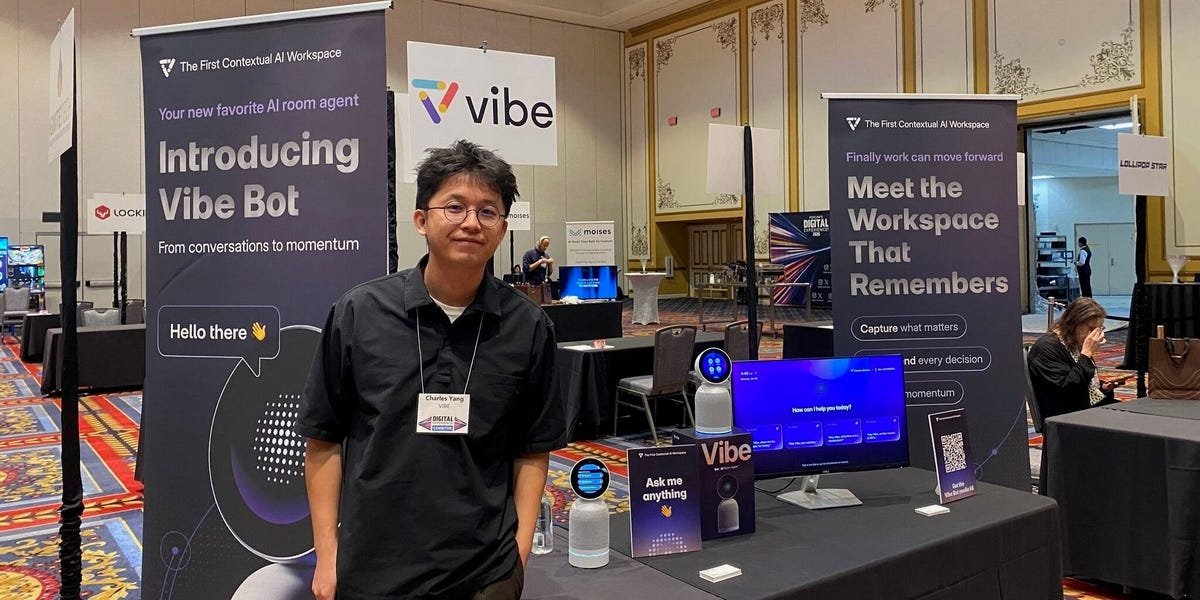
This as-told-to essay is based on a conversation with Charles Yang, the founder and CEO of Vibe, a US-based AI workspace startup. The conversation has been edited for length and clarity.
Loading audio narration…
I started my first company with my friend after finishing my third year at Zhejiang University.
I still remember the morning in January 2006. We went to the bank, and my father gave me about $5,000. My friends and I used that sum to start our own gaming company.
As a computer science major, there were conventional pathways laid out: You can go to big companies like Microsoft, Baidu, or Alibaba; pursue a master’s degree, then a Ph.D, or go to the US to study for a Ph.D and stay there.
I quit college after three years to build my startup. My family did care about whether I would graduate, because I was the only one in my family who attended college.
I was so young that I do not think there was any concept of “risk” in my head.
Moving to the US for a global career
After about 10 years, my gaming company became very successful. We considered selling or going public.
I was married and had a daughter, so I began thinking about my next career and life goal. If you go public, you’re tied to the company for at least six years.
I wanted a better answer if my kid asked what I do. I do not want to build another Chinese game. I want to be a big global player.
In 2016, I moved to Seattle, met friends at Apple and Google, and saw Silicon Valley. I had spent 11 years building virtual things, and I decided to build a new startup and something real — hardware.
I stepped away from my gaming company in China. I built an early-stage immersive collaboration platform exploring spatial computing for teamwork in the US, and raised $1 million in seed funding in 2016.
I saw advantages in linking China’s supply chain to the US ecosystem. We’ve managed to build products and scale the business through e-commerce, and set up distribution and sales pipelines.
In 2024, I pivoted my startup to the AI workspace, and we are backed by Sequoia Capital China, now known as HongShan.
In China, startups feel unstructured. In the US, they run off a playbook
The US startup environment feels like a well-documented software development kit. You follow the playbook, and even some wildcards are documented in a systematic way.
In China, the startup environment is more like a badly documented system. There are a lot of bugs, a lot of holes.
Chinese society follows blurred, vague, and hidden rules. Usually in China, relationships are built through dinners and drinking wine with people. A lot of opportunities come from that.
In China, you don’t put yourself first. You are part of the community first, then yourself. In the US, it is more individualistic.
The pre-pandemic period was probably the golden age for many Chinese tech startups, where many young people chose to start companies.
But now, in China, resources are being allocated more to state-owned organizations and startups that prefer the government-led direction. For example, if Beijing wants something, then a lot of resources go that way.
In the US, it is more organic.
Advice to startup founders
For someone more independent or ambitious, I would probably suggest they join a successful company for at least two or three years. I think I missed out on that at the beginning.
As for when to build a company for yourself, if you have a strong interest in something, just do it. Being young and not having experience does not necessarily prevent success.
At the end of the day, it is really about your passion — and having luck.
Do you have a story to share about a tech career in China? Contact this reporter at cmlee@businessinsider.com.
