


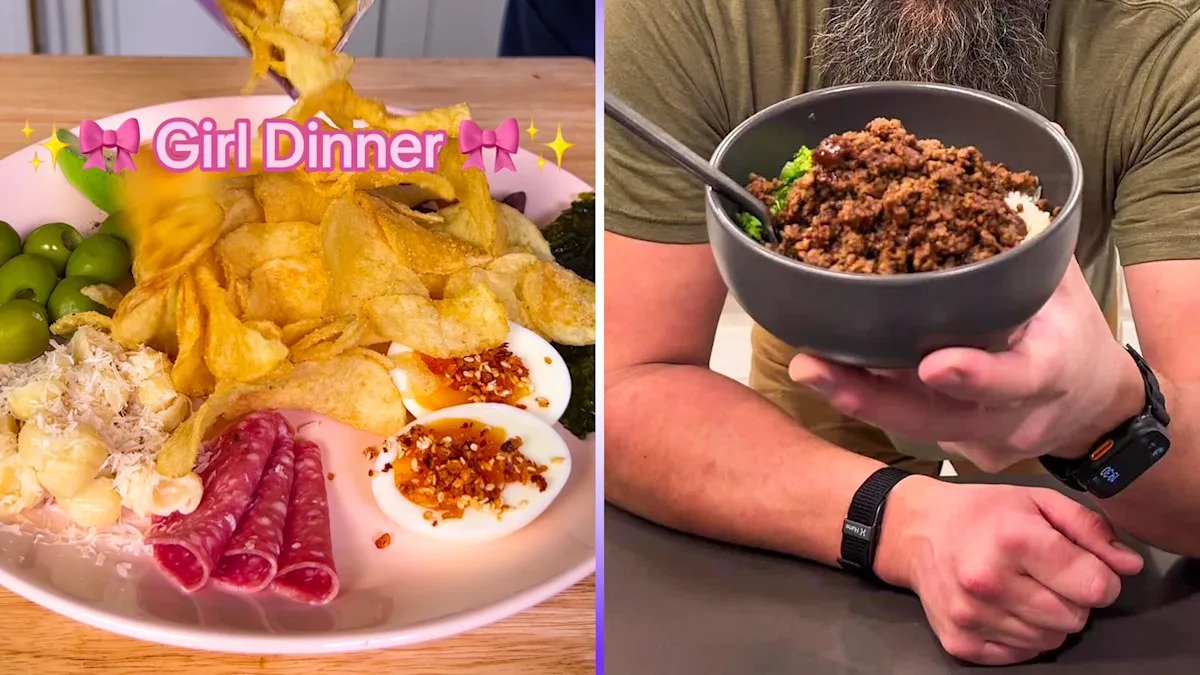
What’s for dinner? If you’re a Gen Z fitness fan scrolling on social media for meal inspiration, the answer might be “boy kibble.”
That’s right, the latest food trend takes inspiration from Fido’s dinner.
Much like “slop bowl” and its predecessor “dog bowl,” boy kibble is exactly what it sounds like: a simple one-bowl meal. It’s high-protein, low-carb, relatively cheap and easy to prep ahead of time.
The now-viral term has been widely attributed to fitness influencer and bodybuilder Christian “Quadfather” Miles. In a January Instagram reel captioned, “Unseasoned ground beef to reach my primal potential,” Miles holds up a bowl of ground beef with what appears to be white rice and addresses the camera, “Y’all may have girl dinner, but I got boy kibble. It’s 8 p.m., and I’m rawdogging some 93/7 ground beef. We’re not the same.”
Then there’s girl dinner — another buzzy food trend, but this one leans into the charm of a low-effort charcuterie board filled with snack staples like cheese, crackers, olives and fruit. Its more aesthetic, Instagram-friendly appearance stands in stark contrast to its scrappy little brother, boy kibble.
Even Harry Styles weighed in on these popular eating habits. During a recent interview with Brittany Broski’s Royal Court, he joked, “My sister always talks about the idea of girl dinner. Boy dinner, I’ve discovered, is just eating a rotisserie chicken over the sink.”
But despite Miles’s (and Harry’s) claim that these two ways of eating are worlds apart, they actually have a lot in common and reflect the modern-day Gen Z mindset: craving comforting, customizable foods while seeking out time-saving shortcuts. The result is quick, healthy-ish meals that blur the line between snacks and dinner. Are they quietly redefining what a satisfying meal looks like?
Too much advice, not enough energy: The case for simple meals
Madison Reeder, a registered dietitian and vice president of clinical operations at ModifyHealth, tells Yahoo that these trends reflect how people are actually living day to day.
“Most people are exhausted and balancing more than ever, and these trends gave a name to what many people were already doing quietly: the snack plate, the ground beef and rice, the ‘I don’t have the energy to cook tonight’ meal,” says Reeder.
While Gen Z (people born between 1997 and 2012) doesn’t have a monopoly on burnout, they are facing their own unique version of it. “They entered adulthood during a pandemic,” says Reeder. “They’re navigating an economy that doesn’t work as expected, and the nutrition information landscape they inherited is overwhelming.”
While platforms like TikTok have made nutrition advice more accessible than ever, they’ve also created a flood of conflicting and often inaccurate information. A 2024 report from MyFitnessPal found that 87% of millennial and Gen Z TikTok users have turned to the platform for health or nutrition advice. Meanwhile, a 2025 study published in the journal Nutrients examined hundreds of nutrition TikTok posts and found that 19% were deemed completely inaccurate and 18% contained mostly inaccurate information.
“There is so much contradictory information out there, and Gen Z is saying, ‘I just need someone who is believable to tell me what to do in a way that requires less stress,’” Jenna Movsowitz, cofounder of Express Checkout, a newsletter focused on consumer products and trends, tells Yahoo.
Against that backdrop, it makes sense that simpler, low-effort meals are gaining traction.
“Gen Z, in particular, values authenticity, practicality and simplicity,” says Amy Goodson, a registered dietitian, sports nutritionist and host of The Sports Nutrition Playbook podcast. “They want food that’s good for them, but they don’t want it to be too difficult. A low-pressure, no-recipe-required dinner concept is far easier to follow than decoding macronutrient ratios or debating seed oils on TikTok.”
Are these food trends healthy?
Boy kibble can indeed be a quality meal, experts say. Lean beef is an excellent protein source, Goodson says, with about 25 grams of high-quality protein in about 170 calories per cooked three-ounce serving. But it could use a few upgrades: Tossing in some vegetables with that lean protein would boost the nutritional value, and swapping white rice for brown rice or quinoa would pack in more nutrients and fiber.
And “a snack-style ‘girl dinner’ can absolutely be nutrient-packed if it includes a source of protein, fiber-rich carbs, healthy fats and some fruits or vegetables, like Greek yogurt with berries and nuts, whole-grain toast with avocado and eggs or a protein plate with hummus, veggies, cheese and crackers,” says Goodson.
At their best, these simple meals offer a great way for people to eat a healthy, wholesome meal with minimal effort and time. “They are … easy and trendy,” says Goodson.
The downside of easy eating
Still, Reeder says that even well-intentioned meals like these can veer off course.
“A trend creates its own feedback loop,” she says. “The more people participate, the more it gets reinforced as the right way to eat, and once that identity is baked in, people tend to stop evaluating whether what they’re doing still actually serves them.”
Reeder says that’s when you see someone eating unseasoned beef and rice seven days a week — “not because it’s working for their body, but because the trend told them it should be,” she says.
Taken too far, eating habits like these can fall short, especially when key nutrients like fiber are missing. In some cases, they can even risk sliding into disordered or undereating territory.
Both girl dinner and boy kibble “can look like discipline from the outside while masking something more rigid underneath, and that matters because disordered eating doesn’t always look like restriction,” says Reeder. “Sometimes it looks like joyless repetition in the name of optimization. A viral trend can give that kind of behavior a socially acceptable wrapper.”
It’s notable, Movsowitz says, that these girl dinner and boy kibble are happening alongside the reappearance of extreme thinness in fashion and celebrity, a familiar echo from the ’90s super-skinny era.
There’s girls dinner and then there’s diet culture and “people proudly talking about how to get skinny and stay skinny online,” says Movsowitz. “I do think that these things that are trending can be hard to separate.”
Rethinking what a ‘real’ dinner looks like
At the same time, the popularity of girl dinner and boy kibble may be doing something surprisingly positive: helping older generations rethink their own complicated feelings around making meals.
Women, especially, often carry guilt if they are not making a “real” dinner on the table every night, says Reeder. But “seeing younger people openly embrace low-effort meals without shame can be freeing,” she notes. “Sometimes the most helpful thing is hearing that a simple, balanced meal is enough, and that can look different to everyone.”
And while what dinner looks like may have changed, the fundamentals of good nutrition haven’t, Goodson says. The goal is still to create balanced meals with adequate protein (like lean meat), fiber from vegetables and whole grains, healthy fats from foods like nuts and avocado and enough overall calories.
“What these trends get right is that people want eating to be less complicated, and that deserves to be taken seriously,” says Reeder. “People are showing up however they can, and that’s exactly where good nutrition starts.”
