


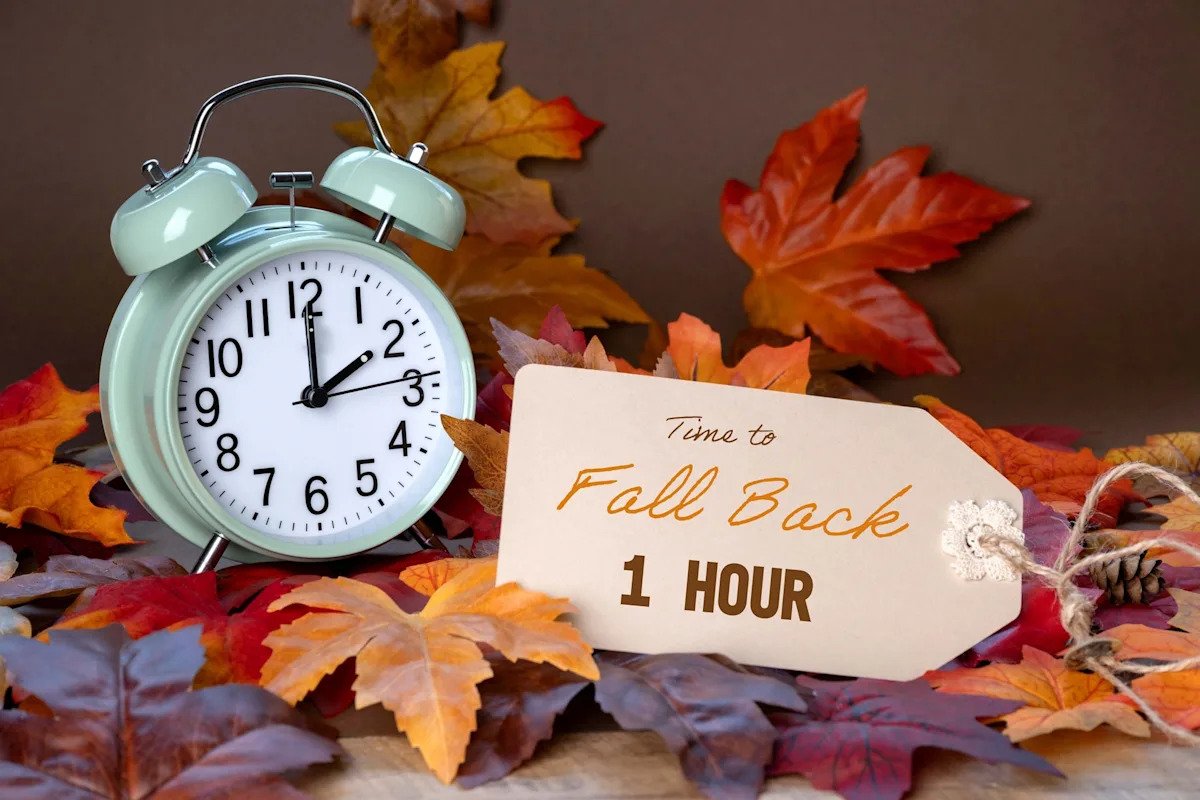
Fall is in full swing, and that means daylight saving time will soon draw to a close.
This year, the time change occurs on Sunday, Nov. 1.
Daylight saving time was first established in the U.S. by Congress after the Calder Act, or the Standard Time Act of 1918, was passed more than 100 years ago and was more recently amended with the Energy Policy Act of 2005.
In the U.S., daylight saving time begins on the second Sunday in March at 2 a.m., when clocks “spring forward” one hour, and ends the first Sunday in November at 2 a.m., when clocks “fall back” an hour.
Read on for more on the annual clock change.
1. When does daylight saving time end in 2025?
Daylight saving time ends Sunday, Nov. 2, 2025, with clocks rolling back one hour at 2 a.m.
With the change, it will get darker earlier in the evening across the United States.

Debby Lowe/Getty Images – PHOTO: Stock photo of a clock for daylight savings.
2. Do we gain or lose an hour of sleep when ‘falling back’?
When clocks “fall back” at the end of daylight saving time, people gain one hour of sleep.
On Sunday, for example, falling asleep at 10 p.m., will really be like falling asleep at 9 p.m., once clocks roll back one hour at 2 a.m.
On the flip side, when clocks “spring forward” in March at the start of daylight saving time, people lose one hour of sleep.
3. How do I help my child adjust their sleep?
Younger kids in particular may find it more difficult to adjust to the change in time, but there are steps that parents and caregivers can take to help them acclimate, according to parenting expert Ericka Souter.
Souter recommends shifting children’s schedules ahead of time, controlling morning light, and with young children, starting with small changes.
“To help your child’s body adjust, don’t just move bedtime,” Souter told ABC News via email. “Start moving everything – meals, naps, and wake times – earlier by about 10 to 15 minutes each day leading up to the time change.”
Souter also suggests keeping bedroom curtains drawn or lights dimmed until it’s time for a child to get up in the morning, so earlier sunrises don’t cause a child to wake up before they need to.
Changes can take time for both adults and children to get used to, so Souter said to expect as much.
“Even with the best plan, most kids need a few days or sometimes a full week to adjust,” Souter wrote. “Don’t panic if you see crankiness, clinginess, or appetite changes. It’s normal, and it will pass.”
4. What is daylight saving time and why did it start?
Daylight saving time became established law in the U.S. in 1918 with the passage of the Standard Time Act, according to the U.S. Naval Observatory’s Astronomical Applications Department.
The time change was implemented as a way to maximize daylight hours to help save on energy consumption during World War I.
Battle over daylight saving as America falls back
Over the next several decades, legislators made unsuccessful efforts to repeal daylight saving time nationally, and some individual states and cities reverted to non-daylight saving time hours.
In 1966, Congress passed the Uniform Time Act, which established a uniform daylight saving time throughout the U.S., according to the U.S. Department of Transportation, the federal agency that oversees time zones.
Under the Uniform Time Act of 1966, states that observe daylight saving time must follow the federally-mandated start and end dates.
States may also “exempt themselves from observing daylight saving time by state law,” according to the DOT.
In January 2025, the Sunshine Protection Act, which would make daylight saving time permanent across the U.S., was re-introduced in both the U.S. House of Representatives and the Senate. However, the legislation has not yet been brought to a vote.
5. What states don’t follow daylight saving time changes?
Hawaii and most of Arizona — with the exception of the Navajo Nation which stretches across Arizona, New Mexico and Utah — are the only two states in the nation that do not participate in daylight saving time, according to the DOT.
Additionally, five U.S. territories also do not participate in daylight saving time: American Samoa, Guam, the Northern Mariana Islands, Puerto Rico and the U.S. Virgin Islands.
6. What are the potential health risks of daylight saving time?
Some health experts argue that daylight saving time disrupts the body’s natural day-to-night rhythms.
In 2023, the American Academy of Sleep Medicine formed a coalition to advocate for state and federal legislation making standard time permanent across the U.S. Other organizational members include the National Sleep Foundation, Save Standard Time, Sleep Research Society and Society for Research on Biological Rhythms.
Effects of daylight saving time on your health
The shift in time has been associated with increased heart attacks, strokes, abnormal heart rhythms, sleep disruption, mood disturbances and even suicide, according to research published in the Journal of Clinical Sleep Medicine.
ABC News medical correspondent Dr. Darien Sutton recommends that ahead of changing the clock, people alter their bedtime gradually to accommodate the change.
Sutton said it’s also OK to take naps if you feel fatigued due to the time change, but try to limit the nap to 30 minutes, and take it before 3 p.m.
Lastly, Sutton said that when the clocks “fall back,” it’s important to increase your exposure to sunlight during the day, especially in the morning, and to limit your intake of alcohol and caffeine.
ABC News’ Katie Kindelan and Dr. Avish K. Jain, D.O., a resident physician at Cooper University Hospital, a medical contributor to the ABC News Medical Unit, contributed to this story.
