


You’ve seen what a cardiac arrest looks like on television – the patient limp and pale, the alert lifesaver pounding their chest, shouting, “Stay with me! Stay with me!”
Although the depictions of bystanders administering CPR make for riveting television, they often fail to provide an accurate example of what to do when someone’s life is on the line, according to a recent paper in the journal “Circulation: Population Health and Outcomes.”
Subscribe to The Post Most newsletter for the most important and interesting stories from The Washington Post.
The paper examined 169 episodes from U.S. television shows, including “Homeland,” “Yellowstone,” and “NCIS: Hawaii,” focusing on incidents that occurred outside of a hospital and involved nonmedical bystanders trying to save someone.
Researchers found that fewer than 30 percent of the episodes showing these scenarios depicted the correct steps for hands-only CPR ― chest compressions, but not breathing into the patient’s mouth. The hands-only method was endorsed by the American Heart Association in 2008 as simpler and faster than traditional CPR.
Almost half of the episodes examined ― 48 percent ― illustrated practices now considered outdated, including mouth-to-mouth resuscitation and checking the patient for a pulse. The AHA changed its recommendations because laypeople often struggle to find a pulse under pressure, and in the first few minutes of a cardiac arrest, the patient has enough oxygen ― the priority is pumping the blood.
“So, one thing we saw a lot was compressions that are not deep enough on TV,” said Ore Fawole, an author of the paper and a research coordinator for a lab at the University of Pittsburgh’s School of Public Health. “We really want to push back against this fear that people have, and it’s a reasonable fear, but unless you’re an Olympic bodybuilder, there’s probably no way for you to do CPR too hard.”
There is a risk that chest compressions can result in broken ribs, a concern for actors on a television show, but not for someone who has stopped breathing from a cardiac arrest.
“One of the things we talk about in our training is that doctors can fix broken ribs,” said Beth Hoffman, one of the paper’s authors and a professor of behavioral and community health sciences at Pittsburgh’s School of Public Health. “They can fix other things that might happen in the course of doing CPR, but they can’t fix a dead brain.”
The study has appeared at a time when Hollywood seems to be aiming for greater accuracy in its depictions of medicine.
“Most of the medical shows we work with have at least one MD on their writing staff, and sometimes two or three,” said Kate Folb, who directs the Hollywood, Health and Society program at the Annenberg School’s Norman Lear Center at the University of Southern California. The center, now in its 25th year, works with the entertainment industry to develop accurate storylines involving health and medicine.
“We know from our research and our work with shows that audiences do learn, and learn from what they see on TV,” Folb said.
Surprisingly, viewers sometimes get the right message even from a sloppy portrayal on TV.
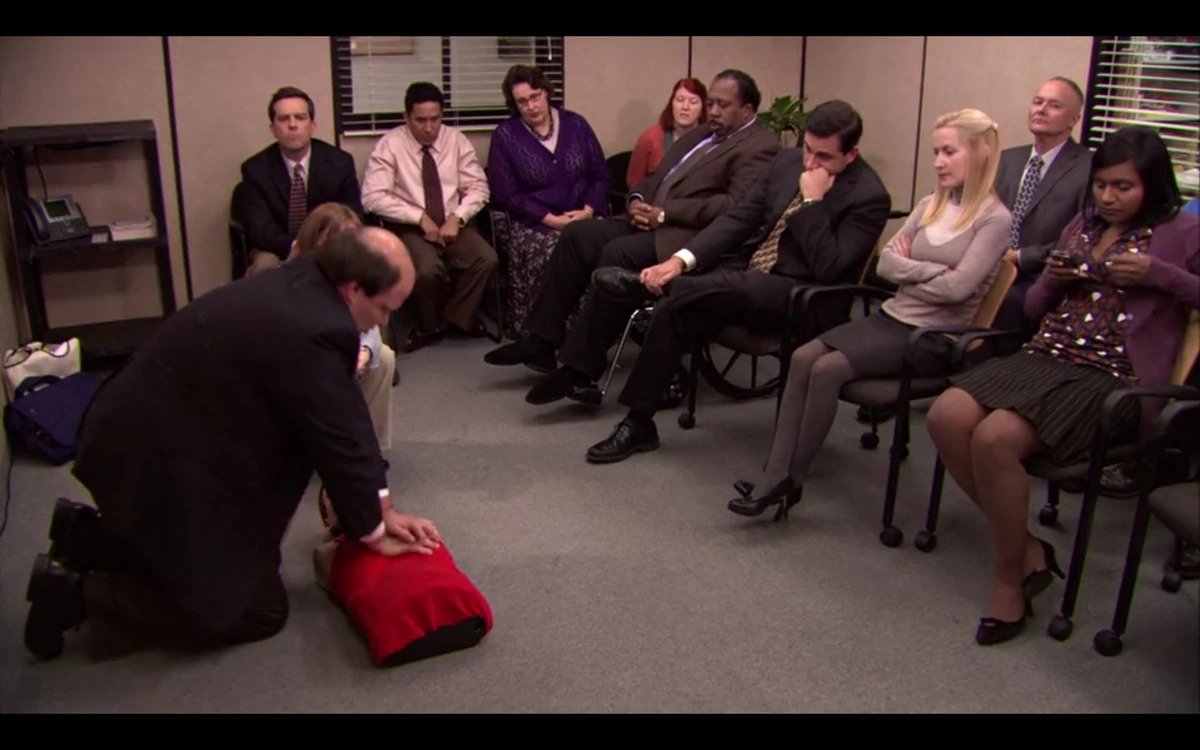
In January 2019, a 21-year-old Tucson man who worked at a tire and auto care center found a woman slumped over her steering wheel. He remembered CPR being performed on an episode of “The Office.”
Hoffman said the chest compressions shown on “The Office” were given too high on the body, almost at the level of the neck. But the man in Tucson remembered how the character on TV had sung the Bee Gees song “Stayin’ Alive” to time the compressions correctly; following that example, he saved the woman’s life.
In 2023, a 12-year-old Florida boy saved the life of his behavioral therapist after the man lost consciousness in a swimming pool and became unresponsive. The boy had watched CPR performed on an episode of “Stranger Things.”
The boy saved the man’s life. Still, the depiction on “Stranger Things” wasn’t perfect, according to Mikhail Varshavski, a 36-year-old family medicine doctor who works at Atlantic Health Systems Overlook Medical Center in Summit, New Jersey. He is better known to his 30 million followers on social media as Doctor Mike.
The character on “Stranger Things” used a precordial thump technique (a hard blow to the chest with a clenched fist), which sometimes succeeds in jolting the heart from a life-threatening rhythm back into a regular rhythm. But the thump, while dramatic, is not routinely recommended, Varshavski said. In his popular YouTube videos, the doctor often replays clips of TV medical scenarios, “where the consistent theme is me yelling at the actors telling them that they need to do chest compressions.”
Kevin M. Hazzard, author of the 2016 book “A Thousand Naked Strangers,” a memoir of his nine years working as a paramedic in Atlanta, said: “I’ve pulled up on a number of scenes in which people are doing CPR, and I can just tell from across the street as I’m getting out of the ambulance that it’s not going right.”
Often the problem is the rhythm and posture. “If you’ve ever seen an oil derrick, that’s the move,” Hazzard said. “The ideal movement is your arms are straight, elbows straight, and the flexion comes from your lower back going up and down.”
Hazzard said most people don’t realize until they perform CPR that it is exhausting work. He and other EMTs said that although patients on television typically revive after a couple of minutes of receiving CPR, in real life the process often requires performing chest compressions for 15 minutes or more. Even then, the chest compressions fail more often than one would assume from TV depictions. When EMS workers administer CPR, only about 9.1 percent of patients survive to the point of being discharged by the hospital, according to the American Heart Association.
While doctors and emergency medical services workers are generally critical of the way television shows portray CPR, a number did single out the HBO Max series “The Pitt” for its realism.
The journal study found that on-screen, nearly half of those receiving CPR are between the ages of 21 and 40. That, too, is unrealistic. In real life, the average age of a person receiving CPR is 62. About 80 percent of the TV episodes the researchers studied showed CPR performed in public; in fact, about 80 percent of out-of-hospital cardiac arrests take place at home.
Other mistakes?
On television, a person flatlines, and the medic goes rushing off for the defibrillator. The nonmedical among us tend to think the process is like jump-starting a car. It’s not.
“It’s like rebooting the heart. But if there’s no electrical activity in the heart, then rebooting is going to be like turning on and off a computer that’s not plugged in,” explained Daniel Sundahl, who worked for 20 years as an advanced care paramedic in a community west of Edmonton, Alberta.
In real life, medical experts also say, the person performing CPR seldom gets emotional to the point of shouting, “Come on, Charlie. Come on!” as one of the characters does on an episode of “Lost.”
They have been trained to remain as calm as possible in such situations. The one possible exception: rare instances in which they are administering CPR to a young child.
At Pittsburgh’s School of Public Health, Fawole said that it is important to acknowledge “that there is some good we’re seeing in these episodes,” but also that there is a compelling reason to improve.
“People are going to the doctor for an hour a year,” she said, “but people are watching thousands and thousands and thousands of hours of television.”
—
Video Embed Code
Video: A new study from the University of Pittsburgh found that only 30 percent of TV episodes show correct CPR methods used outside a hospital.(c) 2026 , The Washington Post
Embed code:
Related Content
The rise and fall of Border Patrol ‘commander at large’ Greg Bovino
America’s oldest warship, sunk in 1776, is getting a 250th-birthday makeover
Deep cold could last days, worsening storm’s impacts: ‘I’m just really, really tired’
