


At least 245 new measles cases have been reported in the U.S., according to newly updated data from the Centers for Disease Control and Prevention.
The CDC said on Friday that a total of 416 cases have been reported in 14 states, including Arizona, California, Florida, Georgia, Idaho, Kentucky, Minnesota, North Carolina, Ohio, Oregon, South Carolina, Utah, Virginia and Washington.
Only three measles cases this year were from international visitors, CDC data shows.
About 94% of cases are among people who are unvaccinated or whose vaccination status is unknown, the CDC said.
1 year since measles cases found in Texas, US still seeing surge of infections with elimination status at risk
Meanwhile, 3% of cases are among those who have received just one dose of the measles, mumps, rubella (MMR) vaccine and 3% of cases are among those who received the recommended two doses, according to the CDC.
CDC data shows that the majority of cases occur among patients under 19. About 2% of all measles patients in the U.S. have been hospitalized.
It comes as a measles outbreak, which began last year, continues to spread across South Carolina. The South Carolina Department of Public Health (DPH) reported 54 new cases of measles on Friday, bringing the total number of cases in the state to 700.
There are currently 485 people in quarantine and 10 in isolation with the latest end of quarantine being Feb. 14, according to state health officials.
Dr. Kristin Moffitt, an infectious diseases physician at Boston Children’s Hospital, said she is “very alarmed” by the increase in measles cases in the U.S. over the last year or two.
“I’m very worried about our current year already,” she told ABC News. “Exceeding 2,000 cases in the last year is indeed alarming [and] … I am worried that even our current year is off to a very concerning start.”

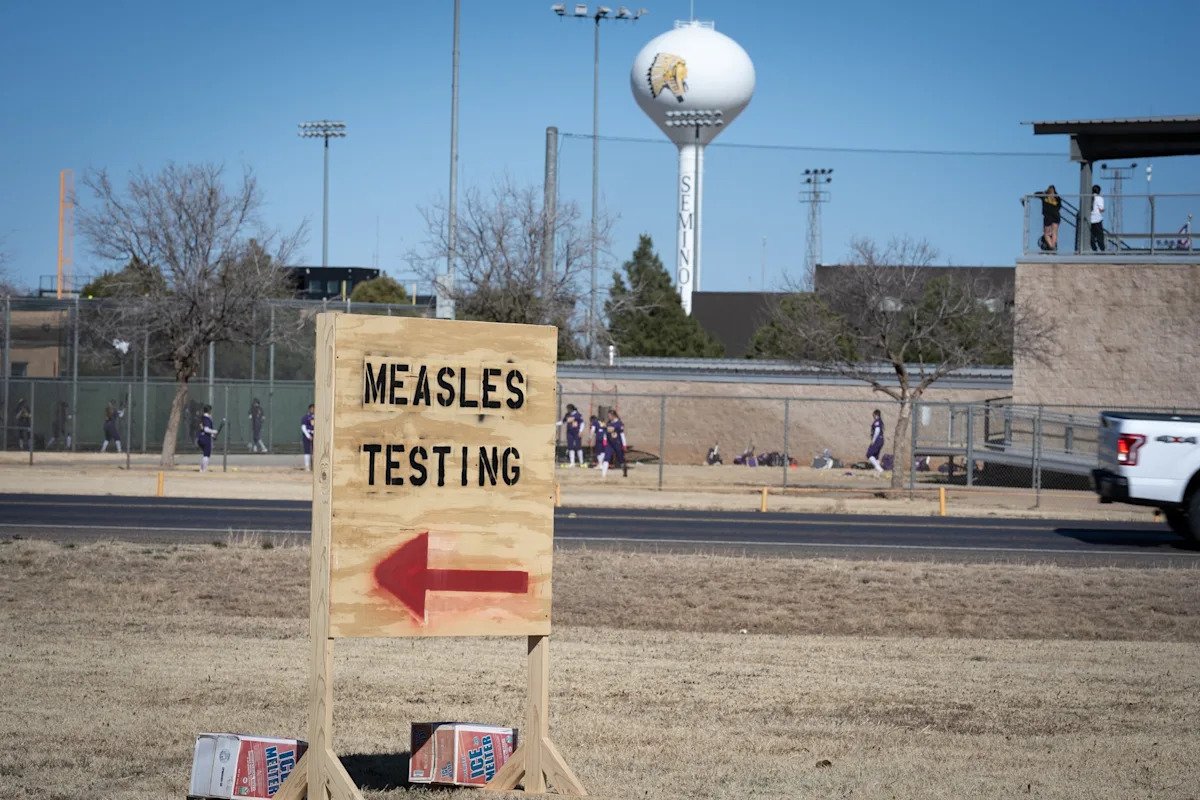
Jan Sonnenmair/Getty Images – PHOTO: Signs point the way to measles testing in the parking lot of the Seminole Hospital District across from Wigwam Stadium, February 27, 2025 in Seminole, Texas.
Moffitt said that declining vaccination rates across the U.S. are behind the recent increase in measles cases.
“This is entirely due to declining vaccination rates,” she said. “It’s very clear based on where these outbreaks are occurring.”
The CDC currently recommends that people receive two doses of the MMR vaccine, the first at ages 12 to 15 months and the second between 4 and 6 years old. One dose is 93% effective, and two doses are 97% effective against measles, the CDC says.
However, federal data shows vaccination rates have been lagging in recent years. During the 2024-2025 school year, 92.5% of kindergartners received the MMR vaccine, according to data. This is lower than the 92.7% seen in the previous school year and the 95.2% seen in the 2019-2020 school year, before the COVID-19 pandemic.
“What our concern is, is that as you have lower vaccination rates each year, you’re gonna get a bigger and bigger population of people that are not immune, and so it’s gonna increase your likelihood of having outbreaks,” Dr. Robert Frenck, a professor of pediatrics in the division of infectious diseases of Cincinnati Children’s Hospital, told ABC News.
New map shows how to spot the measles risk level in your ZIP code
The national trends mirror those see in counties across the U.S. A recent map from ABC News — a collaboration with researchers from Boston Children’s Hospital, Harvard School of Medicine and Icahn School of Medicine at Mt. Sinai that allows people to type in their ZIP code and see the measles risk in their area — found a wide range of risks in areas across the U.S.
Some counties and ZIP codes fell into the “lowest risk,” with 85% or more of children under 5 years old receiving one or more measles vaccine dose to “very high risk” with fewer than 60% of children under age 5 receiving one or more measles vaccine dose.
Moffitt explained that many counties are below the 95% vaccination threshold needed to achieve herd immunity, which occurs when enough people are vaccinated in a community so vulnerable people are protected and the virus has few people to infect.
“So, one in five children, and it is absolutely school-age children who are representing the burden of these cases,” she said. “So, if these numbers continue to increase, we could see significant surges, and they will be very local surges in hospital admissions for measles and complications of the measles.”
Richard Zhang, MD, MA, is a child and adolescent psychiatry fellow at Yale School of Medicine and a member of the ABC News Medical Unit.
ABC News’ Youri Benadjaous contributed to this report.
