


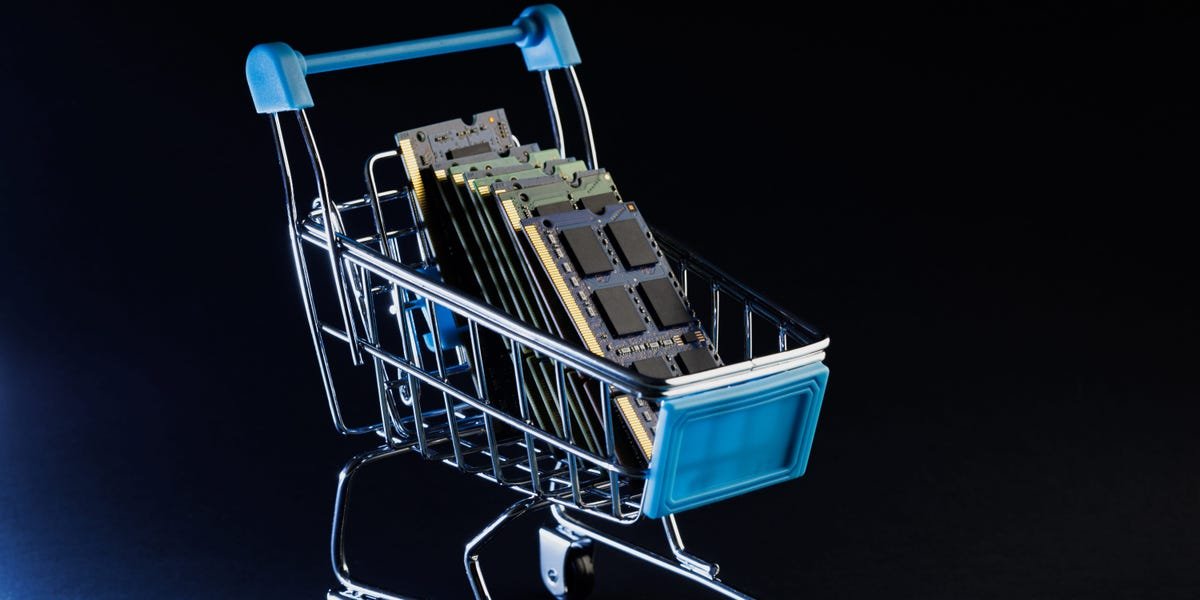
Did that computer you were eyeing jump in price? Is that gaming handheld out of stock? You might want to practice a new refrain: Thanks, memory shortage.
As AI companies demand increasingly large troves of chips to power their large language models, memory chips remain in short supply. That’s bad news for much of the consumer electronics market, which relies on DRAM and NAND memory chips.
The research firm IDC expects “significant pressure on the memory ecosystem,” warning that supply growth would be below historical norms this year. Electronics companies from Valve to Framework have already changed their sales procedures because of the shortage. Even Apple, the industry goliath, said it was expecting supply chain pressures on memory that would weigh on its famously high gross margin.
The memory shortage has existed for months — but it’s beginning to affect more shoppers’ wallets. And the bad news is it’s not expected to let up anytime soon.
Which companies have been affected?
Electronics CEOs are sounding the alarm for “RAMageddon.”
Just last week, Lenovo CEO Yang Yuanqing told Reuters that he expected PC unit sales to “face pressure.” Intel CEO Lip-Bu Tan predicted that there would be “no relief until 2028.”
Dell has already begun adjusting its device prices, according to an internal list of price changes sent to staff in December seen by Business Insider. The company raised the prices of its Dell Pro and Pro Max notebooks and desktops with 32GB of memory by between $130 and $230, among other increases.
HP also planned price hikes “across the board” thanks to the memory shortage, its CEO said on its November earnings call.
Smaller PC makers — which may not enjoy the same amount of supply-chain leverage as their tech titan peers — have also been hit especially hard.
Framework raised its prices in December, then again in January, and again in February. Corsair accidentally underpriced its DRAM kits, canceling preorders and sending out coupons. It then raised prices days later, citing “market costs.”
The gaming device market is also struggling. Valve updated the site for its popular Steam Deck handheld device to say that it may be “out-of-stock intermittently in some regions due to memory and storage shortages.” The company also said it must “revisit” the pricing and scheduling of its upcoming Xbox and Playstation competitor, the Steam Machine, and VR headset, the Steam Frame, because of the shortage.
Bigger players could be next on the horizon: Bloomberg reported over the weekend that Sony was considering pushing back the launch of the next PlayStation, and that Nintendo was considering a price hike for the Switch 2.
Some companies could choose to absorb any associated cost increases at the expense of their margins, opting to wait out the supply crunch.
Meanwhile, bigger and bigger names keep speaking out about the shortage and its impacts.
Elon Musk warned of a “chip wall” on Tesla’s fourth-quarter earnings call. Tim Cook pointed to the shortage on Apple’s fourth-quarter earnings call, saying that the company was watching memory prices increase “significantly.”
So, what’s going on with memory?
This is where things get a bit more technical, but it all boils down to basic supply and demand.
There are three types of chips that are important to know. DRAM (dynamic random access memory) and NAND (non-volatile flash memory) are crucial for building consumer devices. HBM (high-bandwidth memory) chips are used to help train large language models.
Three companies dominate the memory chip market: Samsung, SK Hynix, and Micron. These companies also produce HBM chips.
AI companies are hungry for more and more chips, and are willing to break out the checkbook to be first in line for factory production — giving them an edge over many consumer tech companies. They’re also flush with cash, with companies like Microsoft and Meta projecting multi-billion-dollar capital expenditures, much of which is going toward AI-related costs like chip acquisition.
That leaves chipmakers responding to the spike in demand by raising prices, selling supply to AI companies, and some transitioning to HBM production.
The shortage isn’t fading anytime soon. SK Hynix has long secured demand for its entire 2026 DRAM and NAND production volume. The CEO of Micron predicted on its first-quarter earnings call that supply would remain substantially short for the “foreseeable future.”
And if you’re trying to build your own PC, a mere consumer navigating the increasingly volatile memory marketplace: Good luck.
