


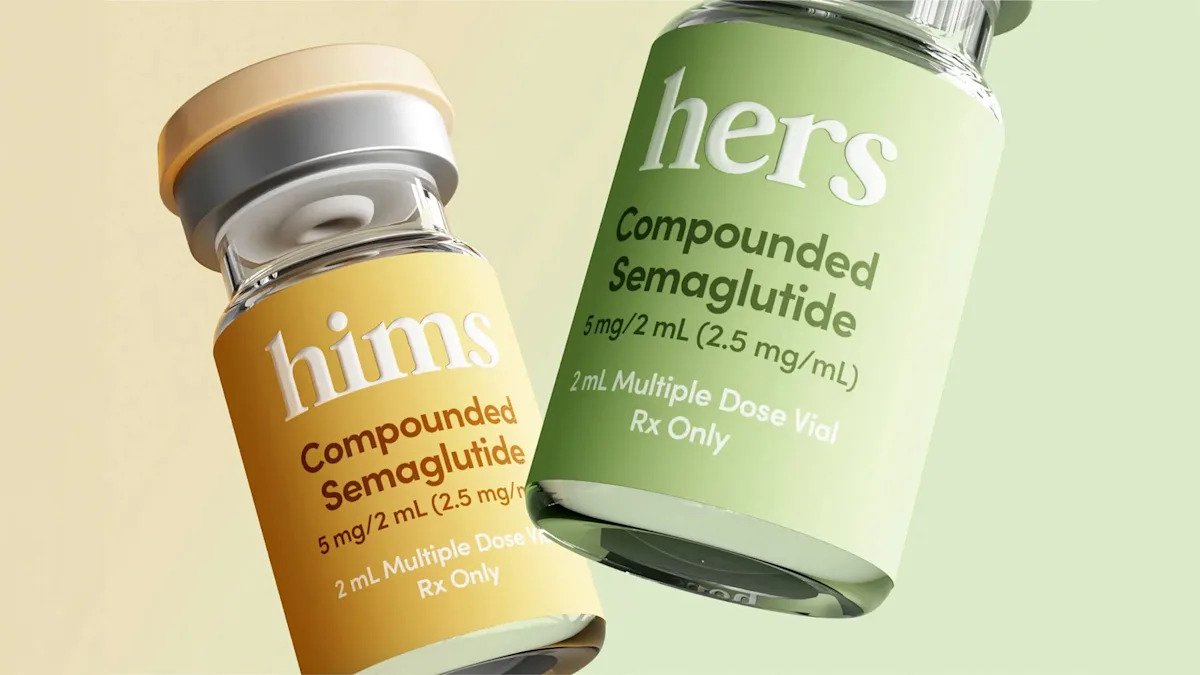
After two splashy Super Bowl commercials focused on making weight loss medication more accessible, Hims & Hers will no longer advertise compounded GLP-1 drugs, the company announced Monday. Instead, Hims & Hers reached an agreement with Novo Nordisk, the maker of Ozempic and Wegovy, to sell the company’s name-brand drugs through its telehealth platform, ending a lawsuit brought by the pharmaceutical company.
Hims & Hers had also planned to sell a compounded version of Novo Nordisk’s oral semaglutide pill, but pulled the medication from its site only days after launch, following the Food and Drug Administration’s announcement that it would crack down on compounded GLP-1 medications. Now it will sell Novo Nordisk’s oral Wegovy, the company announced.
As of August 2025, Hims & Hers boasted 418,000 weight loss customers who bought semaglutide (the active ingredient in Wegovy) and tirzepatide (the active ingredient in Zepbound). Compounded weight loss drugs aren’t being done away with entirely (at least, not yet), but the company now plans to transition the vast majority of those customers to the name-brand versions of their current medications.
The last several years have seen a business boom for Hims & Hers, thanks to its compounded weight loss drug offerings, and patients have flocked to the company to gain access to drugs they couldn’t otherwise afford. The name-brand offerings will likely be more expensive — so what’s in store for patients? Here’s what to know.
Hims & Hers has a long history of controversy over compounded GLP-1s
Hims & Hers began selling copycat versions of Wegovy and Ozempic in 2024, citing a regulatory loophole that allows compounding pharmacies to copy otherwise patent-protected drugs amid shortages. The compounded drugs were sold at a starting price of $199 a month — a fraction of the more than $1,000 per month list price for Wegovy and Ozempic, without insurance.
It was a boon to the company, which reported a 49% increase in year-over-year revenue by Q3 2025. And for many consumers shut out by high prices or lack of insurance coverage, compounded semaglutide was an affordable alternative. Hims & Hers, along with countless other telemedicine companies, including Ro, also sold compounded tirzepatide. Hims & Hers’s buzzy ad campaigns marketed their versions of these drugs as an effort to democratize weight loss, in direct opposition to big pharmaceutical companies’ high-priced solutions.
But these cheaper medications have existed on shaky regulatory ground from the jump, as I reported last year. Compounding pharmacies are only supposed to make copies of patented prescription drugs during active shortages or to create special formulations for patients who can’t take the off-the-shelf versions of medications. For example, if someone can’t swallow pills, a compounder might make a drinkable or injectable form of the medication. Or, if a patient needs a higher or lower dose of a drug than is available, compounding pharmacies can make a custom one.
These are generally rare exceptions. So, regulators have been dubious about telehealth companies’ claims that, in the case of Hims & Hers, nearly half a million patients need custom doses. The FDA has sent warning letters, Novo Nordisk and Eli Lilly have sued various telehealth companies and judges have issued injunctions aimed at stopping the production of copycat drugs. In addition to claims that compounded GLP-1s infringe on pharmaceutical companies’ patents, the FDA expressed concern that because the administration doesn’t regulate compounded drugs, these versions may not be as safe as the brand-name GLP-1s and could carry a risk of improper dosing.
Novo Nordisk and Hims & Hers reached a previous agreement last year that was supposed to bring down prices of Wegovy and Ozempic while tapering the telehealth provider’s compounded offerings, but little came of it. The compounded GLP-1 business continued as usual. But this time around, the deal seems more concrete.
What will happen now?
Hims & Hers has struck a deal with Novo Nordisk to sell its medications and stop marketing compounded versions. As a result, Novo Nordisk has dropped the lawsuit it filed against Hims & Hers in February.
On March 9, Hims & Hers said in a press release that it plans to phase out compounded semaglutide and transition patients to injectable Ozempic or Wegovy or the new oral Wegovy, though compounded medications were still listed on its website as of midday. And Hims & Hers does not say it will stop prescribing compounded GLP-1s altogether. A spokesperson for the company told me it would still sell compounded weight loss medications “at a limited scale,” but did not address my specific questions about pricing for the name-brand drugs.
For many patients, this pivot may not be as simple as the company suggests — and it may hit them harder in their wallets. The starting self-pay price for compounded GLP-1s was $199 a month through Hims & Hers. Ozempic is now offered on the company’s site at a starting cost of $1,799 a month without insurance. Wegovy is listed for $1,999. Although the company hasn’t announced a similar partnership with Eli Lilly, Hims & Hers now lists the drugmaker’s weight loss medications, Mounjaro and Zepbound, as available in some sections of their website, but not on the page where prices can be viewed.
The self-pay prices currently listed for the brand-name drugs on the Hims & Hers website are nearly 10 times higher than the compounded versions. Meanwhile, Novo Nordisk’s own self-pay options list the starting monthly prices for its medications as $149 for the first two months for new patients only and $349 per month without insurance. (Neither Novo Nordisk nor Eli Lilly, which makes Mounjaro and Zepbound, has announced similar deals with other telehealth companies such as Ro. But Ro announced markdowns for FDA-approved, brand-name weight loss drugs and currently does not list compounded options.)
The good news is that the Hims & Hers prices will likely change, Michael Baker, director of Health Care Policy at the American Action Forum, tells Yahoo. “I expect Hims [& Hers] to align their pricing with Novo Nordisk’s pricing because I believe that’s Novo’s goal and they’re going to request that pricing be aligned across all the direct-pay platforms,” he says.
That would still mean a price hike for Hims & Hers customers, since even matching Novo Nordisk’s rates would result in patients paying more than before. Even so, Baker believes that it will ultimately be a win for patients. Telemedicine lowers a barrier for patients who may be reluctant to ask their health care provider in person to put them on a weight loss drug, he notes. And while semaglutide prices may tick up, patients should feel more confident knowing they’re getting an FDA-approved drug.
Plus, Baker suspects that broader availability of GLP-1 medications through Hims & Hers and similar platforms such as Ro will drive down prices long-term, and may spur cost-offsetting programs to spring up to help meet demand. “As the access pie grows, basic economics says that the price will go down,” he says.
