


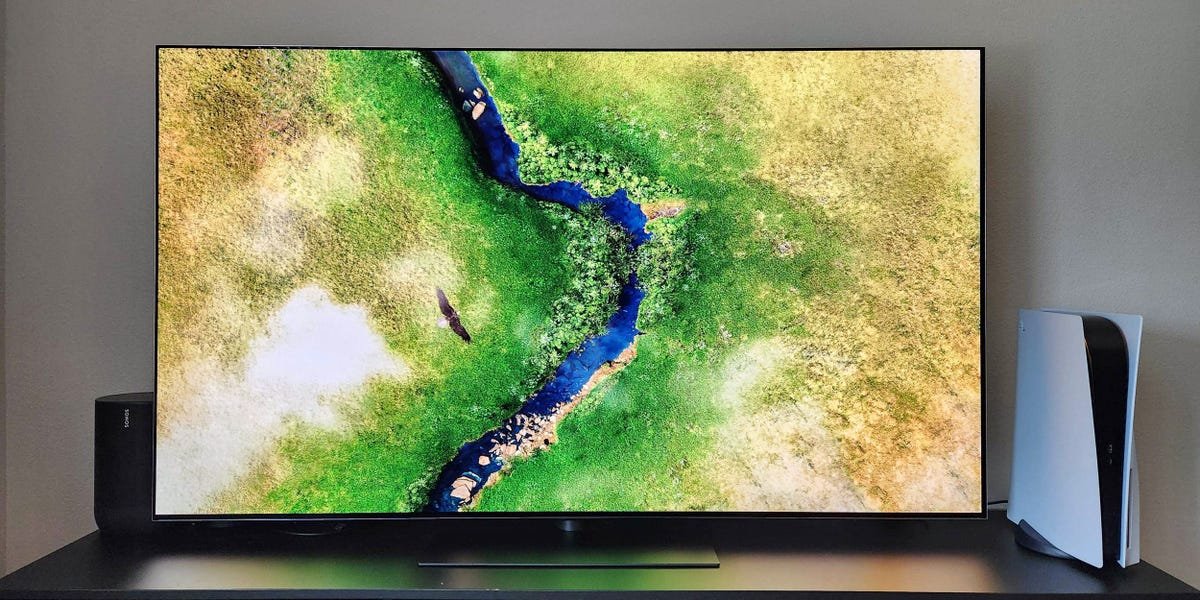
I test TVs for a living, which means I’ve spent countless hours staring at screens and comparing every major display technology. LED and QLED TVs have come a long way, but when it comes to pure picture quality, OLED TVs still reign supreme. The best OLED TVs aren’t exactly budget buys, but what you get in return is hard to beat: perfect black levels, jaw-dropping contrast, and wide viewing angles. That latter feature is an especially handy perk if you’re planning a Super Bowl watch party, since it means guests get a good view no matter where they sit.
To make shopping easier, I’ve narrowed things down to the four best OLED TVs you can buy right now. For most people, my top recommendation is the Samsung S90F, which hits a sweet spot with vibrant colors, impressive brightness, and excellent overall value. However, if you want the absolute best and don’t mind paying for it, the LG G5 sits at the top of the mountain, delivering the most impressive image quality I’ve ever seen from a consumer TV.
Keep reading for a closer look at all four of my best OLED TV picks, chosen to fit different budgets, room setups, and viewing habits.
Our top picks for the best OLED TVs
Best overall: Samsung S90F 4K TV – See at Amazon
Best high-end display: LG G5 4K TV – See at Amazon
Best on a budget: LG B5 4K TV – See at Amazon
Best anti-glare screen: Samsung S95F 4K TV – See at Amazon
Best overall
Samsung 65-inch S90F OLED 4K TV
The S90F is an impressive midrange OLED and one of our favorite displays. It gets a bit brighter than the older S90D and offers better color volume than similar LG OLED models.
The Samsung S90F is the best OLED TV for most viewers — and my pick for the best TV overall. Yes, there are pricier models that push image quality even further, but few deliver this level of performance for the money.
Like all OLED TVs, the S90F delivers wide viewing angles and an infinite contrast ratio. Black levels do rise slightly in bright rooms, but never to a distracting degree, and they disappear completely when you turn off the lights. This model also stands out from similarly priced rivals thanks to Samsung’s use of quantum dot color technology, which enhances brightness and color volume beyond those of a typical OLED panel.
John Higgins/Business Insider
However, quantum dots are only used in the 55-, 65-, and 77-inch sizes, so smaller and larger versions of the S90F don’t benefit from this feature. Those sizes still offer excellent image quality, but they’re more comparable to LG’s C5 in color capabilities.
Our reviewer measured a peak brightness level of around 1,460 nits on the 65-inch S90F. That’s a solid step up from the 1,200-nit max of this model’s predecessor, the S90D, and most competing midrange OLEDs from LG and Sony. This enables HDR content to shine, with rich, saturated colors that stay vivid even in bright scenes.
HDR10 and HDR10+ playback look fantastic via streaming and 4K Blu-ray, though Samsung still skips Dolby Vision. While that omission might bother some enthusiasts, I don’t consider it a dealbreaker since the differences between HDR formats are often hard to spot outside a side-by-side comparison. (If you’re curious, check our HDR TV guide to see how Dolby Vision compares to other formats.)
On the software side, Samsung’s latest smart TV platform feels smoother and more reliable than it has on older models, which were prone to more lag. The interface also features a cool Gaming Hub with access to the Xbox app, which allows Game Pass members to stream games without a console.
Read our Samsung S90F 4K TV review.
Check out our guides to the best Samsung TVs, best smart TVs, and best gaming TVs.
Best high-end display
LG 65-inch G5 OLED 4K TV
The G5 is LG’s flagship OLED TV. It’s one of the brightest OLED TVs we’ve ever seen, delivering high-end image quality and an elegant design that can hang flush on your wall.
I’ve tested many impressive displays, but none can match the LG G5 in overall image performance. This premium set is the best OLED TV for people willing to splurge on high-end picture quality.
Though the G5 doesn’t use quantum dots like those found in Sony and Samsung’s flagship OLEDs, it uses a new four-stack panel design to achieve similar performance. With the TV set in its most accurate HDR picture mode, I measured a peak of 2,410 nits. That’s a record for an OLED TV.
In practice, this high luminance leads to stunning HDR performance. Highlights in bright HDR content pop from the screen with dazzling intensity, offering more visual impact than less expensive OLEDs, like the S90F, can.
Steven Cohen/Business Insider
Now, it’s essential to note that only specific HDR movies and TV shows require the high brightness levels that the G5 is capable of. But if you’re a home theater enthusiast who wants to watch bright HDR content the way it’s meant to be seen, the G5’s combination of pixel-level contrast and high luminance is nearly unmatched. Likewise, if you struggle with glare in your room, the G5’s high brightness can help mitigate this issue.
However, that’s not to say the G5 is flawless. Even with brightness maxed out, its glossy screen is still prone to some reflections (though it preserves black levels better than matte-screen options like Samsung’s S95F). The G5’s webOS smart TV platform is decent enough, but it places too much emphasis on shopping recommendations. I also encountered some intermittent errors with hands-free voice recognition. This wasn’t a major problem, but it’s still worth noting.
The G5 comes with a flush wall mount that allows you to hang the display with virtually no gap. The TV looks gorgeous set up this way, but keep in mind that it doesn’t include a stand. If you can’t wall-mount it in your room, you’ll need to purchase a stand separately.
Read our LG G5 4K TV review.
Check out our guide to the best LG TVs.
Best on a budget
LG 65-inch B5 OLED 4K TV
The B5 is LG’s most affordable OLED TV. It can’t match the brightness of the brand’s pricier models, but it still offers infinite contrast, making it an excellent budget OLED for home theater fans.
OLED TVs rarely come cheap, but the LG B5 stands out as one of the most affordable options. While LG’s higher-end C- and G-Series models get brighter and deliver more refined image processing, the B5 still packs the signature perks that make OLEDs special: perfect black levels, infinite contrast, and wide viewing angles.
Those strengths make the B5 an excellent option for viewers who want a home theater TV that delivers better dark-room image quality than competing QLED and LED models in this price range. However, the B5 is notably dimmer than the other OLED models in this guide.
Steven Cohen/Business Insider
It peaks at around 700 to 800 nits, which means that bold highlights in HDR content, such as large explosions, won’t appear as impactful on the B5 as they would on a brighter TV. It also struggles to overcome glare as well as brighter sets can, so it’s best suited for darker rooms rather than spaces with a lot of ambient light.
However, despite being LG’s entry-level OLED, the B5 isn’t lacking in features. Thanks to HDMI 2.1 ports and a 120Hz panel, it supports key gaming capabilities like variable refresh rate (VRR) and 120fps output on both the PS5 and Xbox Series X. You won’t get the ultra-high 144Hz or 165Hz modes found on the C- and G-Series, but the overall gaming experience remains smooth and responsive.
The B5 is available in 48, 55, 65, 77, and 83 inches, with the 48- and 83-inch options being particularly good values for OLEDs at those sizes.
Check out our guide to all the best budget TVs.
Best anti-glare screen
Samsung 65-inch S95F OLED 4K TV
The S95F is Samsung’s latest flagship 4K TV. It’s one of the top high-end displays available, utilizing an advanced QD-OLED panel with a matte anti-glare screen.
Many OLED TVs advertise anti-reflective coatings, but the Samsung S95F uses a glare-free screen that’s on another level. Instead of a typical glossy surface, it features a matte finish that significantly reduces reflections. This type of finish is a real game changer for rooms filled with windows or overhead lighting.
While most OLEDs exhibit a mirror-like sheen when hit by light, the S95F nearly eliminates that effect. In my tests in a brightly lit space, reflections were barely visible, making this one of the best OLEDs available for daytime viewing.
Les Shu/Business Insider
That said, Samsung’s anti-glare screen comes with a trade-off. In bright rooms, the coating dulls black levels, giving them a more gray, hazy tone rather than OLED’s usual deep, inky look. Turn off the lights, though, and that issue disappears, as the S95F still delivers the perfect black-level performance OLEDs are known for in darker environments.
Beyond its standout anti-glare tech, the S95F is a picture-quality powerhouse. It reaches a peak brightness of around 2,170 nits, which is second only to the LG G5. This enables spectacular HDR impact with vivid highlights and excellent color volume.
Gamers will also appreciate the TV’s high 165Hz refresh rate for ultra-smooth motion. The TV also uses a One Connect Box to house its inputs rather than having them built into the back of the panel. This helps keep cables tidy and enables the screen to be uniformly thin, providing a sleek look from every angle.
Ultimately, the S95F’s matte finish is a polarizing choice, but it’s a fantastic feature for certain viewers. Many buyers will still prefer a traditional glossy OLED for deeper black levels, but if glare reduction is your top priority, no other OLED handles reflections this well.
Read our Samsung S95F review.
Visit our guide to the top sports TVs.
Other OLED TVs we considered
Steven Cohen/Business Insider
The picks above represent our top recommendations, but there are other OLED TVs worth considering. Here are a few notable models, along with details on why they didn’t quite make the cut in our guide.
LG C5 OLED 4K TV – See at Amazon
The C5 is LG’s mid-tier OLED, and it’s a fantastic TV. In many ways, it can be considered a runner-up to the Samsung S90F. Both TVs offer very similar performance and are often sold for around the same price, but we ultimately give the edge to Samsung’s model. The reason? The 55-, 65-, and 77-inch S90F TVs use quantum dots, which give those sizes higher brightness and better color performance than the C5.
Read our LG C5 review.
Sony Bravia 8 II OLED 4K TV – See at Amazon
Sony’s Bravia 8 II is the brand’s top TV, and it goes toe-to-toe with the LG G5 and Samsung S95F in many areas. However, it’s often more expensive and is only available in 55- and 65-inch sizes. Both the G5 and S95F can also get brighter than the Bravia 8 II, though Sony’s proprietary picture processing gives the Bravia 8 II an edge in overall accuracy.
Read our guide to the best Sony TVs.
Sony Bravia 8 OLED 4K TV – See at Amazon
The Bravia 8 is Sony’s midrange OLED, sitting right below the Bravia 8 II in its lineup. Its specs put it in a similar performance class as LG’s more affordable C-series and below Samsung’s S90 series. Given current price differences, we give the edge to the LG C5 and Samsung S90F as better options for the money.
Panasonic Z95B OLED 4K TV – See at Amazon
Panasonic’s flagship OLED is the Z95B. This TV uses the same panel technology as LG’s G5 and offers very similar performance. However, it’s typically more expensive and harder to find in stock.
How we test OLED TVs
Steven Cohen/Business Insider
To test the best OLED TVs, our reviewers evaluate several factors, including peak brightness, HDR performance, smart TV features, navigation speed, and value.
To measure the brightness of a TV’s panel, we use an X-Rite iDisplay Plus colorimeter with test patterns on the Spears & Munsil UHD HDR Benchmark 4K Blu-ray disc. We also use this disc’s patterns to evaluate other objective display qualities. However, test patterns can only reveal so much, so we also use real-world content to get a better sense of how an OLED actually looks when watching regular TV.
We use the same assortment of demo movies and shows on each display to help test each OLED’s overall image performance, with a specific focus on scenes that showcase shadow detail, specular highlights, color fidelity, and sharpness with native 4K, high-definition (HD), and standard definition (SD) content through Blu-ray players, cable TV, and all the best streaming services. We also evaluate OLED TVs under various lighting conditions to assess how each model performs in both bright and dark rooms.
We try to live with each OLED TV we review as if it were our day-to-day personal display. This way, we can identify any quirks or glitches that may appear during general use. We also evaluate smart TV features and navigation to ensure there are no major issues.
For more details on our review process, check out our page detailing how we test tech products.
What to look for in an OLED TV
John Higgins/Business Insider
The best OLED TVs share similar performance, but there are a few factors to consider when selecting a specific model. In particular, you’ll want to decide which OLED panel type is right for your needs, how big you want your screen to be, and how much you want to spend. Here’s some key info to help inform your purchase.
What is an OLED TV?
OLED stands for “organic light-emitting diode.” Instead of using a traditional LCD panel with a backlight, like those found on QLED and LED TVs, OLED TVs are self-illuminating. This means that each pixel on an OLED can emit its own light or turn off completely, enabling an infinite contrast ratio. Because of their high-contrast performance, OLED displays are among the best 4K TVs you can buy.
LG, Samsung, Sony, and Panasonic all sell OLED TV models in the US. Though there are a few types of OLED panels, they all share the same key benefits: pixel-level contrast and wide viewing angles. Some OLED subtypes, however, have extra perks that make them even more desirable.
QD-OLED panels, for instance, offer the added benefit of quantum dot technology, which enables them to produce a wider, brighter color gamut. Sony and Samsung use QD-OLED panels in their top TVs, like the S90F, S95F, A95L, and Bravia 8 II.
Though LG and Panasonic don’t use QD-OLED, their most expensive OLED TVs use other advanced technologies to achieve a similar boost in performance. The LG G5 and the Panasonic Z95B both use a four-stack OLED panel design, which can optimize brightness and color to compete with QD-OLED.
You can learn more about how OLEDs stack up against QLEDs in our full QLED vs. OLED comparison.
What size OLED TVs can you buy?
OLED TVs are sold in various screen sizes ranging from 42 to 97 inches. The most commonly available options are 55, 65, and 77 inches. Both QD-OLED and standard OLED panels are manufactured at those sizes.
A few OLED models are also available in larger 83- and even 97-inch options. However, OLED panels with quantum dots are not currently manufactured at those sizes.
LG, Sony, and Samsung also sell 48- and 42-inch OLED TVs, but only for a limited assortment of their models, and, once again, these options do not use QD-OLED panels.
Some 4K OLED displays smaller than 42 inches are also available, but these sizes are limited to PC monitors, like the 32-inch Alienware AW3225QF.
For OLED TV recommendations specific to certain screen sizes, check out our size-specific guides:
How much should you spend on an OLED TV?
The best OLED TVs don’t come cheap. In general, OLED TVs cost more than other display types, with 65-inch models starting at around $1,000 and maxing out at about $4,000.
Entry-level 65-inch OLEDs under $1,300 aren’t as bright as their more expensive counterparts, with most options in this price range peaking at around 700 nits. Models in the $1,300 to $2,000 range, like the Samsung S90F, can hit around 1,400 nits. Meanwhile, flagship OLEDs in the $2,000+ range, like the LG G5, can reach 2,400 nits.
Unfortunately, it’s rare to find OLEDs, even in smaller sizes, for under $1,000. However, some smaller OLEDs, such as the 48-inch LG B5, occasionally go on sale for around $600. In general, we recommend that budget buyers consider a QLED or LED model instead of an OLED. Check out our guide to the best TVs under $500 for our top picks in that price range.
OLED TV FAQs
Scott Tharler/Business Insider
When will 2026 OLED TV models be available?
LG and Samsung both announced new OLED models at the 2026 CES tradeshow in January. Their upcoming lineups include the new flagship LG G6 and the Samsung S95H, both of which promise a solid jump in peak brightness over their predecessors. Meanwhile, Panasonic and Sony have yet to detail any 2026 OLED models. You can learn more about LG and Samsung’s new displays in our CES 2026 TV roundup.
Though 2026 OLED TV pricing and release dates are still pending, we expect new models to start hitting stores in the spring. However, it’s important to remember that 2025 OLED TVs will remain in stock for much of the year, and they’re likely to get great discounts. With that in mind, we’ll continue to recommend 2025 OLED TVs while they remain the best value.
Should OLED TV buyers worry about burn-in?
Even the best OLED TVs are technically susceptible to burn-in. If you leave a static image on an OLED TV for an extended period — such as a news station’s chyron bar — a faint afterimage can remain on the screen.
Though it sounds alarming, burn-in is not a new phenomenon. Many past TV technologies, including plasma and CRT displays, were also prone to this issue. While OLED buyers should be mindful of this risk, OLED TVs have built-in measures to mitigate burn-in, including automatic pixel-shift modes and pixel refreshers.
Publications like Rtings have done long-term tests with many OLED TV models. While the results indicate that burn-in is possible in extreme use cases, the tests suggest that it shouldn’t be a problem for individuals with regular viewing habits.
I had an LG CX OLED TV in my own home theater setup for over three years, and the screen showed no burn-in. In my experience, as long as you don’t plan to watch the same cable news channel all day, burn-in shouldn’t be a deciding factor in choosing an OLED TV.
Do OLED TVs have good sound quality?
The best OLED TVs all include built-in speakers, but they typically offer mediocre sound quality and lack bass response. If you’re unhappy with your TV’s audio performance, we recommend buying a separate soundbar, particularly one with Dolby Atmos support. Dolby Atmos is a spatial audio format that can spread sound effects around your room with simulated overhead audio, so soundbars with this feature tend to offer the most immersive performance.
Check out our various soundbar and speaker guides to see our top recommendations:
