


With a shaky IPO market, tariff uncertainty, and stock market jitters, these are not easy times to be the chief financial officer of a late-stage tech company.
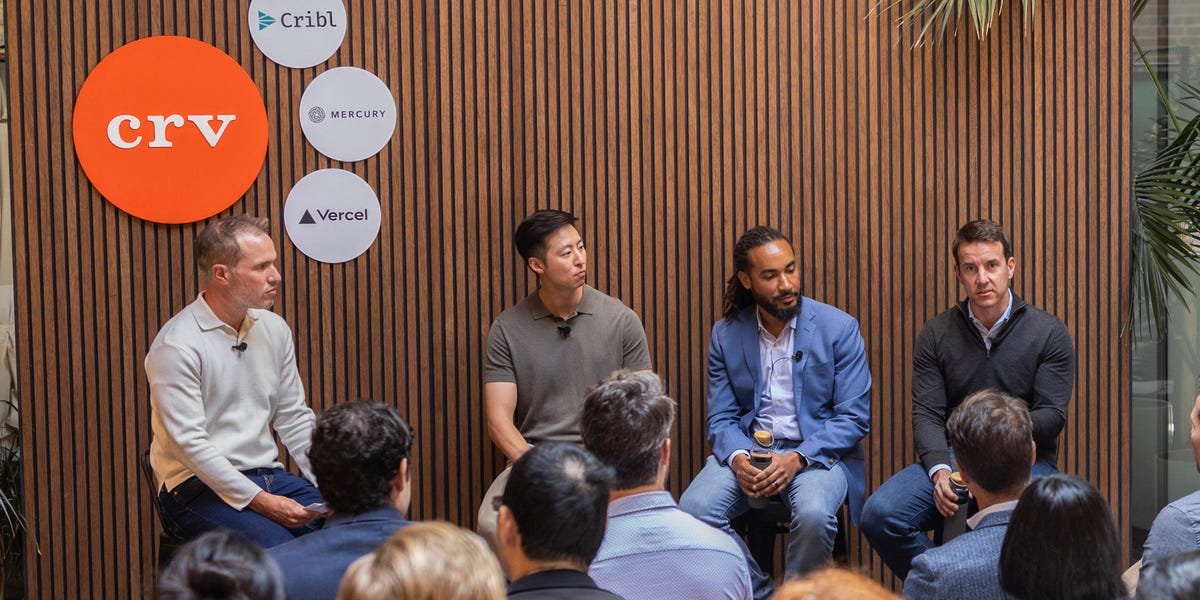
Against that precarious backdrop, I sat down last week with the CFOs of Mercury, Vercel, and Cribl at the San Francisco office of CRV, one of Silicon Valley’s oldest venture firms and an early investor in all three startups.
“I’m expecting a lot more uncertainty,” said Daniel Kang, CFO of Mercury, a fintech banking startup that recently doubled its valuation to $3.5 billion after raising $300 million in its latest funding round. “There’s a lot of impact from what’s happening in DC.”
All the turmoil means CFOs have to be more nimble, said Kang.
Marten Abrahamsen, Vercel’s CFO, was more upbeat. He does not expect a recession this year and predicts a stock market rally in the fall.
“I think a lot of this is going to be fueled by some of the investments we see in AI, and we’re already seeing it for some of our products that weren’t even here a year ago,” said Abrahamsen. “I’m very, very bullish on the remainder of this year and beyond.”
After President Donald Trump announced sweeping tariffs on imports from other countries on April 2, investors panicked and companies from the payments lender Klarna to the physical therapy startup Hinge Health halted their IPO plans.
The pause turned out to be short-lived.
Markets have rebounded after Trump rolled back the most severe tariffs and he said he would not fire Federal Reserve Chair Jerome Powell. Bankers are telling companies to go public while the window is open.
This week, Hinge Health shares jumped 17% in its market debut after eToro, an Israeli trading platform, made a successful public debut on the Nasdaq, opening 34% above its IPO price. (Klarna’s IPO is still on hold after the company reported mounting losses.)
Abrahamsen does not think companies should wait until a better market comes along to IPO; instead, they should focus on what they can control.
“There has been a fear of going public in Silicon Valley,” he said. “Great companies can go public even if there’s not a hot market out there. If you’re an outstanding business, there’s always going to be an opportunity.”
Asked why so few companies are going public, the panelists said companies do not want to deal with the headaches of being a public company when there is so much private financing available. There is also little pressure to IPO from investors and employees, according to Zachary Johnson, CFO of Cribl, a data management solutions startup that raised $319 million last year at a $3.5 billion valuation.
“They understand that we’re trying to build something that’s going to be generational,” said Johnson. “When we think about how we want to build this company, it’s really about focusing on that durability and sustainability of growth.”
Johnson is hopeful that advances in AI can make Cribl even more attractive to investors when it goes public. He recently tasked everyone on his executive team to come up with an AI initiative.
“There’s some work to be done, but I’m optimistic that we can actually get some real returns on that by the end of this year,” he said. “We’re still in the early innings of AI.”
