


After years of development, Sony has finally taken the wraps off its latest advancement in TV technology. The tech, called True RGB, will be used in new Sony TVs coming later this spring. True RGB promises big gains in picture quality over regular old Mini LED and QLED sets. It even has a leg up over OLED in a few areas, particularly color and brightness.
At the core of True RGB is its advanced backlight system, which uses red, green, and blue LEDs to produce a wider, purer, and brighter range of colors than typical TVs that use only white or blue light. But Sony isn’t the only brand that’s bringing RGB backlights to its displays. Rivals like Samsung, Hisense, TCL, and LG are all releasing their own takes on RGB tech this year.
So, what makes True RGB different? Well, to find out, Sony invited a group of journalists to its Tokyo headquarters. There, I was among the first to see this new tech in action, including in comparisons against competing RGB TVs. What I saw left me impressed and instantly wanting more. Here’s what makes True RGB unique and why it could be the high-end TV tech to beat in 2026.
True RGB promises big gains in color and brightness
Steven Cohen/Business Insider
As its name implies, True RGB is Sony’s take on an RGB backlit television. Other companies have already launched or will launch their own RGB offerings this year, and they come with a whole new slew of confusing branding terms to sift through.
For instance, Samsung calls its RGB TVs Micro RGB, while Hisense uses RGB Mini LED. There are differences in how all these brands implement RGB backlighting, so not all RGB TVs are created equal. But the underlying concept is the same: Instead of only relying on a blue or white backlight with a filter to produce color, RGB TVs use backlights with red, green, and blue diodes so the backlight itself creates color.
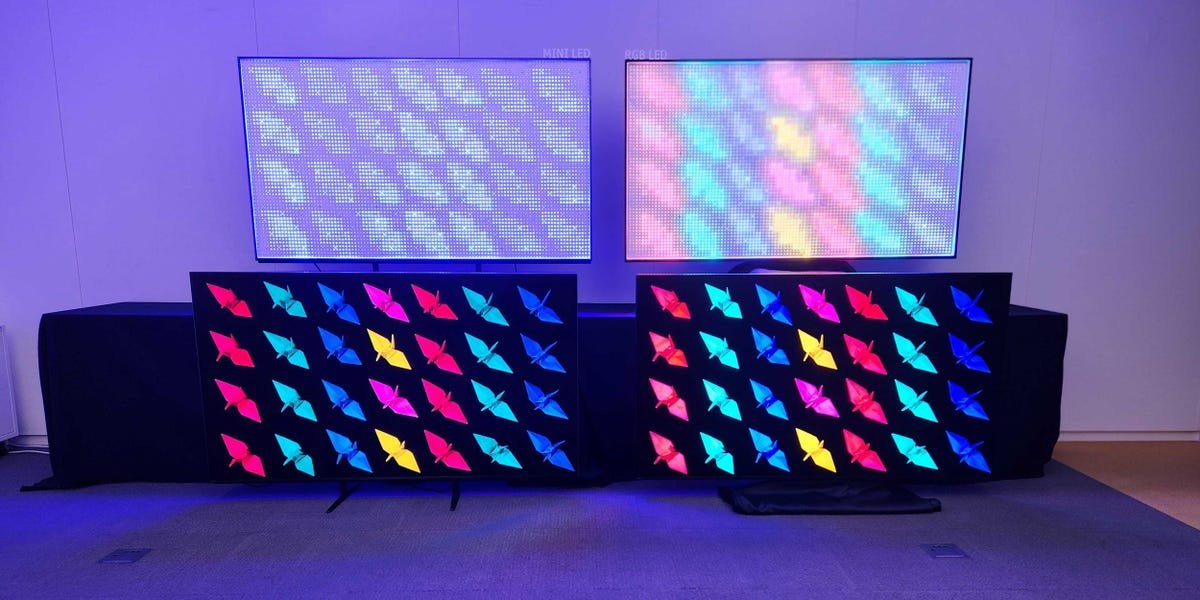
This process enables RGB backlit TVs to produce a much wider range of colors than a typical QLED, Mini LED, or OLED TV. To demonstrate this, Sony set up a demo with a Bravia 9 Mini LED TV (its flagship set from 2025) and a Sony True RGB TV. The Bravia 9 and True RGB TV were both presented with their backlights fully exposed, so I could see how their LEDs helped create images in real time.
Steven Cohen/Business Insider
As expected, the Bravia 9’s light was limited to blue, but the True RGB TV could create color using only its backlight. The TVs were also presented fully intact, so I could see how the final images looked in all their glory. With both TVs displaying a vibrant reel of bold images, the Bravia 9 certainly looked good, but the True RGB TV’s colors looked bolder, with hues that appeared brighter, purer, and more true to life. This is no small feat considering the Bravia 9 remains one of the best Sony TVs ever released and one of the most impressive TVs on the market, period.
It’s also key to point out just how bright the True RGB TV’s backlight was in this demo. In fact, it was so bright that Sony provided sunglasses in case we needed them. A bit gimmicky? Sure, but they actually came in handy.
Sony’s take on the technology could have an edge over the competition
Steven Cohen/Business Insider
Considering all the competing RGB TV terms out there, it’s quite telling that Sony settled on “True RGB” as the official name for its tech. It’s clear the company wants to position True RGB as offering something its rivals lack. To showcase this, Sony set up a comparison demo with a True RGB TV and a few competing TVs that use RGB Mini LED or Micro RGB panels.
Now, comparisons like this can be eye-opening, but they should also be viewed with at least some degree of skepticism. Sony chose the material to compare across all the TVs, so presumably the content was selected to showcase True RGB at its best. That said, Sony was transparent about the settings used on each TV and even adjusted some per request to see if they had any impact. I’ve also previously seen a comparison pitting an RGB Mini LED against an LG OLED, and it showed results similar to this one.
For comparison, the Sony True RGB TV and two RGB Mini LED rivals had the top-right corners of their screens augmented to show their exposed backlights in action, while the rest of the screen displayed a normal image. This allowed me to see how the backlights work while displaying various colors and video clips.
Test patterns of different colors were displayed on all the screens. When using a full-size pattern, all of the TVs used their RGB LEDs to produce light. But when the test pattern was reduced in size, one of the RGB Mini LED TVs reverted to a white backlight instead of RGB. Similar behavior occurred when switching over to clips of actual content. Though the competing TV in question has RGB LEDs, it doesn’t always use them. Meanwhile, the True RGB TV never reverted to a white backlight.
When watching actual content, the True RGB TV had a clear edge in color purity and vibrancy over this competing set. The reason an RGB Mini LED TV might behave this way could be to prevent an issue called crosstalk. Since RGB Mini LEDs create color with their light, that color may sometimes bloom and bleed over into areas of the screen that it’s not supposed to. So, an RGB Mini LED TV displaying a red car on a white background might have its red light spill out into the white area, tinging the white in a red hue. If a TV senses that the scene it’s displaying is too tricky for its RGB LEDs to handle, it may then switch to white or blue light.
Steven Cohen/Business Insider
To avoid this, Sony carefully designed its True RGB backlight with LED density in mind and uses its own advanced algorithm to tell those LEDs how to dim and brighten to produce an optimized picture. This backlight drive uses technology that’s trickled down from Sony’s professional broadcast monitors, which are used to master Hollywood productions. Based on the comparisons I saw, this process really is a step above the competition’s.
To showcase crosstalk in real content, a scene from a film featuring a woman standing before various colorful backgrounds was used. The woman’s skin tones remained correct on the True RGB TV, but background colors subtly tinted her face on some of the other RGB Mini LED sets. The effect wasn’t terrible on the competing TVs, but the True RGB handled it best.
Other scenes were used to highlight the True RGB backlight’s benefits in terms of viewing angles, contrast, and black levels. Again, the True RGB TV had an edge over the competition, with color and contrast that faded and distorted less from angles. That said, the True RGB TV still couldn’t match OLED technology in this regard, and I did still notice some light blooming around a character’s face in one test scene.
Brightness, however, was a big step up over anything I’ve seen on an OLED. A sunset scene was used to showcase the TV’s brightness, and the sun’s highlights were noticeably more impactful than those on the competing TVs in the room. The True RGB TV’s brightness levels were also beyond what any OLED can produce.
Sony True RGB TVs are coming this year
Sony
Though Sony has previewed prototypes of its RGB TV technology in the past, True RGB is no longer just a hypothetical or a cool tease for some far-off release. True RGB TVs are actually coming this year, and soon. Exact availability hasn’t been revealed yet, but Sony says the first Bravia TVs that use True RGB will be coming this spring.
Based on what I’ve seen of the tech so far, I’m excited to spend more time with True RGB and can’t wait to see how actual sets stack up against the best TVs out there. Ultimately, the demos I saw can only show so much, especially since it’s not clear exactly which competing TVs were used in the comparison. But what I saw left an excellent first impression of True RGB TV technology, and certainly left me wanting more.
Hopefully, we won’t have to wait too long to get more details about actual True RGB TVs, but for now, you can head over to the Sony website to get notified when more info is available.
