


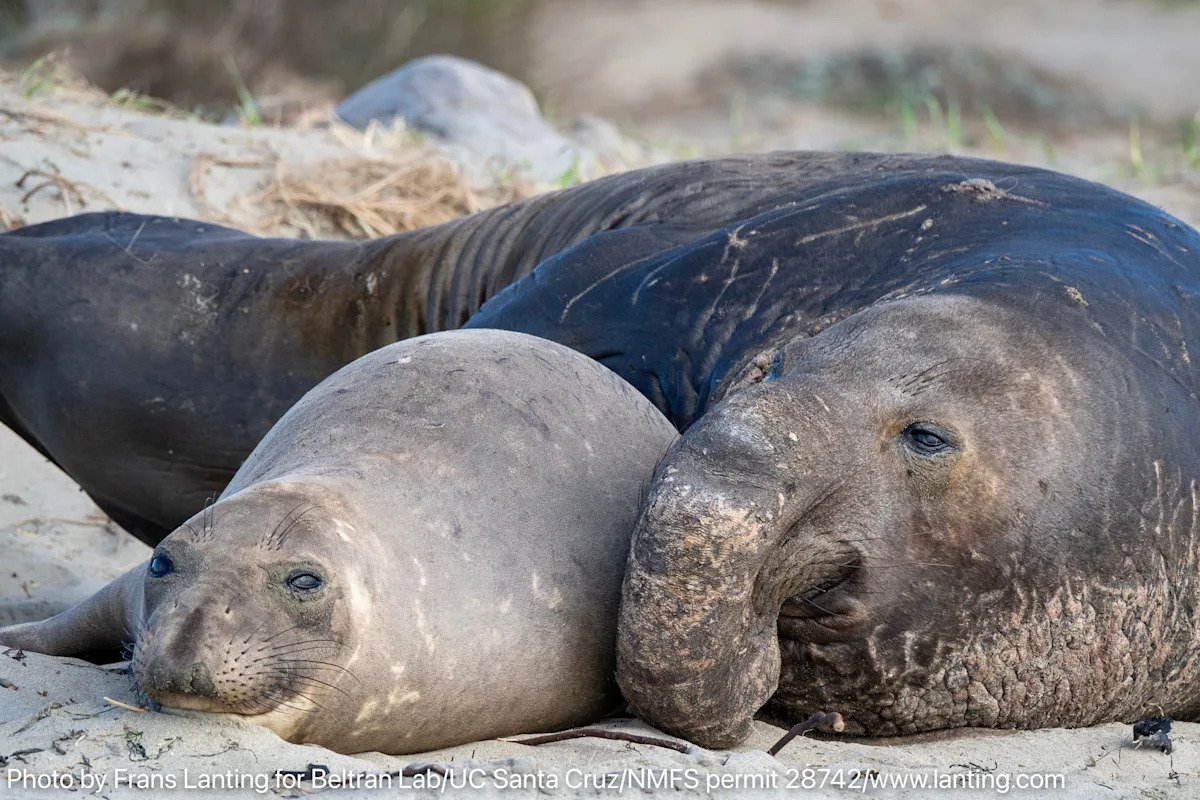
Seven elephant seal pups have tested positive for avian flu at California’s Año Nuevo State Park, after scientists noticed several seals showing abnormal respiratory and neurological signs.
Scientists at UC Santa Cruz, UC Davis, and the U.S. Department of Agriculture’s National Veterinary Services Laboratory confirmed the outbreak late Tuesday evening, marking the first outbreak of HPAI H5N1 in marine mammals in California, according to a press release from UC Davis.

Male and female elephant seals, Ano Nuevo State Park, California, USA
“This is exceptionally rapid detection of an outbreak in free-ranging marine mammals,” said Professor Christine Johnson, director of the Institute for Pandemic Insights at the UC Davis’ Weill School of Veterinary Medicine. “We have most likely identified the very first cases here because of coordinated teams that have been on high alert with active surveillance for this disease for some time.”

UC Santa Cruz researchers in Hazmat suits heading towards elephant seal colony, Ano Nuevo State Park, California, USA
In response to this outbreak, the Año Nuevo State Park has temporarily closed access to the elephant seal viewing area for the rest of the season. The park will provide refunds to any tourists who booked a spot to view the seals.
The state park’s marine education center, horse barn movie theater, and a portion of the Año Nuevo Point Trail will remain open at this time, according to the park’s website.
This is not the first time the disease has been detected in an elephant seal population; in 2023, southern elephant seals in Argentina were affected by it. The disease decimated southern elephant seals, as hundreds of dead pups appeared along the Patagonian coast of Argentina.

UC Santa Cruz researcher in Hazmat suit taking nasal sample from elephant seal pup, Ano Nuevo State Park, California, USA
After the avian flu killed hundreds of southern elephant seals, scientists at UC Santa Cruz and UC Davis increased disease surveillance of the population in North America, out of concern that the disease might spread along the American coastlines.
“Given the catastrophic impacts observed in related species, we were concerned about the possibility of the virus infecting northern elephant seals for the first time, so we ramped up monitoring to detect any early signs of abnormalities,” said Roxanne Beltran, a professor in Ecology and Evolutionary Biology at UC Santa Cruz. Beltran’s lab leads UC Santa Cruz’s northern elephant seal research program at Año Nuevo.
The avian flu was first reported in Canada in December 2021, after the virus was detected in wild birds in every province and territory. However, UC scientists believe this is the first detection of avian flu among the northern elephant seal population.

Ravens feeding on elephant seal carcass, Ano Nuevo State Park, California, USA
The risk of the avian flu transmitting to the general public is very low; the disease can spread between animals and people. Scientists recommend avoiding areas with infected animals, not touching live or dead seals, and not allowing pets to approach them.
If a person encounters a sick, injured, or dead marine mammal in California, Oregon, or Washington, call the NOAA Fisheries West Coast Region Stranding Hotline: (866) 767-6114.
Noe Padilla is a Northern California Reporter for USA Today. Contact him at npadilla@usatodayco.com, follow him on X @1NoePadilla or on Bluesky @noepadilla.bsky.social. Sign up for the TODAY Californian newsletter or follow us on Facebook at TODAY Californian.
This article originally appeared on USA TODAY: Seven elephant seals test positive for bird flu at California beach
