



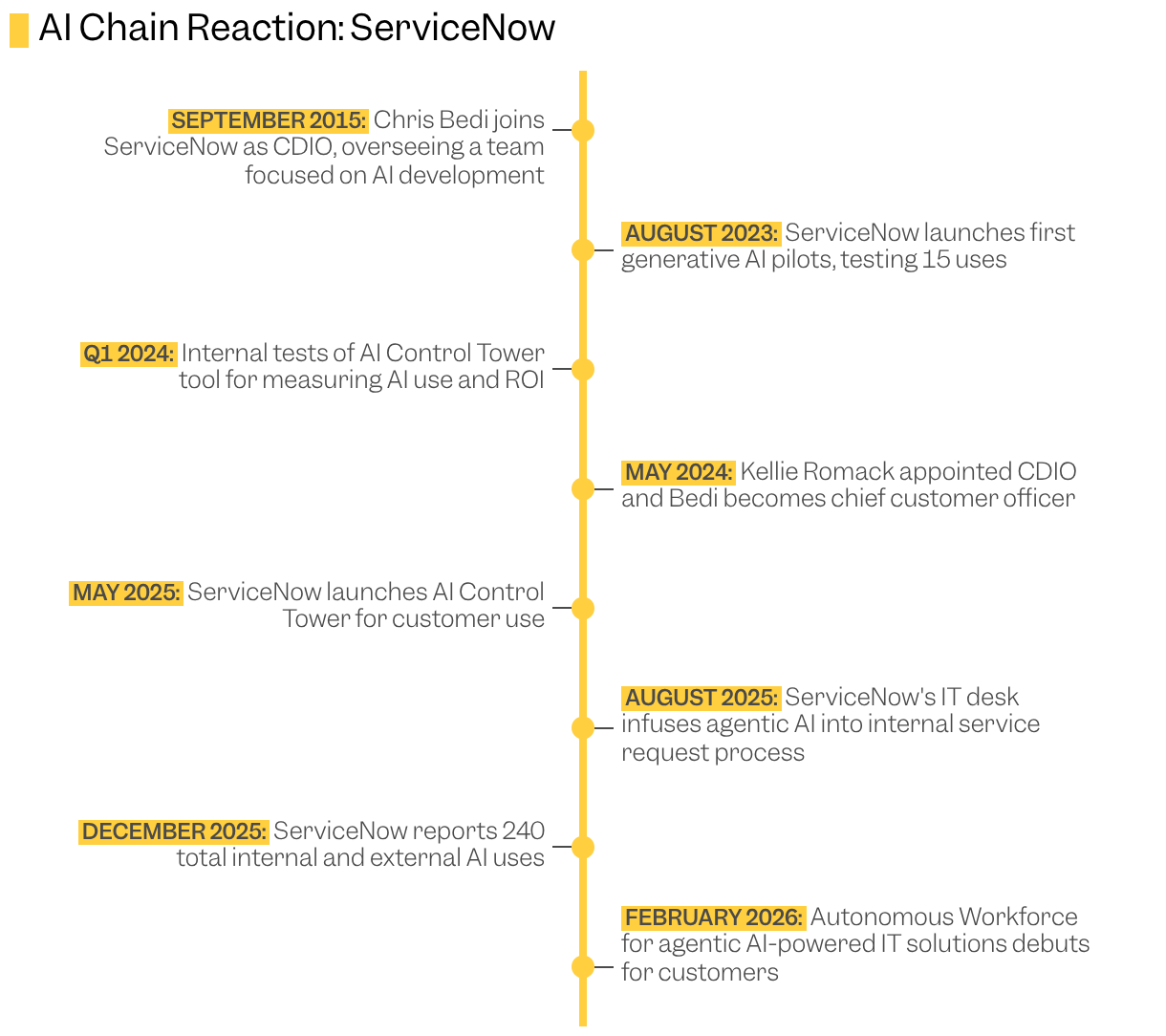
When Chris Bedi joined ServiceNow as chief digital information officer in September 2015, he oversaw a small team of data scientists focused on AI and machine learning development.
Loading audio narration…
Fast forward to 2023, when ServiceNow was piloting applications of generative artificial intelligence internally, with a focus on 15 ways the tech could automate employees’ repetitive tasks. No longer seen as just a range of tech products for internal stakeholders, these pilots were designed to pave the way for ServiceNow’s AI offerings for clients.
In May 2024, Bedi became the company’s chief customer officer, and Kellie Romack, who the company hired in 2022 as its senior vice president of digital technology experiences, became CDIO, underscoring ServiceNow’s strategy of developing AI tools internally before rolling them out to customers. Romack told Business Insider that she spearheads internal efforts to develop and deploy AI tools that automate IT help desk requests and generate code for software developers.
“My team’s job is to create unity, this ecosystem of AI internally,” Romack told Business Insider. “We’re servicing the company and working on ourselves first.”
Kate Smaje, a senior partner at the management consultancy McKinsey and Company, told Business Insider that taking an internal-first approach to developing AI can help companies build confidence and learn, especially when seeking employee feedback.
The tech
The generative AI tools ServiceNow piloted and deployed internally influenced the external products it launched throughout 2023 and beyond.
ServiceNow’s digital technology engineers, who report to Romack, work closely with product and platform engineers focus on developing tools for customers, she said. This pipeline helped ServiceNow as it developed Workflow Data Fabric, its tool for connecting clients’ disparate systems, data, and employees using machine learning.
While building the tool, some engineers discovered that the system was taking too long to send data, according to a ServiceNow spokesperson. The issue was addressed internally and Workflow Data Fabric was made available to customers in October 2024.
This article is part of AI Chain Reaction, a series focused on the real-world downstream effects of AI adoption and implementation.
In the first quarter of 2024, Romack said she also led the development and launch of a governance-focused tool, called AI Control Tower, to track internal AI use cases and large language model adoption.
Romack said the internal development of the AI Control Tower led ServiceNow to focus on three key themes when it launched the product for customers in May 2025: AI governance, tracking efficiency gains, and employee adoption.
The outcome
By December 2025, ServiceNow had more than 240 total internal and external AI use cases — in which various AI agents work together within specific workflows to achieve business outcomes — and nearly 3,000 customers using its AI tools, a company spokesperson said.
According to Romack, one of the company’s most successful internal generative AI applications is on its IT service desk, where ServiceNow added agentic AI capabilities in August 2025. This internal project led to the February 2026 debut of Autonomous Workforce, a tool customers can use to resolve common IT problems, like password resets and network issues, without human intervention.
Romack said AI deployments aren’t always a smooth and linear process. For example, when ServiceNow began to use generative AI for customer support summarization in 2023, early drafts didn’t always accurately summarize cases. ServiceNow had to “hone and tone,” said Romack, using employee feedback to identify the necessary fixes before launching the tool to customers. Now, it’s a strategy Romack uses when launching any new feature.
“I don’t wait two weeks,” said Romack. “We’re talking within 24 to 48 hours that we’re looking at it. With AI, we have such real-time data.”
An AI tool that generates an internal productivity “win” doesn’t always automatically translate to external audiences, said Smaje, because they have different security protocols and employee training protocols.
“Experimentation is only the first step,” Smaje said. “The real challenge, and where value is created, is turning those learnings into robust systems that customers can trust and use at scale.”
