


An AI news app called Particle, from former Twitter engineers, can now keep up with news breaking on podcasts as well as news published on the web.
Just ahead of its recent Android release, Particle has introduced a feature called Podcast Clips, which finds the most interesting and relevant moments across many different types of podcasts, and then includes those clips alongside the related news stories in its feed.
So instead of listening to a lengthy podcast just to catch the 45 seconds of interesting comments, you can play back the clip as you’re reading the news on Particle. You also have the option of reading the transcript of the clip instead, as the words are highlighted as they’re spoken.

“We’ve done that basically for any news story — if there is a podcast that is talking about it, or relevant at all, we’ve got all those clips,” Particle CEO Sara Beykpour, previously the Senior Director of Product Management at Twitter, told TechCrunch. “It’s a really cool way, when you’re reading a story or learning about a story, to get a breath of what are people saying about this? What’s the commentary?”
The addition acknowledges a shift in the news ecosystem that’s been underway for years. Not only are more people getting their news from podcasts and trusting them as reliable sources, but the medium is also becoming a destination for breaking news and major announcements from public figures.
Tech CEOs, in particular, are now seeking out friendly podcast hosts to air their talking points instead of trying to work with traditional media, as Bloomberg reported in 2024.
That makes paying attention to podcasts even more critical if you want to keep up with news.
Beykpour says Particle uses embedding models to understand when podcasts relate to a given news story. These models are provided by the same companies that provide LLM models, but they’re not generative AI technologies, she explains.
“We use vector embeddings to understand that these different parts of the podcasts are related to these different stories,” Beykpour notes. “A single podcast might cover 10 or 20 stories, so we use AI to understand that. We also use AI to do some of the logic around clipping, and understanding when to start a clip and end a clip.”

The company leverages technology from ElevenLabs for transcription. However, some of the technology that identifies where exactly to clip the audio is part of Particle’s secret sauce.
The idea to tap into podcasts to better understand the commentary around news is also something newsrooms are taking a closer look at these days. As Nieman Lab reported this month, The New York Times has been using a custom AI tool that employs LLMs to transcribe and summarize new episodes of dozens of right-wing and more conservative podcasts to better understand what influencers on that side are saying about the news.
Particle’s Podcast Clips feature isn’t tied to only news stories. Because the app already understands different entities — like people, places, or things — you can go to the page for a notable figure, such as OpenAI CEO Sam Altman, to see all of his appearances on podcasts arranged as a feed.

Particle has been busy building other features as well. The company has made its first attempt at monetization with Particle+, an optional $2.99/month subscription (or $29.99/year) that lets you access premium features. These include the ability to use natural language to have the news summarized in a style you prefer; pick from different voices when using the personalized audio feed; “Listen to the News”; unlimited crossword puzzles; support for private questions with its AI chatbot; and more.

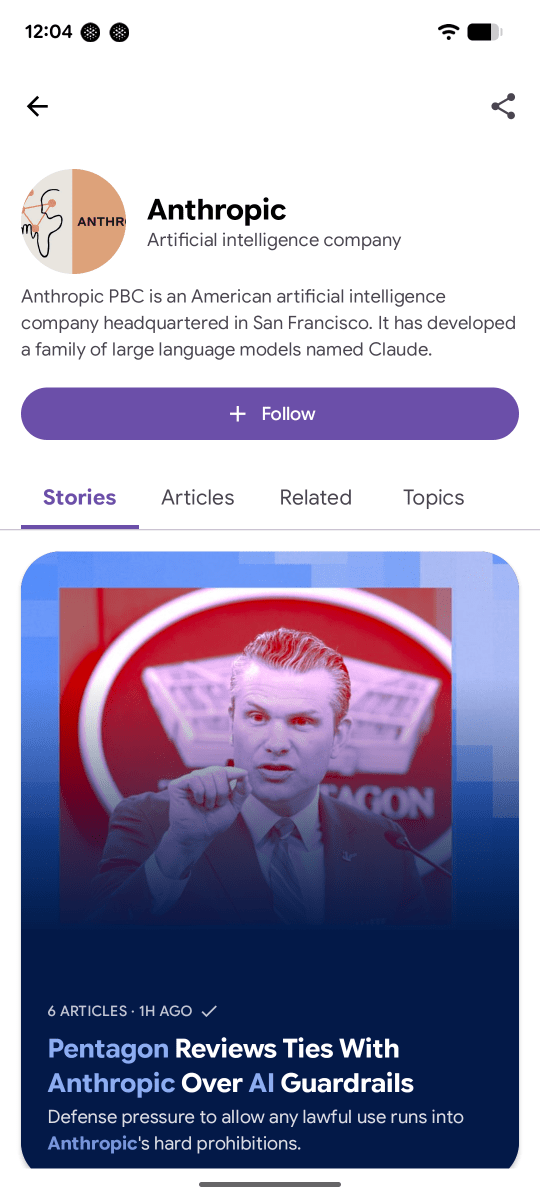
The Android release also brings a couple of other notable changes. The browse tab now includes timely stories, like the 2026 Winter Olympics, in addition to typical sections like politics, tech, or entertainment. Plus, when you tap on an entity, you’ll see a new page with the definition, stories, articles, related entities, and related topics.

Particle isn’t sharing data about user activity or conversion rates, but Beykpour did point to the app’s international audience, pre-Android. On a weekly basis, 55% of Particle’s users are outside the U.S., with India (15%) its biggest market after the U.S.
