


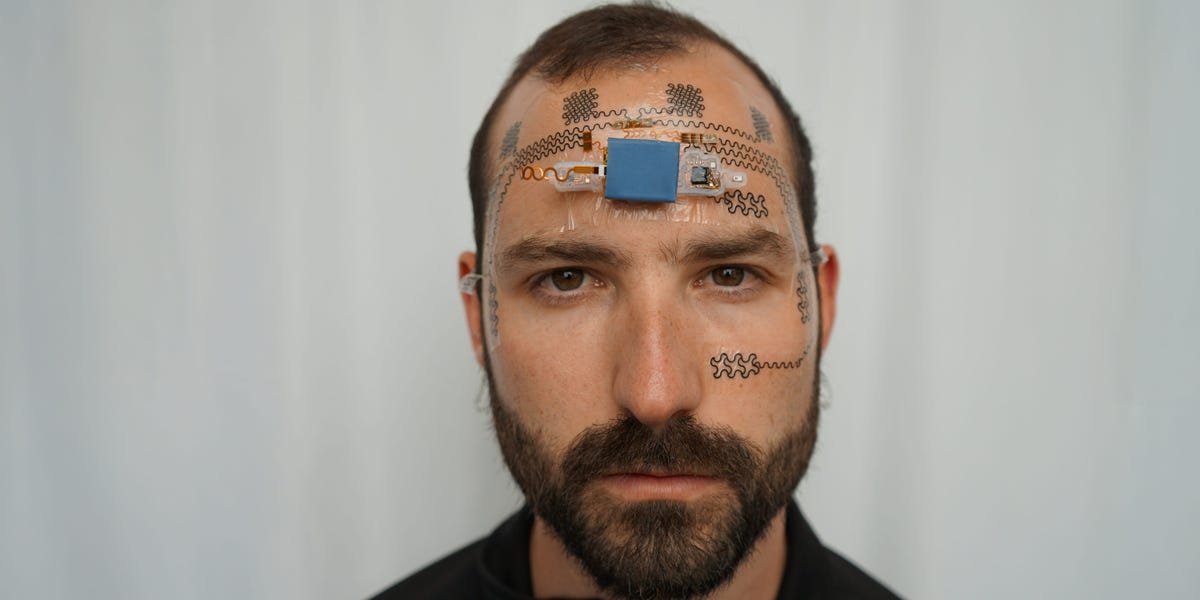
Tattoos can reveal a lot about a person.
One day, they could even reveal a person’s brain waves.
At least, that’s the goal for researchers at the University of Texas at Austin.
“This tattoo is not like a normal tattoo,” Nanshu Lu, a professor in the university’s Department of Aerospace Engineering and Engineering Mechanics, told Business Insider.
Lu worked alongside engineering professor Luis Sentis and others to develop an ultra-thin, wireless wearable device that she compared to a temporary tattoo sticker. The non-invasive device, applied to the skin with an adhesive, measures brain activity and eye movement to gauge an individual’s mental workload.
Lu said the device is intended for people working in high-stakes or high-demand jobs, such as aircraft pilots, air traffic controllers, drone operators, and robot teleoperators. These jobs could be considered high-stress since they require focus, quick-thinking skills, and a small margin for error.
“Technology is developing much faster than human evolution, so it is very hard to keep up with the technological demand in modern jobs,” she said. “Therefore, it’s very important not to overload the operator because not only would that jeopardize the outcome of the mission, it would also harm their health.”
Although the idea of an electronic tattoo might sound like something out of a sci-fi novel, humans and technology have been melding for a while.
Nearly 40 years ago, for example, the first fully digital hearing aid became available to the public, according to the Hearing Health Foundation. And now, Elon Musk is embedding computer chips into people’s brains through his company, Neuralink.
Recent wearable tech inventions include smartwatches, Bluetooth headphones, VR headsets, and fitness trackers, to name a few. Some health-conscious folks invest in wearable technology like the Oura Ring, which collects data on everything from sleep activity to body temperature.
Nanshu Lu/University of Texas at Austin
However, those devices don’t analyze brain activity and eye movement.
“Over the years, we developed a series of non-invasive skin conformable e-tattoos to measure cardiovascular health, then measure the mental stress from the palm sweating,” Lu said of previous devices she helped develop. “Now, finally, we move on to the brainwave.”
Lu said the device certainly isn’t the first or only EEG sensor on the market, but it’s smaller and lighter than previous models. Conducting an EEG test typically requires attaching electrodes to an individual’s full scalp with a gel or paste to collect data, which can be time-consuming.
Researchers at the University of Texas at Austin are attempting to streamline that process by proving mental workload can be measured only from the forehead. During lab tests, participants did memorization drills that involved a screen with flashing boxes.
“In the past, there was no way to objectively assess mental workload. The subjects have to finish the test and then a questionnaire,” Lu said. “But in the future, if we can implement some lightweight machine learning model directly on a microprocessor in the Bluetooth chip on e-tattoo, then yes, our goal is to one day be able to do it in real time.”
A report by Grand View Research said that the global wearable technology market was worth $84.2 billion in 2024 and is expected to reach $186.14 billion by 2030, underscoring consumers’ willingness to integrate technology into their everyday lives.
However, electronic tattoos won’t be commercial anytime soon. Lu and her fellow researchers are still conducting tests on and developing the tech.
Still, she can imagine a world where the e-tattoo is used by people not employed in high-stakes jobs.
It could be used by “people who would like to focus as well as people who want to meditate to see if they are truly relaxed,” Lu said.
