


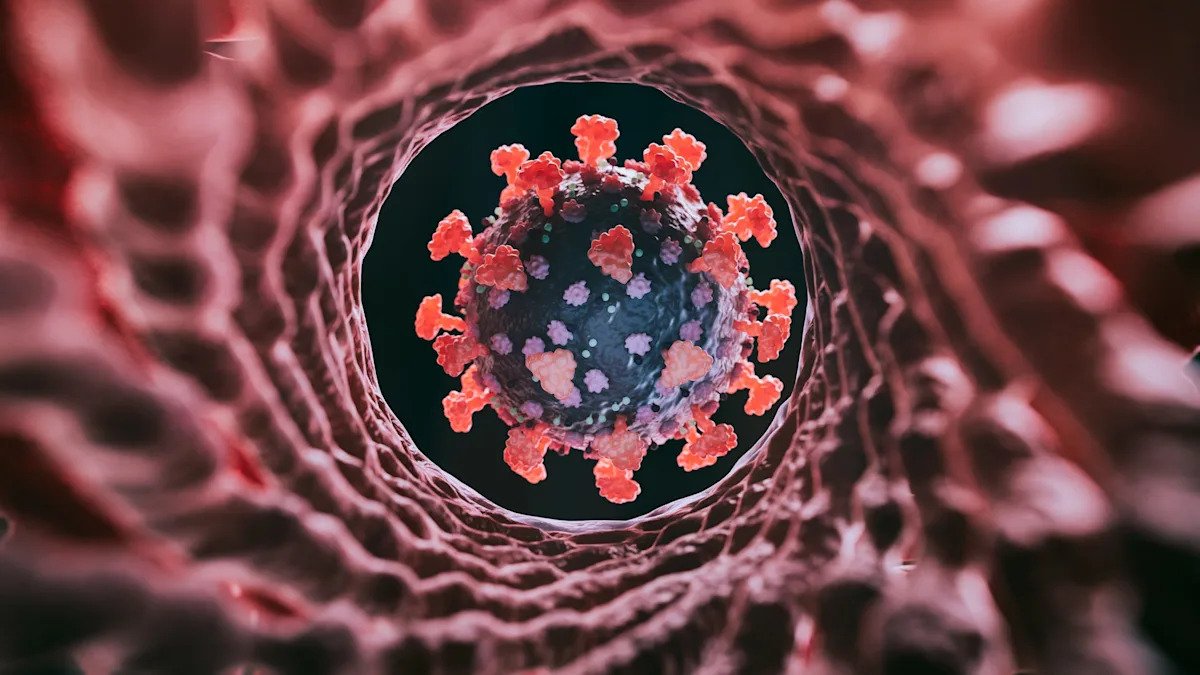
A COVID-19 variant that has remained “underground” for years is catching the attention of health officials in the United States and abroad.
The Centers for Disease Control and Prevention (CDC) said in a March 19 report that it was tracking variant BA.3.2, nicknamed “Cicada,” after routine surveillance noted a steady incline in U.S. cases. The World Health Organization (WHO) likewise listed the “highly mutated” virus on its Feb. 23 “variants of monitoring” record as more detections crop up in various countries, including Japan, Kenya, the Netherlands and the United Kingdom.
While the variant has yet to account for a significant number of cases in the United States, it has been reported in more than 20 countries, accounting for up to 30% of cases in some, according to the CDC.
“Monitoring the spread of BA.3.2 provides valuable information about the potential for this new SARS-CoV-2 lineage to evade immunity from a previous infection or vaccination,” said the CDC report.
Here’s what to know about COVID variant BA.3.2, or “Cicada”.
COVID vaccine: Who can get a COVID shot right now and why it keeps changing
What is the COVID variant ‘Cicada’ (BA.3.2)?
“Cicada” is a nickname given to BA.3.2, a highly mutated COVID-19 variant. It was first detected in a person traveling to the United States in June 2025 and was thus nicknamed after the rarely-emerging insects because it has largely remained undetected or “underground” since discovery, Dr. Robert H. Hopkins, Jr., medical director of the National Foundation for Infectious Diseases, told USA TODAY in an email.
The first case in a U.S. patient was diagnosed in January, he said. Between then and the latest available data from Feb. 11, it was detected in wastewater samples − collected from water sources such as sewage, industrial waste, and stormwater runoff to measure pathogens’ presence − from 132 sites across at least 25 states, according to the CDC. The variant was also present in samples from travelers’ voluntary nose swabs.
BA.3.2 has likewise been reported in at least 23 countries, according to the CDC, which also said the very first case worldwide was detected in November 2024 in South Africa. Cases began increasing in September 2025, the agency said.
The variant is considered “highly mutated” because its 70-75 mutations make it distinct from the JN.1 lineage, which has been the source of the predominant U.S. strains over the last two years, according to Hopkins.

Cicada is a significant mutation from the JN.1 lineage.
Where is the BA.3.2 ‘Cicada’ variant spreading?
The CDC’s latest data from Feb. 11 tracked the presence of BA.3.2 in 25 states, including California, Connecticut, Florida, Hawaii, Idaho, Illinois, Louisiana, Maine, Michigan, Maryland, Massachusetts, Missouri, New Hampshire, New Jersey, Nevada, New York, Ohio, Pennsylvania, Rhode Island, South Carolina, Texas, Utah, Vermont, Virginia, and Wyoming.
More recent data from WasteWaterSCAN, a Stanford University-led tool for tracking the spread of disease, found BA.3.2 was detected in only 3.7% of wastewater samples as of March 14. Variant XFG remains the dominant strain at 53% of samples, followed by LF.7 with 10.3%.
“The number of mutations from JN.1 viruses makes it less likely that the current vaccines will be highly effective against Cicada, but we need more data to better answer this question,” said Hopkins. “It is possible we will see Cicada become the dominant strain in the US, but that is by no means certain. I have heard some concern raised about the possibility that it could drive a US summer surge.”
Cicada already accounts for about 30% of COVID-19 sequences in Germany and some other Northern European countries (such as Denmark and the Netherlands) as of January, he said.
“Low vaccination rates and little to no public health effort toward stopping COVID infections and spread leaves us vulnerable,” Hopkins added.

“Cicada” is a nickname given to BA.3.2, a highly mutated COVID-19 variant.
What are the symptoms of Cicada?
Like in the case of most other variants, the symptoms of Cicada are the same as those of other COVID-19 infections. As a result, the CDC said indicators to look out for remain the same as with existing variants. Some symptoms may include:
Changes to the sense of smell or taste
Some later variants have been associated with “razorblade throat” based on increased reports of throat pain.
“I have not seen any data which indicates that Cicada is any more severe than other circulating variants,” said Hopkins. “Severe sore throat is reported as a common symptom along with other typical COVID symptoms.”
What to do if you test positive
While mutations could mean existing COVID-19 boosters may not prevent infection as effectively, they can still offer protection against severe disease and death, especially as vaccine formulations catch up.
“When sick, get tested. If positive, stay home until better and confirm with a negative test. If that’s not possible, wear a fit N95 mask,” Rajendram Rajnarayanan,assistant dean of research and associate professor at the New York Institute of Technology College of Osteopathic Medicine at Arkansas State University, previously told USA TODAY. “Get Boosted as soon as it’s available. It works against all of the top circulating lineages, including XBB.1.16, EG.5.1, FL.1.5.1, etc.”
If you believe you may have COVID or test positive, the CDC suggests several ways to treat the symptoms and stop the spread.
Stay home and separate from others.
Improve ventilation in your home.
Wear an N95 or other high-quality mask when around other people.
Keep up to date on COVID vaccines and boosters.
Monitor symptoms and stay in touch with your healthcare provider.
Take medications and treatments as prescribed.
Rest and use over-the-counter medications to manage symptoms like headaches.
Practice hygiene such as washing hands often and cleaning shared surfaces.
This article originally appeared on USA TODAY: What is BA.3.2? What to know about COVID-19 variant dubbed ‘Cicada’
