


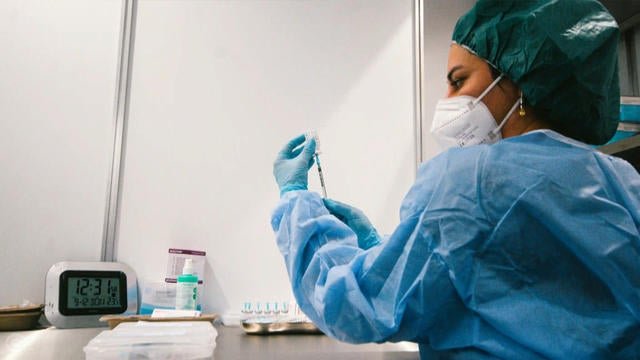
If you think last week’s decision by the federal government to halt $500 million in funding for vaccine development projects that use mRNA technology will only affect COVID vaccines, think again.
These types of vaccines use messenger RNA, or mRNA, to prompt the body to make proteins that induce an antibody response to protect against a pathogen. The science behind it is also being studied for a wide range of other uses, from fighting cancer to treating autoimmune conditions and more.
Health experts have criticized the move to defund this research, pointing to the impact it will have on America’s ability to develop breakthroughs against deadly or debilitating diseases.
Jeff Coller, professor of RNA biology and therapeutics at Johns Hopkins University, called the cuts a “completely reckless decision from Robert F. Kennedy Jr.” that was “clearly being made for political motivations and not those that are rested in our science.”
Former Surgeon General Dr. Jerome Adams, who served in the first Trump administration, said the technology “helps us develop vaccines and new treatments,” and warned that cuts could halt progress in one of the “most promising areas of modern medicine.”
“People are going to die because we’re cutting short funding for this technology,” Adams said in a recent appearance on CBS News’ “Face the Nation with Margaret Brennan.”
mRNA studied for pancreatic cancer, rare diseases and more
Collier said one of the most exciting avenues for mRNA technology is in the treatment of deadly cancers, including pancreatic cancer, which is fatal for many patients within six months to a year.
In recent years, researchers have been testing the effectiveness of using an mRNA vaccine to target the cancer. A small NIH-funded clinical trial by Sloan Kettering in 2023 used infusions of an mRNA vaccine to help boost T cells in the immune system of pancreatic cancer patients. The results, published in the journal Nature, showed improvements among about 50% of participants.
“It was, in essence, the start of a cure for pancreatic cancer, where half of the patients in that study were surviving,” Coller said.
The early results encouraged scientists, but the small sample size called for further studies, which led to a Phase 2 trial published in Nature earlier this year.
Experimental mRNA-focused treatments have also showed promise in fighting lung, colorectal and gastric cancers. For example, a study published online in the journal Gastric Cancer found a mRNA-based vaccine led to robust gastric tumor regression in mice.
And earlier this year, the world was was awed by news that an infant named KJ Muldoon became the first patient to undergo personalized gene-editing treatment using a technique known as CRISPR to fix a rare and potentially fatal genetic disorder.
As Coller pointed out, the CRISPR technology had to be delivered via mRNA.
“This opens a floodgate for rare diseases,” he said. “We’re now talking about, could we use the same technology to go after all rare diseases?”
Autoimmune diseases are another area of research, for treating things like multiple sclerosis, Type 1 diabetes, rheumatoid arthritis, inflammatory bowel disease and celiac disease.
While all of these are still at the early research stage, Coller urged the importance of investing in this technology now for future progress.
“We need to do experiments and see where we can get with the next generation of mRNA-based drugs,” he said.
Like with COVID-19, there has also been continued research on mRNA-based vaccines for infectious diseases like the flu, RSV, Zika virus and cytomegalovirus, known as CMV, an infection that can be harmful to babies exposed during the mother’s pregnancy.
“We’re at a point where, if we continue to develop this technology, we’ll get more personalized, bespoke medicine that we can use on patients and improve health care outcomes,” Coller said.
How is mRNA medicine so versatile?
RNA stands for ribonucleic acid, an essential molecule in the body’s cells. It is similar to DNA but has different functions. Messenger RNA, or mRNA, carries the information required for making proteins.
As Coller put it: “If your DNA is a cookbook, your mRNA is an individual recipe that’s telling your body what to do.”
To harness that power for treating disease, “All we’re doing with this technology is giving it new recipes. We’re taking advantage of this powerful natural system that exists in your body,” he said.
The versatility and potential to help such a range of illnesses is what has experts like Coller — who was not immediately impacted by the funding cuts — hoping the administration will reinstate funding for mRNA research.
“We have to keep moving forward,” he said. “People wanting to improve their family’s lives and their children’s lives is a bipartisan issue, it’s truly an American issue. So we’ve got to keep moving.”
President Trump says meeting with Russia’s Putin is not to broker peace deal in Ukraine
Could Tropical Storm Erin become the first Atlantic hurricane of 2025?
Trump claims “land swapping” between Russia, Ukraine will happen
