


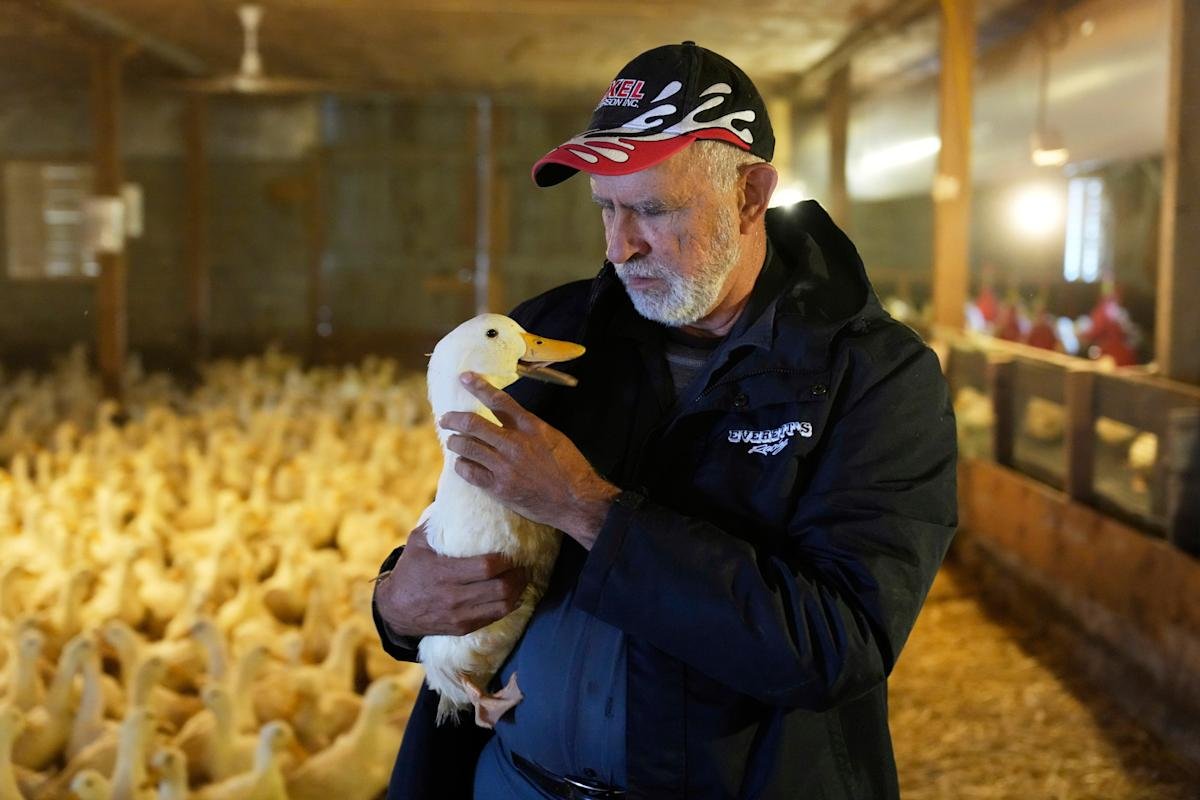
AQUEBOGUE, N.Y. (AP) — Doug Corwin knew there was a problem at his family’s commercial duck farm in Long Island when he spotted scores of dead or lethargic birds during a barn inspection in January.
Within days, Crescent Duck Farm became a casualty of the global avian flu outbreak, one of many farms around the U.S. that had to cull their entire flock, sending the prices of eggs and other agricultural commodities soaring.
Now the more than century-old farm — the last duck farm remaining in a New York region once synonymous with the culinary delicacy — is cautiously rebuilding.
But for Corwin, a 66-year-old fourth-generation farmer, it’s not enough to bring the farm back to its 100,000-bird capacity.
With ducks hatched from eggs spared from slaughter, he’s working to preserve the unique lineage of fowl that’s allowed his family’s farm to thrive even as others on Long Island fell by the wayside — all while worrying that another flu outbreak would finally wipe him out.
“All I know is I don’t want to be hit again,” Corwin said. “If I go through this twice, I’m done as a duck farmer.”
Make way for ducklings
For months, Corwin and his reduced staff have been thoroughly sanitizing the farm’s dozens of barns, clearing out hay and debris, and replacing feeders, ventilation systems, wooden and metal structures and more.
At the end of May, the first wave of roughly 900 young ducks arrived from a nearby farm where they had been carefully raised in quarantine these last few months.
Another batch of 900 arrived last week and some 900 more will soon make their way to the roughly 140-acre (55-hectare) farm in Aquebogue, which is tucked among the vineyards and agricultural lands of Long Island’s North Fork, about 80 miles (129 km) east of Manhattan.
By the end of next summer, Corwin hopes the first ducks will be ready to be processed and brought to market.
But he says he won’t rush the reopening. It will be many more months — if ever — before the operation, which processed about 1 million ducks for consumption annually, returns to full capacity, he said.
“I keep telling people I’m running a high hurdle race,” Corwin said. “I’ve got a lot a lot of steps to get back to where we were.”
Bird flu pandemic still looms
Since 2022, the H5N1 strain of bird flu has been detected in all 50 states, leading to more than 1,700 recorded outbreaks affecting nearly 175 million birds, according to the most recent tally from the Centers for Disease Control and Prevention.
The outbreak at Corwin’s farm shows how this strain has inflicted more damage on a wider range of species than past variants, said Dr. Gavin Hitchener, director of Cornell University’s Duck Research Laboratory, located a short drive away in Eastport.
Ducks have generally been less prone to serious illness and death than chickens and turkeys, he said. H5N1 is also vexing American cattle farmers after the virus jumped from fowl to cattle last year.
“Something has changed in the virus’ makeup that has made it more virulent,” Hitchener said.
With no end to the bird flu pandemic in sight, Corwin worries he won’t be able to weather another outbreak.
The farm received federal compensation for its euthanized ducks, but it wasn’t nearly close to the market value of the birds — never mind the expense of rebuilding in a high cost region that also includes the Hamptons, he said.
Corwin hopes the federal government will, at long last, require poultry operators to vaccinate their livestock against bird flu. It’s an uphill climb, given the Trump administration’s deep skepticism of vaccines and the long-standing opposition of far larger, industrial poultry operations, he acknowledged.
“I would sleep an awful lot better at night. But right now I’m very nervous,” Corwin said. “We’re just playing with deck chairs on the Titanic.”
Carrying on local heritage
The ducks newly arrived to the farm are crucial to its revival.
Fully grown and approaching breeding age, the cohort of white Pekin ducks were all that survived from the more than 15,000 eggs state officials allowed the farm to spare from the winter culling after they tested negative for bird flu.
That means they and their progeny carry on the unique genetic makeup the farm has honed over generations of selective breeding to build its reputation.
Established in 1908 by Corwin’s great-grandfather, Crescent Duck Farms has been the island’s lone commercial duck operation for the better part of a decade. But in the early 1960s, Long Island boasted more than 100 farms producing about two-thirds of the nation’s duck output.
“I feel I owe it to the ancestors of farmers who’ve been here all these years and have come this far to just make a go of it,” Corwin said. “I want to make Long Island proud.”
___
Follow Philip Marcelo at twitter.com/philmarcelo.
