


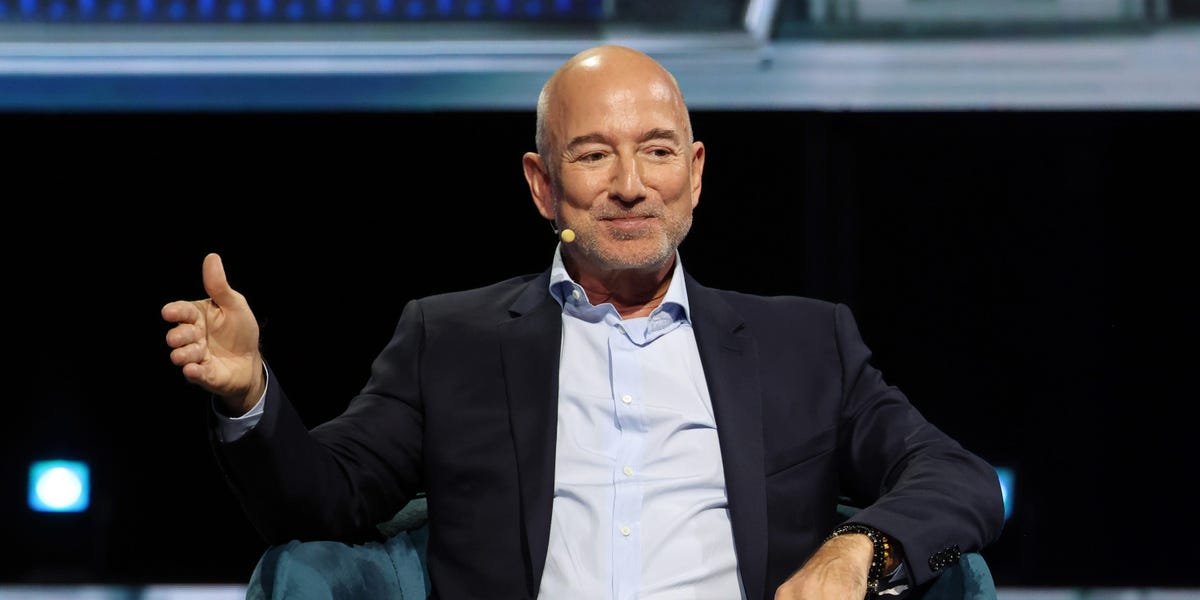
Jeff Bezos has unveiled his plans for a massive satellite network, mounting a direct challenge to Elon Musk’s grip on internet infrastructure in orbit.
The project, called TeraWave, would deploy 5,408 satellites into orbit to serve data centers, governments, and businesses worldwide, Bezos’s space venture, Blue Origin, said in a statement on Wednesday.
Launches are expected to begin in the fourth quarter of 2027.
TeraWave is designed to deliver “data speeds of up to 6 terabits per second anywhere on Earth,” enabled by advanced optical communications between satellites, the company said.
The network is “optimized for enterprise, data center, and government customers” and would serve up to 100,000 customers, it added.
The announcement comes after Bezos’ other company, Amazon, rebranded its consumer satellite network Leo in November. Formerly known as Project Kuiper, the initial constellation design includes more than 3,000 low-Earth-orbit satellites providing standard broadband service.
The launch of TeraWave raises the stakes in a billionaire-led fight over space-based internet infrastructure. Starlink, led by Elon Musk, dominates the field with roughly 10,000 satellites in orbit. The subsidiary project of SpaceX targets consumers, businesses, and governments, and serves more than 6 million users globally.
In a reply to an X user on Monday, Musk said “Starlink space to ground laser links will exceed this,” referring to the data speeds touted by TeraWave.
SpaceX has also begun laying the regulatory groundwork to scale its satellite operations. In a January filing with the US Federal Communications Commission, the company said satellite systems should be treated as essential infrastructure for future wireless networks as the US seeks to maintain leadership in next-generation space-based services.
Data centers in space
Beyond internet access, the satellite race is increasingly tied to the future of computing, as tech leaders point to satellite networks as potential infrastructure for future data centers in space.
Responding on X to an article about building data centers in space, Musk said in October that “simply scaling up Starlink V3 satellites, which have high speed laser links would work.”
“SpaceX will be doing this,” he added.
Musk has also discussed the idea internally. During an xAI all-hands meeting in December, he said he sees data centers eventually moving off Earth, raising the possibility of space-based facilities that could be operated by Tesla Optimus robots, people with knowledge of the meeting told Business Insider.
Jeff Bezos has voiced a similar long-term view, predicting that data centers could shift to space within the next 10 to 20 years.
Google CEO Sundar Pichai said in November that the concept may sound “crazy,” but “when you truly step back and envision the amount of compute we’re going to need, it starts making sense and it’s a matter of time.”
